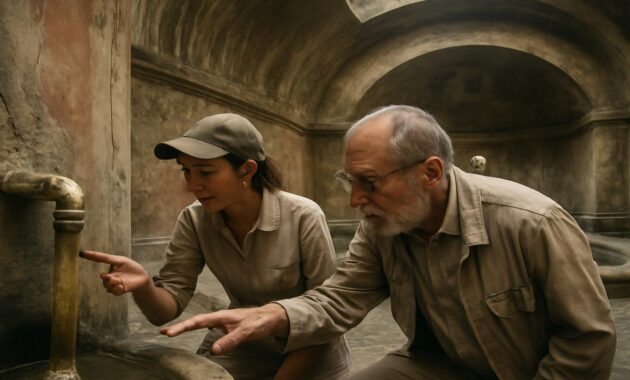
The water in Pompeii’s famous baths would have looked delicious on a hot afternoon—clear, shimmering, reflecting columns and painted ceilings. Imagine the steam rising in silky sheets, the murmur of voices, the splash of bodies easing into warmth. You might picture the scent of olive oil soap, the tang of sweat and perfume, sunlight slicing in through small high windows. Everything about the scene feels inviting, civilized, almost luxurious. But what if that clear water hid a quiet, metallic menace—one that seeped into every pore, every breath, every cup? What if the baths, those proud symbols of Roman sophistication, were not cleansing their citizens at all, but slowly poisoning them?
The Sound of Water and the Taste of Metal
Walk, for a moment, through the stone streets of Pompeii as if the city still breathes. Your sandals scrape over worn paving slabs. The air holds a whisper of wood smoke and baking bread. Over the hubbub of vendors and the rattle of cartwheels, you hear it: the constant chuckle of water, the heartbeat of a Roman town. Fountains bubble in small plazas, troughs brim for animals, and above it all, elevated like a stone ribbon, runs the aqueduct—Pompeii’s lifeline.
Fresh water, people will tell you, is what made Roman cities possible. It arrived in a never-ending flow, carefully channeled and split, measured and managed. But that marvel of engineering had a hidden flaw, one that glinted dully in the sun: lead. Lots and lots of lead.
For the Romans, lead—plumbum—was as normal as plastic is for us. It was soft, easy to shape, perfect for pipes. Walk under ancient streets and you can still trace those lines: slender, gray, clinging to the edges of old walls. Through them, water slithered on its way to cisterns and fountains, and most famously, to the bathhouses that defined civic life.
You step into one of those baths in your mind. Stone floor cool underfoot, walls painted with ochre and crimson, the faint sour-sweet smell of bodies in close quarters. Somewhere, water gurgles through a hidden pipe, out of sight, carrying with it what the eye cannot see: dissolved lead, in tiny amounts, again and again, day after day.
The Baths That Promised Purity, but Offered Something Else
Roman baths were more than just places to scrub off dust. They were social theaters, business hubs, and stages for power and preening. In Pompeii, the Stabian, Forum, and Suburban baths were architectural showpieces: vaulted ceilings, carefully calibrated rooms that stepped you from chilly air to dry heat to steamy embrace. In a culture obsessed with balance and bodily harmony, bathing was almost ritual.
Yet for all that ritual, the water itself might have betrayed the promise. To us, contamination usually conjures images of murky, foul-smelling liquid. Lead is more insidious. It doesn’t darken the water, doesn’t float in visible clumps. It rides invisibly, like a ghost with weight.
In Pompeii, the plumbing that fed those baths was likely lined with lead pipes and fitted with lead fixtures. Archaeologists and historians, studying the city’s infrastructure, have pieced together a picture that’s both impressive and unsettling. Some of the research focused on the chemistry of Roman water systems suggests that water flowing through these pipes could pick up significant amounts of lead carbonate, especially when the water was slightly acidic or sat stagnant in pipes and tanks.
Bathwater, warmed and cooled, pushed and held inside tanks, was particularly exposed to this process. The more time water spent in contact with lead, the more opportunity it had to carry a little bit of that metal onward. A single bath wouldn’t doom anyone. But the Romans didn’t bathe once in a lifetime; many bathed nearly every day.
You can imagine the daily scene: a merchant washing away the dust of the forum, a baker easing sore muscles after hours by the oven, a matron leaning back in perfumed steam. Each breath deepens her feeling of comfort, but each soak may also mean a bit more lead entering her body. It doesn’t knock on the door loudly. It just moves in, quietly.
Invisible Poison in a Very Public Place
Lead exposure is a patient predator. It does not cause the dramatic, cinematic collapses that volcanic ash and pyroclastic flows do. It erodes. It lingers in bones, in teeth, in the nervous system. In children, it blunts growth and dulls learning. In adults, it can muddle thinking, strain the kidneys, twist the heart’s rhythms, and gnaw at fertility.
In the context of Pompeii, we are left with questions more than answers. How sick did its citizens become from this constant low-level exposure? Did some of the sluggishness, the ailments, the headaches and mysterious fevers recorded in ancient texts have metal fingerprints?
Modern analysis of ancient Roman plumbing from various sites has revealed surprisingly high lead content in water residues, suggesting that what felt like pristine, mountain-fed springs by the time they reached the tubs had become something more troubling. For Pompeii, with its dense piping and pride in its public baths, this raises a bracing possibility: the very spaces that symbolized community health might have been compromising it.
Picture the Suburban Baths, perched near the sea, with windows opening to dazzling light and the smell of brine. Tour groups stand there today, their voices echoing off the same walls, marveling at the ancient genius. Few think about what once coursed through the veins of this building, and what it did to the people who leaned back in its pools with eyes closed, thinking themselves refreshed.
The Comfort of Water, the Cost to the Body
It’s tempting to imagine that mineral-rich spring water, which the Romans loved, could have offered some protection. Some studies suggest that carbonates in the water might have formed a film inside the pipes, limiting how much lead dissolved into the flow. But that protective story isn’t entirely comforting. It depends on water chemistry, usage patterns, and time. If the conditions were just a little off—if the water sat too long, if the film was disturbed—contamination could spike again.
Baths were not quiet trickles; they were hungry beasts. They demanded large volumes of water, and their storage tanks and basins gave plenty of surface area for lead to leach into the supply. In those dim, echoing rooms, the danger would’ve been utterly silent.
Imagine a father lifting his child, laughing, splashing together in the tepidarium. The child gulps a mouthful of warm water and coughs, eyes shining. In that instant, nothing looks more joyous. Yet each playful mouthful may have contributed to a burden that settled deep inside, a weight no one could see or name, but that might have shaped a lifetime of health in small, invisible ways.
| Aspect | Ancient Pompeii Baths | Modern Perspective |
|---|---|---|
| Water Source | Aqueduct-fed, stored in cisterns, moved via lead pipes | Carefully monitored municipal supplies with regulated materials |
| Plumbing Material | Predominantly lead for pipes and fixtures | Lead banned or heavily restricted; copper, PVC, and steel are common |
| Perceived Cleanliness | Clear water, regular turnover, social prestige | Microbial and chemical testing; contamination defined by standards |
| Health Knowledge | Little awareness of chronic metal toxicity | Well-documented risks of even low-level lead exposure |
The Paradox of Roman Progress
The story of Pompeii’s baths and their likely lead-laced water is really a story about progress with shadows. Romans were unmatched in the ancient world for their ability to move water over long distances and distribute it through cities. Standing under the broken spine of an aqueduct today, you can feel their confidence in stone and arc and gravity. It’s humbling, and a little intimidating.
Yet in their eagerness to control water, they embraced a material that turned out to be deeply hostile to human bodies. Not because they were careless, but because their understanding of long-term, low-dose toxicity was nearly nonexistent. They saw, and feared, what killed quickly. They rarely recognized what killed slowly.
In a way, Pompeii’s baths are an ancient mirror held up to our own world. We, too, celebrate technologies that feel life-changing, world-organizing. We, too, surround ourselves with materials whose long-term effects we only partially grasp. Plastics, chemicals, micro-particles in the air—our version of lead, hiding in plain sight, sometimes in the most luxurious corners of our lives.
The baths, with their shimmering pools of status and sociability, remind us that a culture can be both advanced and deeply vulnerable at the same time. You can tile your floors with perfect mosaics, calibrate your heating systems, pump hot water through the walls—and still leave an entire population quietly exposed.
Dirty in Ways the Eye Couldn’t See
When we say that Pompeii’s bath facilities may have been “filthy,” we’re twisting our usual sense of that word. By all visible signs, they might have looked immaculate: water constantly replenished, floors cleaned, servants tending to oils and linens. Dirt, in the conventional sense, didn’t stand a chance.
But chemical filth is different. It’s not in the floating hair or the ring around the basin. It’s in the invisible layers. In this case, it may have lurked in the very heart of what made the baths work: their intricate plumbing.
So a bather in Pompeii would have seen clarity and felt coolness or heat, and judged the baths clean. A modern visitor, knowing what we know now, might shudder a little. The contamination lay just beneath the threshold of ancient senses—undetectable without the lenses and instruments of our own age.
Listening to Ruins in a Different Way
When you visit Pompeii now, the baths sit silent, drained of everything but echoes. The paint on the walls is faded but still astonishing. In some rooms, you can see the clever way architects funneled light to make the spaces glow. The marble, the benches, the hooks where bathers hung their clothes: all remain, fixed in the ash that smothered the city in 79 CE.
It’s easy to be overawed by the opulence and forget the water itself. Most people glance at the empty basins and think only of temperature: hot room, warm room, cold plunge. Few imagine the chemistry that once swirled in those pools. Yet the ruins invite that deeper listening, if you let them.
Stand in the frigidarium, the cool room, and let the silence settle. Picture the gleam of once-present water, and then imagine it as a solution, not just of mineral salts but of dissolved metals. Imagine the years packed into the bones of people who used these places, their very skeletons recording quiet exposure. It adds a layer of weight to the stillness, a sense that these spaces held more than laughter and conversation; they also held a long, invisible experiment in human tolerance to contamination.
Questions Buried in Ash
We don’t yet know exactly how much damage bath-related lead exposure did in Pompeii. Bones and teeth tell part of the story, but turning that evidence into a precise understanding of everyday suffering is tricky. Did people die earlier than they otherwise might have? Did children struggle more in ways no one could explain? Did certain ailments that Romans accepted as normal aches of life actually have a metallic root?
The city’s sudden destruction froze many questions in time, unanswered. The baths were left mid-routine: a towel perhaps abandoned mid-fold, a brush left beside a basin. A normal day, petrified. The lead in the pipes, in the water residues, in the bodies, became part of that freeze-frame too, waiting for modern science to come along and interpret it.
What Pompeii’s “Filthy” Baths Mean for Us
Thinking of Pompeii’s baths as tainted by lead-contaminated water changes how we read the site, but it also shifts how we think about our own relationship to water and infrastructure. We marvel at Roman ingenuity, yet we now know that certain materials they trusted were slow-acting poisons.
We’ve removed lead from most modern pipes and fuels for exactly that reason. But the story doesn’t end with lead. It forces a deeper question: what are we bathing in now—literally and figuratively—that future generations will look back on with the same mixture of awe and alarm?
There’s a strange comfort in realizing that even a culture as proud and technologically capable as Rome missed dangers that now feel obvious. It suggests that our own blind spots are not a matter of stupidity, but of perspective and time. The key is to cultivate enough humility to suspect those blind spots might exist, especially wherever life feels smooth and unquestioned.
So the next time you turn a gleaming faucet, soak in a hot tub, or swim in a crisp blue pool, you might think briefly of those Pompeian baths. Imagine hot steam rolling up toward a painted ceiling, voices humming in Latin, water sliding over stone—and under that, a thin, silent thread of lead binding the scene together. Not very inviting, once you know. But very human, in its mix of brilliance and error.
Frequently Asked Questions
Did the people of Pompeii know their bath water was dangerous?
No, there is no evidence that Pompeii’s inhabitants understood the chronic dangers of lead in their water. While some ancient writers suspected that lead fumes or heavy use might be unhealthy, the slow, long-term effects of low-level lead exposure were essentially invisible to their medical understanding.
How did lead get into the bath water in the first place?
Lead entered the water as it traveled through the plumbing system. Pompeii, like many Roman cities, used lead pipes and fittings to distribute water from aqueducts to baths, fountains, and homes. When water sat in these pipes or tanks, or when the water chemistry was slightly acidic, small amounts of lead could dissolve into it.
Were all Roman baths contaminated with lead, or just Pompeii’s?
Lead plumbing was common across the Roman world, so it is likely that many urban baths had some degree of lead contamination. Pompeii is a particularly vivid case because its infrastructure is so well preserved, making it easier for modern researchers to reconstruct how its water system operated.
Could mineral deposits inside pipes have reduced lead exposure?
Yes, in some situations mineral deposits—such as calcium carbonate—can coat the inside of lead pipes, forming a partial barrier that reduces the amount of metal dissolving into the water. However, this protection is inconsistent and depends heavily on water chemistry and flow patterns, so exposure could still be significant.
Did lead from the baths contribute to the fall of Rome?
The idea that lead poisoning alone caused Rome’s collapse is an exaggeration. While chronic lead exposure likely affected health in various ways, the fall of Rome was driven by a complex mix of political, military, economic, and environmental factors. Still, contamination from baths, pipes, cookware, and other sources probably added an invisible layer of strain to Roman public health.