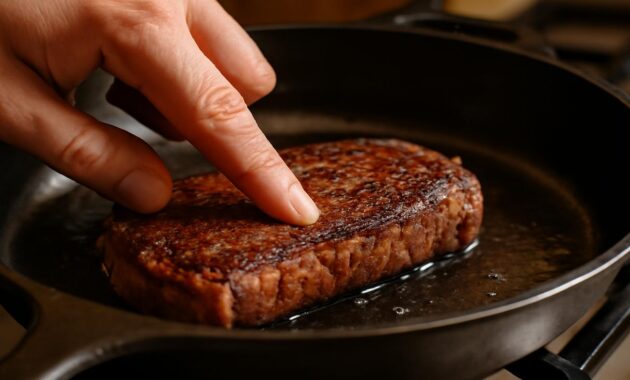
The steak hisses softly as it hits the pan, a quick, sharp sizzle that blooms into a low, steady crackle. The air fills with the rich smell of browning fat, and a faint curl of smoke rises like a promise. You stand over the stove, tongs in hand, heart a little too invested in this moment. You’ve salted carefully, let the meat come to room temperature like every recipe insists, and now you’re facing the one question that can undo it all: is it done?
You could cut into it, of course. Just a quick slice in the middle to peek at that secret interior. But the idea feels like sacrilege—watching those juices spill out, the neat brown surface broken open like a wound. There has to be a better way, something quieter, something that feels more like intuition than surgery.
And there is. It’s in your hands—literally. The simple finger test, a small, surprisingly intimate way of telling exactly how done your steak is without ever breaching its beautiful seared crust. It’s old-school, unscientific-looking, and yet strangely reliable. And once you learn it, you may never reach for a meat thermometer again.
The Language of Touch: Why Your Fingers Know More Than Your Eyes
Think about the last time you tried to judge a steak just by looking at it. Maybe you stared at the color—dark brown edges, a bit of caramelization in the middle, a thin crust that looked “done.” But appearances are tricky. Two steaks cooked for the same amount of time might look almost identical on the outside and still be wildly different inside: one a juicy blush of pink, the other dry and gray.
Heat, like a storyteller, works from the outside in. The surface goes first—scorching, searing, crisping up as the fat renders and sugars brown. The inside follows more slowly, the heat traveling gradually into the center. And depending on the thickness of the steak, the pan temperature, even the cut of meat itself, that interior transformation happens at wildly different speeds.
Your fingers, though, are paying attention to something deeper: texture. They notice the subtle change as the proteins inside the meat tighten and firm up with heat. Raw meat is loose and floppy. As it cooks, it becomes more structured, more resistant to pressure. The more done the steak, the firmer it feels under a gentle press.
That’s the essence of the finger test. You’re not judging by sight, you’re judging by touch—by the spring and give of the steak when you gently tap it. And the clever twist is that your own hand can teach you what each level of doneness feels like.
Meet Your Built-In Steak Thermometer: The Hand Test
Right now, without moving from where you are, you can feel what rare, medium, and well-done steaks are like. It’s all in the palm of your hand.
Hold out one hand, palm up, relaxed. With the other hand, use your index finger to press the fleshy pad just under the base of your thumb—the soft cushion of your palm. Notice how loose and squishy it feels when your hand is completely relaxed. That texture is your baseline: the tender, pliant feel of a rare steak.
Now, bring the tip of your thumb to touch the tip of your index finger, like you’re making an “OK” sign. Don’t clench—just a gentle touch. Press the same fleshy pad under your thumb again with the other hand’s index finger. Feel that? Slightly firmer, a bit more resistance. That’s the feel of medium-rare.
Move your thumb to touch your middle finger. Press the pad again. It’s firmer still—that’s medium.
Thumb to ring finger. Press. Notice how solid it feels now? That corresponds to medium-well.
Finally, thumb to pinky. Press once more. Very firm, almost unyielding. That’s well-done. At this point, the steak has lost most of its juiciness and become dense and chewy—just like that tight patch of muscle in your hand.
How to Use the Finger Test on an Actual Steak
Now bring that awareness to the pan. Your steak is sizzling away, a rich, brown crust forming where it touches the hot metal. You want to know if you’ve hit that perfect medium-rare sweet spot, but you’re not going to cut or poke it with a fork. You’re going to tap.
Take your tongs or, if the heat allows and you’re careful, a clean finger. Gently press the center of the steak. Don’t jab—just a light, decisive touch, like testing the ripeness of a peach. Notice how it responds. Does it give way easily, soft and yielding, like that loose pad of your palm when your hand was relaxed? That’s rare territory. Does it push back a bit, springing lightly under your touch the way your thumb pad did when you joined thumb and index finger? You’re at medium-rare.
You’re not trying to memorize some abstract idea of “firmness.” Instead, you’re pairing each level of resistance in the steak with the matching feel in your own hand. It’s like a living scale, moving from soft to firm as your thumb marches across your fingers—rare to well-done, written in muscle and skin.
At first, you might doubt yourself. You’ll press, compare, second-guess, and maybe still sneak a thermometer in out of habit. That’s fine. The finger test is less a trick and more a language. You grow fluent with repetition.
Doneness, Translated: What Each Level Feels Like
The more you practice, the more the words—rare, medium, well-done—start to dissolve into sensations. To help you build that feeling-based vocabulary, here’s how each doneness tends to behave under your touch, along with a rough guide to internal temperature if you still like numbers in the background.
| Doneness | Finger Test (Thumb +) | Feel Under Your Finger | Approx. Temp (°C / °F) |
|---|---|---|---|
| Rare | Hand relaxed (no finger touching) | Very soft, almost gelatinous; minimal resistance | 50–52°C / 122–125°F |
| Medium-rare | Thumb + index finger | Soft but springy; gentle bounce-back | 54–57°C / 130–135°F |
| Medium | Thumb + middle finger | Noticeably firmer, less give in the center | 60–63°C / 140–145°F |
| Medium-well | Thumb + ring finger | Firm with just a faint hint of softness | 65–68°C / 150–155°F |
| Well-done | Thumb + pinky finger | Very firm, dense, almost rigid | 71°C+ / 160°F+ |
What’s important isn’t hitting an exact number. It’s learning when that soft, sighing give of a steak turns into a bouncy resilience, then a stiff, unyielding center.
When your steak feels like that relaxed palm—loose, barely holding itself together—it’s deeply rare: cool, red, and very tender inside. When it matches the thumb-and-index combination, it’s entered that beloved medium-rare zone: warm, red-pink, and juicy, with just enough structure to feel satisfying as you bite.
As your touch moves closer to thumb-and-middle, the steak has become medium: pink but not red, more set, with a slightly firmer chew. Beyond that, things tighten further, the fibers almost bracing against your pressure. At thumb-and-pinky, you’re in well-done territory: cooked all the way through, brown or gray inside, firm to the point of resistance. Still edible, sure—but the tenderness has largely left the building.
The Dance of Heat and Rest: Timing the Finger Test
The timing of when you press matters. A steak’s journey doesn’t end when you turn off the heat. It keeps cooking from the residual warmth inside, even after it’s left the pan. That quiet continuation is called carryover cooking, and your finger test should account for it.
Imagine you’re aiming for medium-rare. You press the steak in the pan and feel that perfect medium-rare bounce—the same gentle resistance as your thumb-and-index test on your palm. If you leave it on the heat much longer, it’ll drift into medium before you even get it to the plate. So, it’s wise to stop just shy of the feel you’re aiming for.
For medium-rare, you might pull the steak off when it still feels halfway between rare and medium-rare—a touch softer than your thumb-and-index pad. As it rests on the cutting board, loosely tented with foil or just sitting vulnerably in the open, the internal temperature climbs a little, the juices redistribute, and by the time you slice, you’ve landed exactly where you wanted.
This is where the finger test becomes not just a detection tool, but part of your timing. You’re reading the steak in real time, deciding when to flip, when to nudge the heat down, when to pull it from the pan. It’s an ongoing conversation between you and the meat.
Step-by-Step: Putting the Finger Test into Practice
To make it feel less abstract, try walking through a simple steak night with this method:
First, choose a steak about 2.5 to 3 centimeters thick (around 1 to 1.25 inches). Thinner cuts cook too quickly for careful checking; thicker ones give you time to feel the transitions. Pat it dry, season generously with salt and, if you like, a twist of pepper just before it hits the pan.
Heat your pan until it’s properly hot—enough that a drop of water skitters and vanishes on contact. Add a film of oil, wait for a shimmer, then lay the steak down away from you so the fat doesn’t splash your wrist. The sear should be immediate and insistent.
Let it sear undisturbed for a couple of minutes, then flip. After that first flip, start your gentle pressing routine:
- Press the center of the steak lightly with your tongs or finger.
- Quickly compare that sensation with the feel of your thumb pad against your relaxed hand, then with thumb-and-index, then thumb-and-middle.
- Note which it’s closest to, and keep going a bit longer if you’re not there yet.
Flip once or twice more if you like, pressing in between. As you approach your desired feel, shorten the time between checks. When it’s just a touch below your target firmness, remove it from the pan and let it rest on a warm plate or board for 5 to 10 minutes, depending on thickness.
Only after that rest do you slice—and then, you get your reveal. The more often you practice, the more your hand and eyes will sync, turning every dinner into feedback for the next one.
When the Finger Test Shines—and When It Struggles
Like all analog skills, the finger test isn’t flawless. It’s less about precision and more about intuition sharpened over time. Understanding its limits will make you better at using it, not worse.
It shines with steaks that are thick enough to have a real gradient between crust and center—say, at least 2 centimeters thick. Ribeye, strip steak, sirloin, filet, even a good lamb chop all respond beautifully to the method. They give you that perfect progression from soft to firm as they cook.
Very thin cuts, like minute steaks or some skirt steaks, change too quickly. By the time you flip and press, they might already be well-done. For those, high heat and speed matter more than subtle testing.
Different cuts also have slightly different “feels” even at the same doneness. A well-marbled ribeye might still feel a bit softer than a lean sirloin at medium-rare. That doesn’t break the method; it just means your fingers need a little calibration time with each new cut.
And then there’s personal preference. What one cookbook calls medium-rare, your taste buds might call too red or not red enough. The beauty of the finger test is that it lets you standardize your own version of perfection. Once you know what “just right” feels like to you, you can chase that sensation every time, regardless of the label on the recipe.
Letting the Ritual Become Yours
There’s something quietly grounding about using your body to cook instead of relying on gadgets alone. A thermometer is precise, yes, and invaluable for roasts or food safety with poultry. But for a simple steak, the finger test turns cooking into a tactile ritual.
You listen to the sizzle, watch the changing color of the fat around the edges, smell the caramelization deepen, and then—lightly—you press. It’s almost like testing the mood of the meat, asking if it’s ready. Over time, the little details start to stand out: how a thicker steak feels more forgiving, how grass-fed beef firms up a bit faster, how your pan’s hot spots cook one side slightly ahead of the other.
The finger test doesn’t replace knowledge; it deepens it. You still think about resting times, about seasoning, about the right kind of heat. But with this small, simple practice, you gain something that algorithms and charts can’t give you: a direct, sensory connection to the food you’re cooking.
Conclusion: The Quiet Confidence of a Perfectly Cooked Steak
One evening, sometime soon, you’ll find yourself standing over a pan again, watching the edges of a steak turn from shiny red to browned. The aroma will be fuller, sharper, alive with the promise of dinner. You’ll flip the steak, listen for that reassuring hiss, and then—without drama—you’ll reach out and tap the center.
Soft, but not too soft. A little bounce, not too much. Instantly, your fingers will recall the feel of your own hand: thumb and index, that gentle springiness of medium-rare. You’ll move the steak to a board, let it rest, and when you finally slice in, the inside will glow just the way you wanted—juicy, pink, perfect.
You won’t have cut into it early. You won’t have stabbed it with a probe. You’ll have trusted something quietly ancient instead: the conversation between heat, flesh, and touch.
That’s the quiet magic of the finger test. It’s simple enough to learn in a minute, subtle enough to refine over a lifetime, and satisfying every single time you sit down to eat and realize—yes, you nailed it.
FAQs
Is the finger test as accurate as a meat thermometer?
No, a meat thermometer is more precise for exact internal temperatures. But for everyday steak cooking, especially once you’ve practiced a bit, the finger test is accurate enough to consistently hit your preferred doneness. Many chefs rely on touch alone.
How long does it take to get good at the finger test?
After three or four steak cooks where you both use the finger test and occasionally verify with a thermometer or by slicing, you’ll start feeling much more confident. It’s a quick skill to pick up, but it keeps improving with repetition.
Can I use the finger test on other meats?
Yes, you can use the same touch-based idea for lamb chops, pork chops, and even thick burgers. Just remember that safe internal temperatures vary: pork and poultry should be cooked more thoroughly than beef.
Does resting the steak change the feel after cooking?
Yes. A steak feels slightly firmer after resting because the internal temperature evens out and the juices settle. That’s why you pull it from the pan just before it reaches your ideal firmness, letting carryover cooking finish the job.
What if my hand feels different than someone else’s—will that affect the test?
There are natural variations in hand firmness, but the relative change from relaxed palm to thumb-and-fingers is what matters. You’re using your own hand as your personal reference scale, so once you match the feel of your steak to the feel that gives you your favorite doneness, you’ll be consistent for yourself, which is what counts most.