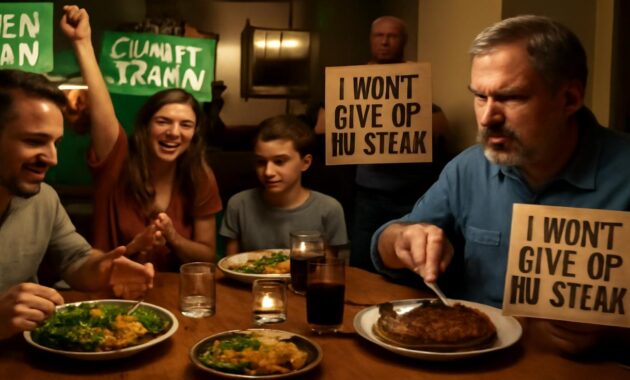
On a damp Thursday night in late October, the line outside Green Spoon Bistro curled around the block, umbrellas bobbing like dark mushrooms in the rain. Inside, the smell of caramelized onions and garlic drifted through the warm air. The menu shimmered in soft candlelight: oat-milk béchamel, smoked mushroom ragù, lentil bourguignon. No beef, no pork, no chicken. No compromise, according to the handwritten chalkboard over the bar: “Planet-friendly plates only.”
Three streets away, at Bruno’s Steakhouse, the air was different—thicker, louder. The hiss of fat hitting the grill cut through a chorus of clinking glasses and low conversation. On the wall, a TV glowed with news: a panel of commentators arguing over the government’s new “Climate Responsibility Act,” a sweeping law that had just made meat—real meat—so expensive that many people were calling it “priced off the menu.”
“Over my dead body,” muttered a man at the bar, eyes locked on the screen, fingers wrapped stubbornly around a pint. “They can tax my car. They can regulate my gas stove. But they are not taking my steak.” He stabbed a fork into a marbled ribeye as if the law itself were on the plate.
A few stools away, a woman in a green sweater rolled her eyes. “Nobody is taking it,” she said. “You can still buy it. It just has to reflect its actual cost to the planet.”
He snorted. “You say cost; I say control.” He raised his glass. “Here’s to rebellion, medium rare.”
The Night the Bill Passed
The vote came in just after midnight, when most people were asleep and the last trains were rattling through the city’s veins. In a drafty apartment where potted ferns crowded the windowsill, twenty-three-year-old activist and climate science graduate student Lila watched the numbers shift, blue and red bars adjusting as if the future itself were being dragged by a mouse cursor.
“This is it,” she whispered to nobody in particular. Her roommates had already gone to bed; the house cat snored on the couch, its tail tucked over its nose like a comma at the end of a long, tense sentence.
The announcer’s voice trembled slightly as the final tally appeared. The Climate Responsibility Act had passed. The meat levy—tiered according to carbon intensity—would roll out in phases, starting with beef and lamb, then pork, then poultry. The projected price hikes were brutal: depending on the cut, beef could more than double in price within a year.
Lila sank back into the battered armchair and let herself feel something she’d spent years suppressing: relief. Not celebration, exactly—there was too much grief embedded in the science she studied daily for that—but a flicker of “maybe we didn’t totally blow it.”
Her phone began vibrating. Messages from the group chat: “WE DID IT.” “History, babes!!” “For once, I’m crying and it’s not because of a new IPCC report.” A friend sent a picture from the plaza downtown: hundreds of young people, faces lit by phone torches, holding signs that read “FOOD, NOT FLOODS” and “LESS COW, MORE FUTURE.”
The victory tasted like cheap sparkling wine and instant noodles eaten at 1 a.m. It also tasted like trouble. Because Lila knew what was coming next: the morning phone call with her father.
The Carbon Price That Came for Dinner
When the news broke, coverage splintered into two parallel universes. On one channel, environmental economists explained calmly that meat had gotten an “all-you-can-eat free pass” for too long, that its methane emissions, deforestation impact, and water use now had to show up in the bill. On another, the chyron screamed: “WAR ON DINNER: GOVERNMENT ATTACKS FAMILY TRADITIONS.”
The Act didn’t actually ban meat. It did something messier: it made the true climate cost visible. Beef, with its high methane emissions and land use, was hit hardest. Plant-based foods were lightly taxed or even subsidized. Suddenly, the calculus of a shopping cart felt like a political statement.
| Food Item | Average CO₂e per kg* | New Climate Levy (per kg) | Relative Price Impact |
|---|---|---|---|
| Beef (grain-fed) | 50–60 kg | High | Price may double |
| Lamb | 40–50 kg | High | Price may increase 70–90% |
| Pork | 10–12 kg | Medium | Price may increase 40–60% |
| Chicken | 6–7 kg | Lower | Price may increase 20–30% |
| Lentils | < 1 kg | Minimal | Little to no change |
*Approximate lifecycle emissions, including production and processing; values vary by system and region.
For climate campaigners, it was long-awaited accountability. For many others, it felt like an intrusion into something intimate: family meals, religious rituals, weekend barbecues that smelled like childhood.
Sundays at the Grill: A Family Divided
On the first Sunday after the law passed, the Novak family gathered for lunch at their suburban home, as they had done nearly every week for two decades. The grill sputtered in the backyard, smoke drifting lazily over the fence. But this time, something was off.
Instead of the usual gleaming platter of sausages and steaks, there was a smaller, more defensive-looking arrangement: two thick, expensive-looking strip steaks on one side of the plate, surrounded by grilled vegetables and plant-based sausages on the other, each kind carefully segregated like rival nations on a tense border.
“Choose your fighter,” joked twenty-year-old Max, reaching for a charred mushroom skewer. His older sister Ana, home from university, stiffened.
“It’s not a game, Max,” their mother said, passing a bowl of salad. “Your father and I had to go to three different stores to find beef that didn’t make me want to cry at the checkout.”
Their father, Mark, a mechanic with grease still black under his fingernails, sliced one of the steaks with more force than necessary. “I’ll pay it,” he said. “I work for my money. They can’t shame me out of how I eat.”
Ana watched the juices seep onto the cutting board like a slow red tide. Her laptop was littered with bookmarked studies on methane and land use; she could quote the emissions factors of cattle from memory. The steak on the table looked to her like a luxury carved out of someone else’s future—a future already thin from heatwaves and floods.
“Dad,” she started carefully, “it’s not about shaming. It’s about, like, physics. The atmosphere doesn’t care about our feelings.”
He set the knife down. “I grew up poor,” he said quietly. “Meat on the table meant we were okay. It meant your grandpa had work. Now these people on TV—these kids younger than you—look at me like I’m some kind of villain because I like my steak. I won’t be told by a government or a bunch of activists what’s allowed on my plate.”
In that moment, the law stopped being a piece of legislation and became something else: a wedge, thin and sharp, sliding between generations across a shared table.
‘Climate Kids’ vs. ‘Realists’
Around the country, family chats became minefields. Group texts lit up with links, charts, memes. One side posted images of parched fields, burned forests, flooded subways. The other side posted jokes: a T-bone steak photoshopped with a halo, the caption reading “Saint Sirloin, Defender of Freedom.”
Young people, especially those who had spent their teenage years watching climate disasters roll in like unwelcome seasons, largely shrugged at the law’s inconvenience. Many were already dabbling in plant-based diets. To them, it felt overdue—part of a larger pattern of finally aligning policy with reality.
But their parents and grandparents often carried a different history. For them, meat was not just protein; it was arrival. It meant no more ration lines, no more empty fridges, no more state control dictating what could be bought and when. To have meat every Sunday—sometimes every day—was to have stepped into security, even dignity.
So when climate crusaders framed the levy as “basic responsibility,” for some older folks, it felt like an erasure of their stories. They heard, “The way you climbed out of scarcity was wrong.” They heard, “The small joy you earned is immoral now.”
The culture war over dinner wasn’t simply about science versus denial. It was about memory, identity, and the painful realization that what once symbolized progress may now symbolize planetary harm.
In the Crosshairs: Farmers and Butchers
In a foggy valley two hours from the capital, where cows once dappled the hillsides like slow-moving stones, farmer Tomas leaned on his fence and counted his herd. Fewer heads each month. Fewer calves each spring.
He’d seen the writing on the wall years before the law passed. The reports about emissions. The testy interviews with agricultural ministers. The way supermarkets pushed plant-based burgers with earnest signage and soft lighting, while the meat counter quietly shrank a few inches every year.
But the levy turned a creeping shift into a tidal one. Overnight, Tomas’s margins evaporated. The price he could charge, even with the higher retail tags, didn’t match the new costs he faced for feed, compliance, emissions reporting. The bank, once comfortably patient, began asking pointed questions about “transition plans.”
“Nobody asked us,” he said, flicking ash from his cigarette into the mud. “They tax the cow, fine. But where’s the help for the man who’s been told his whole life that cattle is how you honor the land?”
For small butchers, the story was similar. In the city’s older neighborhoods, where corner meat shops had been fixtures for generations, window displays became sparse. A butcher named Rita stood behind her glass case, rearranging the few cuts she could still afford to stock, trying to make abundance out of scarcity with careful spacing and garnish.
“They tell customers ‘eat less, but better,’” she said, slapping parsley beside a lone roast. “But ‘less’ means I close. ‘Better’ means they buy once a month instead of every week. Do I rebrand as a bean shop now?”
Yet not all meat producers resisted. A new wave of ranchers began experimenting with regenerative practices: rotational grazing, silvopasture, smaller herds that, on paper at least, carried lower net emissions. Some argued fiercely for nuance, insisting that “how” meat was raised mattered as much as “how much” was eaten.
In late-night policy meetings, climate modelers looked at their charts and shook their heads. The arithmetic of large-scale beef reduction was brutally clear. But out on the land, the story was messier, woven with traditions and livelihoods that didn’t fit neatly into emissions tables.
The Quiet Revolution in the Aisles
Back in the city, the revolution was quieter. It sounded like shopping carts squeaking down supermarket aisles, like sighs at the meat counter, like murmured calculations over price stickers.
On a wet Wednesday, a high school teacher named Jorge stood in front of the refrigerated section, comparing a bacon-wrapped pork loin to a tray of marinated tofu. His daughter, Lucia, tugged at his sleeve, eyes on the tofu.
“Come on, Dad. We tried it at school. It’s not that bad. And look”—she pointed at the new “Climate Score” label—“it’s like, so much lower than pork.”
He frowned. “Your grandpa would disown me if he saw me putting tofu in the cart.”
Lucia crossed her arms. “Grandpa also said phones would rot our brains, and you spend half your life on yours.”
He laughed, then stopped. The price tag under the pork loin glared up at him, newly swollen from the levy. He thought about the flooded subway last summer, knee-deep water smelling like rust and mold. He thought about the wildfire smoke that had turned the sky orange above the stadium, cancelling Lucia’s soccer game.
Without ceremony, he reached for the tofu.
Moments like that—small, quiet, almost boring—were where the law’s architects hoped the real impact would unfold. Not in shouting matches on TV, but in lean budgets and gentle nudges, in the gradual reconfiguration of “normal.”
Online, Every Bite Is a Battle
If supermarket aisles were the front lines of behavior change, social media was the war room—and often the battlefield. Hashtags surged and collided: #MeatFreedom, #PlanetOnAPlate, #MySteakMyChoice, #FutureOverFilet.
Videos of sizzling steaks, posted with defiant captions, went viral. So did clips of tearful young activists describing climate anxiety and pleading for older generations to see the levy as a lifeline, not an attack. Influencers filmed “7-Day Meatless Challenge” reels, complete with overhead shots of colorful grain bowls and plant-based tacos.
Some of the loudest voices weren’t even opposed on the facts. They were reacting to tone—to being scolded, shamed, or told that something as simple as a burger made them “part of the problem.” Others were done with caution altogether, insisting that politeness had gotten the planet nowhere and that “yes, your steak is killing my future.”
Caught in the middle were people who felt both the urgency and the sting. They understood the data, but they also remembered their grandmother’s stew, their uncle at the barbecue, the way a roast had anchored holidays. They wanted a world where those memories could exist beside a livable climate.
But on screen, nuance struggled. Algorithms rewarded outrage more than empathy, polarization more than patience. You either cheered the climate crusaders or stood with the steak defenders; both sides offered identity, belonging, a script. You didn’t just choose what to eat. You chose who you were.
Can Taste and Responsibility Coexist?
In the weeks after the levy’s introduction, something else slowly emerged, quieter than the shouting and less photogenic than protest marches: experiments.
Restaurants began designing “climate-friendly tasting menus,” where a single, small portion of carefully sourced meat appeared as a centerpiece amid a constellation of plant-based dishes. Cooking shows shifted from “how to nail the perfect steak” to “how to build flavor without relying on meat.” Chefs rediscovered old peasant recipes built around beans, roots, and grains—meals invented in eras when meat was rare, not routine.
At home, people tried compromises. Meat became a weekend ritual, not a daily default. Families agreed on “meatless Mondays” without making every dinner a political summit. Some older relatives cooked their beloved dishes with half the usual meat, bulking them out with lentils or mushrooms, insisting, “It tastes the same,” whether or not it actually did.
There were missteps, inedible casseroles, overcooked seitan. There were also tiny revelations: the rich sweetness of roasted carrots, the deeply satisfying chew of well-seasoned beans, the realization that a good sauce could make almost anything sing.
For climate activists like Lila, the law marked a turning point. Not because it solved everything—the models still showed hard decades ahead—but because it signaled that society was, finally, willing to change something as intimate as dinner for the sake of a shared future.
For people like Mark, it remained a sore point, a symbol of overreach. Yet even he, on a quiet Tuesday when nobody was looking, found himself grilling a marinated cauliflower steak, half-curious, half-annoyed—and grudgingly admitting it wasn’t terrible.
The Generation at the Table Together
On a late-summer evening, months after the law had settled into daily life like a new piece of furniture you kept bumping into, the Novak family gathered again. This time, the table looked different.
At one end, a small platter held two thick, expensive steak medallions—carefully sourced from a regenerative farm that Ana had researched obsessively, complete with awkwardly printed-out certification documents that she placed beside the dish like a peace treaty. At the other end, bowls of roasted vegetables, herbed lentils, and a bright salad of tomatoes and cucumbers shimmered in the fading light.
They ate. They argued, but more gently this time. Mark rolled his eyes at the paperwork beside his steak but admitted he liked the lentils. Ana didn’t flinch when he closed his eyes to savor each small, rationed bite of meat. The air smelled of garlic, char, and something else: uneasy truce.
Outside, beyond their yard, the culture war over dinner raged on. Politicians campaigned on promises to repeal or strengthen the levy. Think pieces debated whether it was a brave necessity or a moralizing overreach. Farmers lobbied. Activists organized. But in millions of homes, the debate had shifted from abstract principle to concrete plate.
Nobody at the Novaks’ table believed that a single law would save the world. The seas would not recede because they ate fewer sausages. But they also knew—and this was the uncomfortable, liberating part—that the world they were leaving to Lucia’s generation was being built not just in parliaments and boardrooms, but here: around the clink of cutlery, the passing of bowls, the stories they chose to tell about what was normal, what was luxury, and what was necessary.
As the sun slid behind the houses and crickets began their evening chorus, Lucia reached for the last spoonful of lentils, then looked at the tiny, perfect circle of steak left on the platter.
“Maybe,” she said, more to herself than to anyone else, “it’s not about giving up steak forever. Maybe it’s about deciding which bites are worth the world they cost.”
Nobody answered right away. The night hummed softly, rich with smells and feelings too tangled for easy slogans. Somewhere in the city, activists were cheering and steak-lovers were swearing. Somewhere in the countryside, a farmer was redoing his numbers under a dim kitchen light. Somewhere in a supermarket, a father was reaching, uncertainly, for tofu.
At the table, four people kept eating—carefully, imperfectly, together—trying to find a way through a crisis that had finally, undeniably, come home for dinner.
FAQs About the New Meat Levy and the Culture War Around It
Why did the government decide to tax meat instead of just promoting plant-based diets?
Policymakers argued that voluntary change wasn’t happening fast enough to match climate targets. Meat, especially beef and lamb, has a disproportionately high climate footprint compared to most plant foods. By attaching a cost to those emissions, the levy aims to make climate impacts visible in everyday prices, nudging consumption patterns while still leaving people free to choose.
Is meat actually banned under this new law?
No. The law doesn’t ban meat; it makes it more expensive in proportion to its estimated climate impact. People can still buy and eat meat, but frequent, large portions become financially harder to justify. The goal is to reduce overall consumption, not eliminate it completely.
What about farmers and workers in the meat industry? Are they being supported?
In most versions of this kind of policy, some revenue from the levy is earmarked for transition support: helping farmers adopt lower-emission practices, diversify their operations, or shift into other forms of production. However, many farmers and small butchers still feel that support is inadequate or too slow, which fuels resistance and a sense of betrayal.
Is it fair to say individual diets can really affect the climate crisis?
Individual diets are only one piece of a much bigger puzzle that includes energy, transportation, and industry. But food systems account for a significant chunk of global emissions, and high-meat diets amplify that. No single person’s dinner changes the world, but large-scale shifts in what millions of people eat, combined with systemic policy changes, can meaningfully alter emissions trajectories.
Why has this become such a culture war instead of just a policy debate?
Food is deeply tied to identity, memory, class, and culture. For many, meat symbolizes success, security, or tradition. When climate policy reaches into something as intimate as the dinner plate, it can feel like moral judgment, not just regulation. That emotional charge, amplified by social media and political framing, turns a climate measure into a broader struggle over values, freedom, and generational priorities.
Can meat and climate responsibility coexist, or is the future fully plant-based?
Most climate models suggest that rich, high-meat societies need to reduce meat consumption significantly, especially beef and lamb, to meet climate goals. But that doesn’t necessarily mean a world of absolute veganism. A future with much less meat, eaten less often and produced with far lower environmental impact, is one plausible compromise between culinary tradition and planetary limits.
Originally posted 2026-03-07 00:00:00.