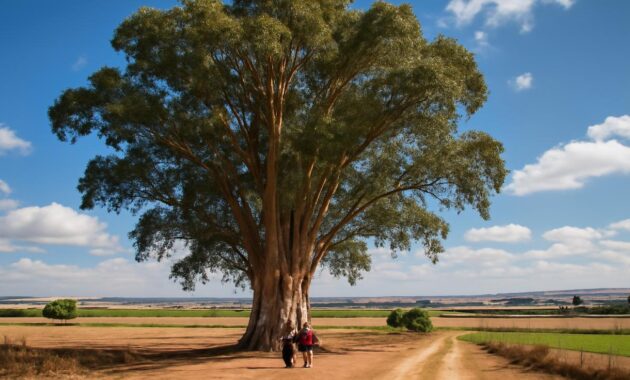
The first time I saw the great eucalyptus of Aznalcázar, it did not appear so much as a tree as a sudden interruption in the sky. For almost an hour I had been driving through the soft, flat quilt of rural Seville—fields of wheat worn to a pale gold, pockets of dusty olive groves, low farmhouses blinking in the sunlight—until the landscape began to fold into shy hills and pockets of darker green. Then, around a gentle bend, there it was: a vertical astonishment in a horizontal world, a column of living wood rising more than 60 metres into the late afternoon light.
The Road to a Giant
The eucalyptus doesn’t reveal itself all at once. From a distance, it’s just a suggestion—something too tall to be a farmhouse chimney, too slender to be a communications tower. It stands in a rural corner of the Seville province, not far from the shadowy edge of Doñana’s great mosaic of wetlands and pine forests, in a place that does not announce itself with visitor centres or glossy signs. This is a tree you have to go looking for, or stumble upon by accident and never forget.
The road narrows as you approach, the tarmac shrugging into gravel, then dust. In summer, the heat takes on a physical texture, thick and humming. Grasshoppers clatter away from your footsteps. Somewhere nearby, a dog barks once, then loses interest. The smell changes almost imperceptibly: dry earth, sun-struck stone, and then, as you draw closer, a cool edge—sharp, medicinal—like a doctor’s waiting room thrown open in the middle of the countryside. That is the smell of eucalyptus oil, seeping from leaves high above, drifting down in invisible threads.
Only when you step out of the car and crane your neck do you finally grasp the scale. The tree’s trunk is pale and muscular, shedding sheets of bark like old parchment, revealing flesh-coloured smoothness beneath. The crown, 60 metres overhead, dissolves into hanging scythes of silver-green leaves that shiver even when the rest of the air is pinned in stillness. It is, by all available measures, one of Spain’s tallest trees, a botanical expatriate from the Australian bush that has found a second life in Andalusian soil.
The Eucalyptus That Crossed an Ocean
In the story of this giant, Spain and Australia share a quiet thread of history. Eucalyptus globulus—the Tasmanian blue gum, to give it its full presidential name—never grew here naturally. It travelled. It was brought, pocketed, planted, and persuaded to stay.
Most likely, the seeds that would become Seville’s sky-grabbing colossus arrived in Spain during the 19th century, when eucalyptus trees were the ecological celebrities of their day. They promised everything: fast-growing timber for mines and railways, windbreaks for exposed villages, shade for farmhouses, and, most seductively, a supposed solution to malaria. Their thirsty roots were thought to drain fever-ridden marshes. Across the Mediterranean, from Portugal to Italy, landowners planted eucalyptus by the thousands, transforming horizons in a single generation.
Imagine the first person who pressed a eucalyptus seed into the ground here, somewhere between orange groves and cork oaks. Perhaps it was a landowner with modern ideas, perhaps a forester eager for new species. Perhaps they had heard stories from Galicia, where eucalyptus would eventually cloak entire hillsides. They couldn’t have known that, more than a century later, one of their trees—or one of their neighbour’s—would be climbing past 60 metres, outliving owners, workers, and even the supposed scientific fashions that brought it here.
Spain’s rural landscapes are layered with such quiet experiments. A line of pines planted to hold back dunes. A row of figs brought by a returning emigrant from North Africa. A solitary cypress marking a well. The giant eucalyptus of rural Seville stands among these as one of the most extravagant gestures—a tree that seems to have misread the manual on Mediterranean modesty and exploded instead into sheer vertical ambition.
Standing in the Shadow of 60 Metres
Walking up to the base of the tree feels a little like approaching a cathedral from the inside out. The trunk is the nave, tall and echoing. The crown is the vaulted ceiling, full of soft, windy murmurs. If you place a hand against the bark, it feels unexpectedly cool and faintly waxy, the surface broken by long vertical scars where sheets of outer bark have peeled away, collecting at the roots like curled wood shavings.
There is an instinct, almost childlike, to wrap your arms around it. You soon realise this is impossible. It would take at least three, maybe four adults to encircle the base entirely. The ground beneath is a scatter of dried leaves, curved and stiff, and pencil-thin twigs that snap underfoot with a brittle sigh. Above, swallows stitch and un-stitch the air around the upper branches, while wood pigeons lurk somewhere in the foliage, their calls muffled and echoing, as if coming from the rafters of a hidden hall.
Even sound behaves differently near a tree this size. On a breeze-less day, the countryside can feel as though someone has muted the world. Conversations at the base of the tree seem strangely intimate, voices contained by its sheer presence. Then a gust arrives, and the upper canopy begins to whisper—only at first. The whisper builds into a hush, then a low roar, like distant surf along an invisible coastline. It is disconcerting: the rest of the surrounding trees, shorter pines and willows, barely move, but the eucalyptus becomes a living wind instrument, playing high above the human scale.
At 60 metres, this is not just tall by Spanish standards; it is tall by almost any European standard. In the cool, damp north, firs and pines reach similar heights, but here in Andalusia, where summers can burn at 40 degrees and more, such extreme growth is an act of botanical audacity. Measured with laser rangefinders and tape, verified by forestry records and the quiet pride of local enthusiasts, this tree has nudged its way into lists of Spain’s tallest living beings. But no measurement, no dry figure in metres, quite prepares you for the improbable angle of your own neck when you try to follow its trunk upwards.
The Tree and Its Human Neighbours
For the people who live in the surrounding countryside, the tree has long been more than a statistic in a register. It is landmark, compass, and conversation starter. Farmers use it to orient themselves across the patchwork of fields: “Drive until you can see the eucalyptus; then turn left.” Children grow up with it as the unspoken north star of their games, its silhouette a constant at the edge of their world.
On still evenings, neighbours sometimes drift towards it, as if pulled by its gravity. Someone might lean against the trunk, another sit on the low earth bank nearby, sharing gossip or worries under a crown that doesn’t care about either. One old man, when asked what he thought about having one of Spain’s tallest trees in his backyard, only half-joked, “I think about how much firewood it would be, if it ever fell.” His smile made clear he didn’t really want that fate for it. There is a certain protectiveness in his voice, the same tone people use when speaking about a long-lived family animal.
Not everyone is equally charmed, of course. Eucalyptus have their critics, and not without reason. They drink deep and fast from the soil. Their leaf litter is slow to decompose. In large plantations, they can crowd out native species and change fire behaviour. Environmentalists in Spain often speak of them with complicated frowns, particularly in regions where eucalyptus monocultures have marched across hillsides once fringed with oaks and chestnuts.
Yet a single eucalyptus, left to age into quiet grandeur, inspires more tenderness than debate. Standing underneath this 60-metre giant, it is hard to see it as an invader. It feels instead like a somewhat eccentric immigrant that has stayed long enough to become part of the local story.
A Giant in a Changing Climate
In the fierce light of midday, the tree casts a pool of surprising coolness. Step from full sun into its shade and the temperature seems to slip down a couple of notches. It is a small mercy, but a telling one, because summer in rural Seville is no time for the faint-hearted—or the shallow-rooted.
Climate, here, is no mere backdrop; it is a sculptor. The rains that once fell more regularly now arrive in erratic bursts. Heatwaves stretch longer, hotter, more insistent. Storks nesting on power lines arrive earlier from Africa and stay later. The soil cracks, then floods, then cracks again. To survive, any tree has to be both stubborn and lucky.
For a eucalyptus, adaptability is its birthright. Back in its native Australia, it evolved in a land of fire and drought, and those evolutionary lessons are etched into its fibres. Its leaves hang vertically to reduce exposure to the highest midday sun. Its bark peels, shedding parasites and dead tissue. In many eucalyptus species, buds can resprout after fires, turning disaster into opportunity. Here in Andalusia, those same traits that once made it attractive to landowners may now be helping it endure in a century of climatic uncertainty.
But even giants have limits. Extended drought can stress the highest limbs, leading to dead branches that snap and fall with no warning. Intense storms—rarer, but seemingly fiercer—can rip entire limbs away, leaving jagged scars that take years to heal. A tree this size is a living record of weather extremes: each wound, each hollow, each twist in the bark a footnote in the region’s changing climate diary.
A Living Layer of Life
Look closely at the trunk, and the eucalyptus stops being a single tree and becomes a crowded neighbourhood. In the tiny crevices of its bark, green and grey lichens etch abstract maps. Ants navigate highways along the vertical ridges, indifferent to gravity. Spiders rig invisible suspension bridges between the lower branches, their webs catching the light in brief, perfect geometric flashes.
Higher up, in the branches you can only just see with squinted eyes, birds claim their apartments. Hoopoes patrol the lower limbs, their zebra-striped wings flashing as they hop from branch to ground in search of beetles. Kestrels sometimes use the upper canopy as a hunting lookout, heads tilting as they scan the fields for movement. In spring, the whole tree hums with insect life, drawn by nectar and shade, forming an invisible cloak of wings and legs.
This layering of life—fungus, lichen, insect, bird, mammal—turns the tall eucalyptus into more than a solitary monument. It becomes what ecologists call a microhabitat: a structured, three-dimensional world where different species can nest, feed, and shelter at different heights, like floors in a living skyscraper.
In a surrounding landscape shaped so strongly by agriculture, where many trees begin and end their lives in orderly rows and predictable cycles, this element of wildness is not trivial. A tall, old tree acts as a stubborn anchor for biodiversity, a vertical island for species that need continuity more than perfection.
Numbers, Stories, and a Table of Giants
To talk about one giant tree is inevitably to wonder about its peers. Spain, stretched from the wet Atlantic fringe of Galicia to the dry, sun-baked plains of La Mancha, is home to many remarkable trees—some famous, some obscure. In the cool north, Sitka spruces and Douglas firs pushed into forestry plantations have grown to formidable heights. In valleys once logged for shipbuilding, old chestnuts spread their many-armed crowns wide. And scattered throughout the peninsula, exceptional individuals—oaks, poplars, pines—have made the leap from mere tree to local legend.
The Seville eucalyptus sits among them in this informal pantheon of Spanish giants, a vertical outlier in a region more famous for cork oaks and olive groves. Its story becomes clearer when placed next to a few of its tall contemporaries:
| Tree / Common Name | Location (Province) | Approx. Height | Notable Feature |
|---|---|---|---|
| Colossal Eucalyptus of Rural Seville | Seville (Andalusia) | ≈ 60 m | One of Spain’s tallest trees; landmark in agricultural landscape |
| Historic Eucalyptus in Lourizán | Pontevedra (Galicia) | ≈ 65–70 m | Among the tallest measured trees in Spain’s wetter north |
| Veteran Douglas Fir Groves | Various northern provinces | Up to 60+ m | Planted for timber; now reaching impressive heights |
| Ancient Black Poplars | Central river valleys | 50–55 m | Riverside sentinels, valued for age as much as size |
| Monumental Stone Pines | Mediterranean coast & interior | 35–40 m | Broad crowns; cultural symbols of the Mediterranean |
On paper, the difference between 55 and 60 metres may look unimpressive, a mere question of a few digits. But out in the real world, standing at the base of a tree that has stretched itself just a little bit farther than its neighbours, the effect on the human imagination is disproportionate. That extra reach feels like an act of defiance—a refusal to be confined by the typical limits of a landscape.
Why These Giants Matter
It is tempting to think of superlatives—tallest, oldest, thickest—as a kind of ecological tourism, a way to organise our awe into record lists and ranking tables. Yet the more time you spend with a tree like the eucalyptus of rural Seville, the more such labels begin to feel secondary.
What matters, perhaps, is not that this tree is recorded as one of the tallest in Spain, but that it has stood long enough and high enough to gather stories around itself. Beer shared in its shade after harvest. First kisses stolen beneath its branches. Children daring each other to touch its trunk on dark nights. Biologists geeking out over tape measures and clinometers. Elderly neighbours remembering when it was “only half that size,” even if the arithmetic doesn’t quite check out.
In a century when so much of our relationship with nature is mediated through screens and headlines—wildfires in one tab, floods in another—tall trees provide a different kind of headline: one you have to go out and stand under to really read. They remind us that growth is not always a metaphor and that time can be felt not just in wrinkles on skin or cracks in walls, but in rings of wood we may never see, hidden in a column of living tissue rooted quietly in the earth.
Leaving the Eucalyptus Behind
Late in the day, when the light softens from white-hot to honeyed gold, the trunk of the eucalyptus seems to glow. The layers of peeled bark catch the low sun in overlapping shades of cream, pink and grey. Shadows lengthen, and the fields around it take on that familiar Andalusian end-of-day melancholy—a hush before the cool of evening, when cicadas hand the night over to crickets.
As you step back, farther and farther, the tree gradually shrinks from impossible colossus to improbable line in the distance, then to a barely visible stitch in the horizon. Yet something about it travels with you. Perhaps it is simply the sensation, still in your neck and shoulders, of having looked so far upward. Perhaps it is the faint trace of that medicinal scent lingering in your clothes. Or perhaps it is the knowledge that, long after you have driven away, after your thoughts have jumped to other things, that tree will still be standing there, adding invisible millimetres to its height, catching wind and light in a corner of Spain that few maps ever emphasise.
We live in an age of shrinking wild spaces, of forests cut, burned or reshaped for our purposes. In such a context, even a planted tree, an introduced species, can become something quietly radical simply by being allowed to grow old and large. The colossal eucalyptus in rural Seville may not be part of Spain’s ancient native forests, but it has, over decades, stitched itself into the emotional and ecological fabric of the place where it stands.
To visit it is to step, briefly, into a conversation between continents, climates and centuries—a conversation conducted not in words but in wood, leaf, and air. And as you turn away, there is a subtle, almost embarrassing urge to say goodbye out loud, as if leaving the presence of a host who has been silently generous with shade, scale, and perspective.
Frequently Asked Questions
Is the 60-metre eucalyptus in Seville really one of Spain’s tallest trees?
Yes. While exact rankings can change as new measurements are taken, a eucalyptus reaching around 60 metres in height is exceptional by Spanish standards, especially in southern regions. Most native Mediterranean trees rarely approach this height, putting this individual among the country’s tallest measured trees.
What species of eucalyptus is it?
The tree is generally identified as a form of Eucalyptus globulus (Tasmanian blue gum) or a closely related species. These are among the most commonly planted eucalyptus in Spain, known for their rapid growth and great height in suitable conditions.
How old is the tree likely to be?
Precise age is difficult to confirm without invasive methods, but given its size and growth patterns of eucalyptus in Spain, the tree is probably between 80 and 140 years old. Many large eucalyptus in the Iberian Peninsula trace back to planting waves in the late 19th and early 20th centuries.
Are eucalyptus trees native to Spain?
No. Eucalyptus trees are native primarily to Australia and nearby regions. They were introduced to Spain for timber production, land drainage, windbreaks, and ornamental use. Over time, some planted individuals, like the Seville giant, have become local landmarks.
Are eucalyptus trees harmful to local ecosystems?
The impact of eucalyptus depends on scale and context. Large monoculture plantations can reduce biodiversity, alter soil conditions, and influence fire behaviour. However, individual old trees or small groves—especially when mixed with native species—can offer habitat and shade without the same level of ecological concern.
Can visitors easily see this particular eucalyptus?
Access conditions can vary, as many large trees stand on or near private or working agricultural land. Anyone wishing to visit should respect property boundaries, follow local guidance, and treat the area with care, avoiding damage to roots, bark, or surrounding vegetation.
Why do tall trees like this matter to people?
Tall, long-lived trees act as living landmarks and emotional anchors. They provide habitat, microclimates, and a sense of continuity across generations. For many people, standing beneath a giant tree is a rare chance to feel both small and connected—an encounter with time and scale that everyday life seldom offers.