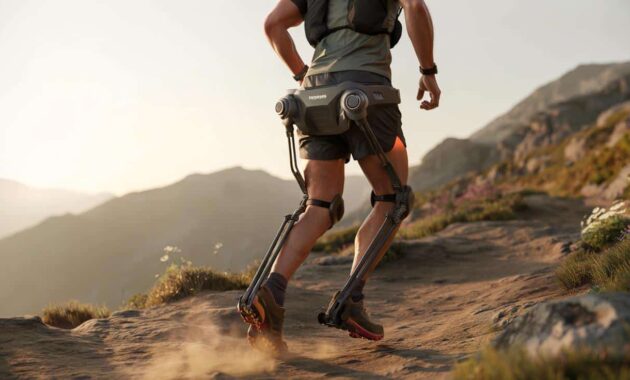
A new consumer exoskeleton called the Hypershell X Ultra brings powered assistance to human legs. The system promises up to 1,000 watts of push and assisted speeds up to 25 km/h. It’s not a concept. It’s already on sale, aiming at hikers, fast-packers and runners who want extra range and extra vertical without burning out.
What this exoskeleton actually does
The X Ultra straps around the hips and connects to the thighs. It senses your gait and adds torque as you extend your leg. The goal is simple: preserve your natural motion while reducing the energy you spend with each step. It doesn’t steer you. It doesn’t lock your joints. You move, and it amplifies that movement.
Rated assist: 1,000 watts — about 400% of the maximum motor output allowed for e-bikes in the European Union.
That number matters. E-bikes in the EU are capped at 250 W nominal power, which feels gentle on hills. A 1,000 W burst feels very different at the hips. Think quick acceleration on fire roads. Think steady pull on long climbs with a pack. The company pegs assisted running up to 25 km/h. That beats elite marathon pace, although it assumes smooth ground and a strong user.
Top assisted speed: 25 km/h. That’s faster than a marathon winner’s average pace, delivered through your stride rather than pedals.
Where it actually helps most
The biggest gains show on steep grades and over long days. Climbing demands power. Power equals force times speed, and hills demand both. Hip-driven assistance lifts the load at the moment your glutes and hamstrings do the heavy work. On flats, it helps you hold a brisk cadence without flooding your legs with lactate. On descents, the focus shifts to control, so the benefit shrinks.
- Hiking with a heavy pack: reduce peak effort on steps and switchbacks.
- Fast ascents: hold tempo pace on long climbs without spiking heart rate.
- Scrappy terrain: add a little push when footing is loose or rutted.
- Commuting on foot: arrive drier and less fatigued on hot days.
- Mountain rescue or patrol: keep capacity in reserve for emergencies.
How it feels to move with power at your hips
Users describe a quiet surge when the device times the push at toe-off. It feels different from cycling assistance. Your arms swing as usual. Your feet land as usual. The help lives in that split-second when your leg drives back and your center of mass rises. Done well, the motor fades before your leg recovers forward. The reward is cadence that holds steady on climbs, plus less micro-stumble when the ground gets chunky.
It doesn’t turn you into a passenger. It rewards an active stride and punishes sloppy form.
Power, speed and the rules of the trail
With 1,000 W on tap, etiquette and legality matter. Many trails ban motorized vehicles, yet most codes never considered a hip-mounted device. Land managers may treat it like a mobility aid or like a motor, depending on context. Racing bodies tend to prohibit powered assistance to keep fields fair. Urban footpaths bring a different risk calculus, because 25 km/h on foot can scare pedestrians.
➡️ Crew of a U.S. Air Force C 5M Super Galaxy has declared an emergency over Pacific
➡️ “I’m a compliance coordinator, and my earnings grew without chasing promotions”
➡️ With Starlink on mobile only the rich will truly have access to the open internet
➡️ Experts say this one mineral deficiency is the real reason behind your constant fatigue and low mood
| Feature | Typical e-bike (EU) | Hip exoskeleton (X Ultra) |
|---|---|---|
| Max nominal assist power | 250 W | Up to 1,000 W (rated) |
| Assisted speed | Assist to 25 km/h | Assist up to 25 km/h (running) |
| Hands needed | Both hands on bars | Hands free |
| Terrain | Paved/gravel routes | Footpaths and mixed trails |
| Access rules | Clearly regulated | Often undefined |
Why 1,000 w changes effort, not just speed
Power at the hips reduces the metabolic cost per kilometer. Less muscular effort means less heat and slower glycogen drain. On steeps, you can lift the same body and pack mass with fewer spikes in heart rate. On rolling ground, you can hold a quicker rhythm without bursting into a run. That can double practical day range for some users, because fatigue tends to arrive from cumulative strain rather than one brutal climb.
The device also shifts how you plan food and hydration. With less heat from muscle work, you may sweat less on the same route. That affects salt needs and water carry. It also changes pacing. You can bank time on climbs while keeping a cap on perceived exertion. That opens new routes in a safe day’s window, which is the real promise here.
Safety, maintenance and common-sense use
Respect momentum. At 20–25 km/h on foot, stopping distance grows fast. Give space on shared paths. Signal when overtaking. Keep speed down near dogs and kids. Practice short sessions first, then add distance.
Check fit every hour. Loose thigh cuffs can chafe. Over-tight straps can pinch nerves. Inspect moving joints for grit after muddy sections. Wipe the rails before storage. Charge in a cool place and avoid full drains if the pack allows partial charging.
Use power to reduce strain, not to mask pain. If something hurts unpowered, fix that before you amplify it.
Where this could head next
Exoskeletons already assist workers on factory floors. Outdoor units will likely fragment into niches: ultralight hikers chasing grams, mountaineers seeking torque in cold, runners wanting float on undulating singletrack. Expect software to matter more than raw wattage. Smarter gait detection means less jerk and better timing, which users feel as “natural.”
Regulation will follow. Cities will define footpath speed limits for powered wearables. Race rules will harden. Insurers may require helmets above certain assisted speeds. None of that stops adoption; it simply sets norms, much like helmets and lights did for bikes.
Tips to get real value from a powered stride
- Set a heart-rate ceiling and let the motor do the rest on climbs.
- Use short strides on technical ground to keep timing predictable.
- Save battery for the final third of your route, when fatigue bites.
- Carry poles for descents; assistance helps less when gravity does the work.
- Track your vertical meters and pace to learn where assistance pays most.
One last angle to consider is training effect. Assistance lets you log longer time on feet with lower peak strain. That can build connective tissue tolerance without trashing muscles. You can also simulate altitude-like workloads by holding cadence on climbs while keeping heart rate modest. Balance that with unassisted sessions, so your neuromuscular system stays honest.
If you’re curious about the physics, try a simple hill test. Pick a 200-meter climb at 10% gradient. Walk it once unassisted while measuring time and average heart rate. Repeat assisted at the same heart-rate cap. The time delta shows what power does for you on honest terrain. Use that gap to plan bigger days with safe margins.
Originally posted 2026-03-10 18:41:00.