Not speech, not colors, not faces — not yet. First comes something simpler and stranger: tiny bursts of light that appear where there was nothing. The question hanging in the air is deceptively basic. Can a pattern of sparks become a picture you can use?
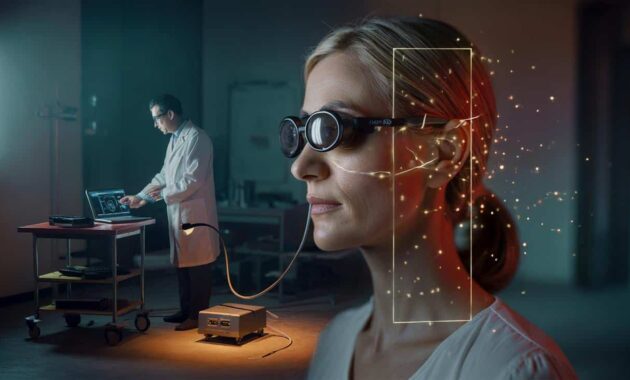
At a clinic visit on a windy Tuesday, a neuroscientist rolled in a cart with a tangle of cables and a glossy pair of camera glasses. The patient, blind for more than a decade, sat very still as the room dimmed. A soft chime marked the first pulse, and she whispered that a dot had popped up like a firefly on the left. The room holds its breath.
They upped the current, nudged a neighboring electrode, and the single firefly became two. She said it felt like a faint snow of light, there and gone, gentle but real. The neuroscientist nodded, fingers hovering over a keyboard, drawing an invisible line in her visual cortex with electricity. Then she blinked.
Inside the cortex: turning electricity into flickers of sight
When the retina no longer sends usable signals, the detour is the brain itself. Tiny arrays — think grains of rice studded with hair-thin pins — press into the visual cortex where vision first maps the world. Each pin, when activated, can create a phosphene: a brief sparkle of light in a specific spot. One dot is a syllable. A cluster can be a word.
Engineers learned something important: sparking many electrodes at once is messy, but guiding them in sequence makes a line appear to “move.” In one session I watched, the team traced a T with a sweep of pulses and the patient called it instantly. Accuracy rose with practice, from hesitant guesses to confident hits at simple shapes. For the first time, the letter wasn’t just imagined — it was seen as light.
Why this works comes down to a map etched in the cortex. Your visual field is laid out like a distorted grid across the back of your brain, a retinotopic atlas from center to periphery. Stimulate a spot on that map and you tend to get a dot in the same part of your mental screen. Multiple spots, carefully timed, let the brain interpolate motion, edges, and contours. The result isn’t sight as you knew it, but a mosaic the brain can learn to read.
Training the brain to read a code of sparks
The first weeks look like language class. Map one electrode at a time. Log where the dot appears. Rank the cleanest channels. Then step up to sequences: short dashes tracing arrows, L-shapes, squares. Sessions are short and frequent, mixing rest with repetition to avoid fatigue. Practice turns jittery sparks into a steady vocabulary.
People stumble when they chase realism too fast. The mind wants faces; the implant gives confetti. Better to anchor the training to simple goals — door frames, windows, a bowl on a dark table — so the dots cue action, not disappointment. Celebrate tiny wins: finding a hallway by a vertical streak, detecting a bright sidewalk seam. Let carers and family learn the same code so support feels shared. Let’s be honest: nobody really does that every day.
This is where expectations meet the patient’s own pace and grit. Habits form around what the implant does well — high-contrast edges, motion, simple symbols — and that’s enough to change daily life in small, stubborn ways.
“Think of it like learning to read a new alphabet,” the neuroscientist told me. “At first you see dots. Then you notice the spacing. One day the spacing becomes meaning.”
➡️ Why this haircut looks better after a few weeks than on day one
➡️ What are the benefits of putting your phone in airplane mode: how to do it
➡️ “We’re eyeball to eyeball with the Russians”: French navy chief on sea power in a dangerous decade
➡️ If you feel unsettled by ordinary days, psychology explains what your mind expects
➡️ A piece of foil in the oven the restaurant trick that quietly saves electricity
➡️ “I realized my soil was alive” only after I stopped disturbing it constantly
- Start with one task per session: detect a vertical bar on a dark wall.
- Use dynamic “tracing” rather than all-at-once flashes to outline shapes.
- Pair sounds with light patterns to ground the meaning in the moment.
- Track fatigue; a tired brain turns sparks into noise.
- Redraw maps monthly; electrodes and cortex both change with time.
The horizon: from dots to meaning
Every success in this field is incremental and stubbornly human. Brain implants won’t rewind the clock, and they bring trade-offs: surgery, calibration days, maintenance, occasional electrode dropouts. Cameras mounted on glasses pipe video to a processor that boils the world down to edges and motion, which then gets translated into pulses across the array. The alchemy is in that translation. No one is promising natural vision.
Still, momentum is real. Cortical arrays are getting smaller and denser. Stimulation patterns are adapting with AI that learns a user’s best “alphabet” and redraws it on the fly. Some groups mix video with depth sensors, making doorways sing in light while neutral walls stay quiet. Others are exploring current steering to create “virtual” electrodes between pins. We’ve all had that moment when a new tool finally clicks in your hands. This technology lives for that click — the instant a spark becomes a hint, and a hint becomes a path.
| Point clé | Détail | Intérêt pour le lecteur |
|---|---|---|
| Cortical implants create phosphenes | Electric pulses on the visual cortex produce dots of light in specific locations | Understand why “sparkles” are the first step toward usable patterns |
| Sequential stimulation beats simultaneous | Guided pulses can trace lines and letters that people recognize more reliably | Gives a mental model for how dots turn into edges and shapes |
| Training shapes the perceptual alphabet | Short, focused tasks build a personal code of light tied to actions | Practical takeaways for real-life navigation and object finding |
FAQ :
- How does a brain implant “make” light if the eye doesn’t work?By stimulating the visual cortex directly. Each electrode can evoke a small flash (a phosphene) at a predictable place in your visual field.
- Is this the same as retinal implants like Argus II?Not exactly. Retinal devices use remaining cells in the eye; cortical systems bypass the eye and optic nerve entirely, which can help in advanced degeneration.
- What can patients actually perceive right now?High-contrast edges, simple shapes, motion cues, and patterns that look like clusters of dots or sparks. Over time, many learn to use them for orientation and basic tasks.
- How safe is the surgery?It’s invasive brain surgery with risks like infection or device failure. Programs include screening, sterile technique, and ongoing monitoring to reduce those risks.
- Will AI make this look like normal vision soon?AI will likely make the code smarter and more personalized, but the output still rides on dots of light. The goal is utility and meaning, not a photo-real reboot.