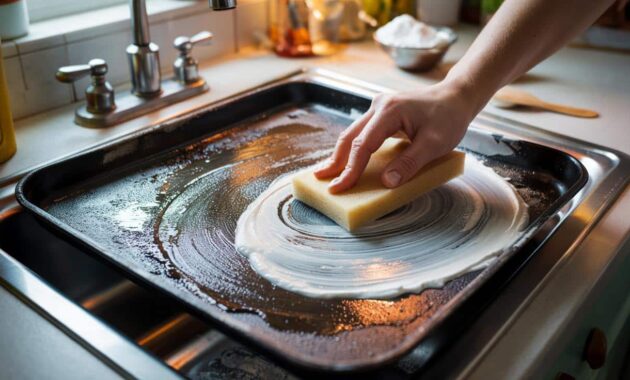
The tray came out of the oven with that familiar burnt halo around the edges, the kind that no sponge wants to touch. You know the look: patches of sticky brown, black crust welded on like it survived a fire, and that faint smell of old fat that seems to cling to your hands. You stack it in the sink “for later,” spray a bit of product on top, then walk away pretending this isn’t going to follow you all evening.
Two hours, three podcasts, and one procrastination scroll later, it’s still there. Waiting.
That’s usually the moment someone mentions baking soda, like an old family trick you never really took seriously.
Then the paste hits the metal, and things quietly start to change.
Why burnt oven trays look hopeless (and why they’re not)
There’s a particular kind of shame that comes with showing someone your baking trays. The front of the oven might be spotless, the countertops clear, the dishes stacked neatly. Then you pull out a tray and the truth appears in brown rings and baked-on splatters. You suddenly remember every time a sauce spilled, every pizza cheese that escaped.
We tend to treat these trays like they’re ruined, as if this is just what “grown-up” kitchen gear looks like after a few years of heavy use. The good news: that’s only half true.
Picture a Sunday roast gone slightly wrong. The potatoes were great, the chicken was golden, everyone complimented you. But under the feast, the tray took a hit. The juices burnt at the corners, a shiny black layer formed, and by the time you’d finished dessert, everything had cooled and solidified.
You gave it a quick soak, scraped a little, then called it a day. Two weeks later, that stain has become part of the metal, or so it seems. Yet people quietly posting before-and-after photos of their trays online are all relying on the same cheap white powder from the cleaning aisle or baking shelf. That’s not magic. That’s chemistry.
When grease sits in a hot oven, the fats and sugars go through a series of reactions that turn them sticky, carbonized, and stubborn. Typical dish soap is great for fresh grease, but once heat has had its way, the residue behaves more like burnt glue than oil. Baking soda steps in differently.
It’s mildly alkaline and gently abrasive, so when you add a few drops of water and let it sit, the paste starts to loosen the bonds between the burnt layer and the metal. Rubbed lightly, those tiny particles work like soft sandpaper, but without scratching the tray. It’s slow power, not brute force.
How to use baking soda paste on a burnt tray (without wrecking it)
Start with the basics: a dirty tray, some baking soda, and a little water. That’s it. Lay the tray flat in the sink or on the counter, then sprinkle a generous layer of baking soda over the burnt zones. Don’t be shy here; a thin dusting won’t do much.
Drip in water slowly until you get a thick paste, about the texture of toothpaste. Spread it with your fingers or the back of a spoon, pressing gently into the worst patches. Leave it there for at least 30 minutes, longer if the stains look ancient. While it rests, the paste quietly works on those tough bonds.
When the waiting time is up, grab a non-scratch sponge or a soft brush and start rubbing in circles. You’ll often notice the paste turning brown or grey as it lifts burnt residue away from the metal. Rinse and repeat on stubborn areas, refreshing the paste when it dries out.
This is the part where many people give up too soon, expecting the tray to shine in one pass. Reality is less glamorous: big progress on round one, surprisingly better on round two, almost-new look by round three. Let’s be honest: nobody really does this every single day. That’s exactly why the before-and-after can feel so dramatic.
Sometimes the most satisfying part of cleaning with baking soda isn’t the final shine, it’s watching that first patch of black gunk finally surrender and slide off the metal.
- Use warm water with the paste
It helps soften old grease slightly faster, especially on corners and edges. - Avoid steel wool on delicate coatings
On non-stick trays, stick to soft sponges so you don’t damage the surface. - Let the paste do the work
If nothing seems to move, extend the soaking time instead of scrubbing harder. - Combine with a little dish soap for fresh spills
This doubles the effect on trays that are dirty but not yet fully burnt. - *Test on a small corner first for fancy or colored trays*
Some decorative finishes can be more sensitive than standard metal.
Living with real trays, not showroom ones
There’s something oddly comforting about accepting that oven trays are allowed to look lived-in, as long as they’re clean and safe to use. Yet there’s also a small thrill in discovering that what you thought was permanent damage is actually just old grease waiting for a proper baking soda spa. That gap between “ruined” and “recoverable” is where this simple paste shines.
Maybe the real shift isn’t just having a shinier tray, but feeling slightly more in control of a kitchen that often feels like it’s winning the war on mess.
Some people turn this into a slow ritual: paste on, kettle on, podcast playing in the background while they gently work on a single tray. Others line up every burnt pan and decide this is the day of reckoning. You might even find yourself showing the after photo to a friend, half proud, half amused that a €1 box of powder beat that expensive spray cleaner.
We’ve all been there, that moment when you realise the “secret trick” your grandmother mentioned was not folklore, just low-cost chemistry and a bit of patience.
Baking soda won’t fix a tray that’s warped, rusted through, or peeling its non-stick coating. It does something quieter: it buys your kitchen tools more time, and by extension, saves you a little money and a lot of visual noise. Next time you pull out a burnt tray and feel that tiny spark of defeat, you might pause before hiding it in the back of the cupboard.
You already know what a spoonful of white powder and a few drops of water can do. The rest is just a matter of letting it sit, and giving it a few minutes of your hands.
➡️ How allies of AI are ramping up their political donations for the midterms
➡️ Álvaro pedrera, experte für pflanzen: der größte fehler bei aloe vera ist das gießen
➡️ Gen Z is losing a skill we have possessed for 5,500 years: 40% are losing mastery of communication
| Key point | Detail | Value for the reader |
|---|---|---|
| Create a thick baking soda paste | Mix baking soda with a little warm water until it’s like toothpaste, then coat burnt areas | Maximizes cleaning power while staying gentle on trays |
| Let the paste sit before scrubbing | Rest time of 30–60 minutes loosens burnt grease and carbon | Reduces physical effort and limits the risk of scratching |
| Use soft tools and repeat in stages | Non-scratch sponges, circular motions, and 2–3 rounds for old stains | Restores trays gradually without damaging coatings or metal |
FAQ:
- Can baking soda damage my oven tray?Baking soda is mildly abrasive but generally safe on standard metal trays. On non-stick or painted trays, use a soft sponge and gentle pressure, and test a small corner first.
- How long should I leave the baking soda paste on?For light stains, 20–30 minutes is often enough. For heavy, long-standing burnt areas, 1–2 hours or even an overnight rest can give better results.
- Can I mix baking soda with vinegar for faster cleaning?You can, but the fizzing mainly looks impressive. It slightly helps lift grime, yet the steady work usually comes from the baking soda paste and scrubbing time.
- Will this work on oven racks and other metal parts?Yes, the same paste method works on racks, grill grates, and pan bottoms. Just avoid using it on aluminum that stains easily or on delicate decorative finishes.
- How often should I deep-clean my oven trays with baking soda?If you cook frequently, a deeper clean every few weeks keeps buildup manageable. For occasional bakers, once every couple of months can already transform how your trays look and smell.