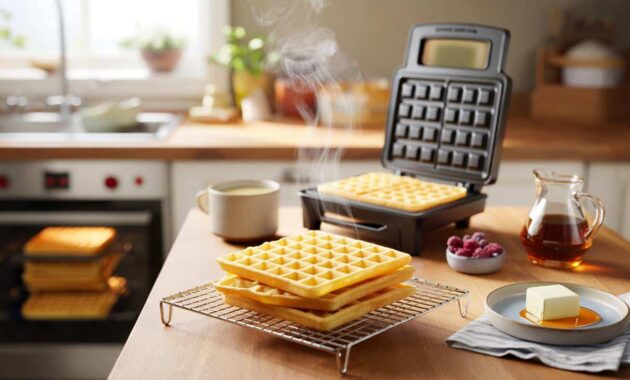
Sunday morning. Coffee smell, a half-open window, that quiet in-between moment before everyone grabs their phones. You pull out your waffle maker like a small act of rebellion against frozen toaster waffles. The batter hisses, the plates close, and a few minutes later you’ve got a stack that looks like a magazine cover: golden, airy, crisp.
Ten minutes pass. Someone asks for seconds. You lift the plate and… the waffles are soft, a bit sad, almost damp. The crunch is gone, swallowed by steam and syrup. You pretend it doesn’t matter, but you feel slightly cheated.
What nobody tells you is that the secret to long‑lasting crispy waffles isn’t in the batter first.
It’s in what you do the second they leave the iron.
The real reason your waffles go soggy so fast
The scene plays out the same way in countless kitchens. Waffle iron on the counter, a plate ready nearby, maybe a clean tea towel you toss on top to “keep them warm”. The first waffle comes out perfectly crisp, you stack the second on top of it, then the third. By the time everyone finally sits down, you’ve created a small sauna on your plate.
All that lovely steam, trapped between hot waffles, has nowhere to escape. So it goes straight back into the crust you worked so hard to caramelize. Result: floppy waffles.
And you start wondering if it’s your recipe that’s wrong.
I watched this play out in real life at a family brunch. My cousin had spent the week hunting down the “best Belgian waffle recipe” and proudly poured his yeasted batter like a pro. The first waffle came out shatter-crisp. We all did the polite “wow” noises.
Then he stacked them on a dinner plate, slid the plate into a turned-off oven “to keep warm” and covered it with foil. 20 minutes later, that crunch had disappeared. The waffles were tasty, but they had the texture of cake. You could almost see the disappointment on his face when the knife didn’t crack through.
There’s a simple logic behind it. Crispness is just water leaving the surface of the batter fast enough to dry and brown it. The waffle iron blasts heat, the moisture inside turns to steam, and the outside dries into that golden shell we love.
As soon as you pile hot waffles on top of each other or trap them under a cover, that steam can’t leave. It condensates and rehydrates the crust. The same way leftover fries go limp in a closed box. *Crispy food hates closed spaces.*
So the real enemy isn’t your recipe, or even your waffle maker.
It’s trapped steam and zero airflow.
➡️ 9 things every senior did as a child that we no longer teach our grandchildren
➡️ Dogs Getting The Zoomies wild suddenly For Their First Snow Day Of The Year
➡️ Why cooking mushrooms without stirring at first gives them deeper flavor
➡️ “I became a training facilitator, and my income improved without longer hours”
The simple trick: crisp in the iron, finish in the air
The trick sounds almost too simple: let your waffles breathe. Not on a plate, not in a stack. On a wire cooling rack, in a single layer, in the open air.
As soon as a waffle leaves the iron, lay it gently on the rack. No overlapping, no towel on top, no foil. The steam rises, escapes, and the crust actually keeps drying for a couple of minutes. If your oven has a “warm” setting, slide the rack in there at low heat, around 90–100°C (195–210°F), door slightly ajar. You’re not cooking them again, just holding the crisp.
This one tiny change can keep homemade waffles crunchy for 20, 30, even 40 minutes.
The hard part isn’t the technique. It’s letting go of our habits. Many of us grew up seeing pancakes and waffles stacked high on a plate, covered to “keep them hot”. It feels cozy and generous. Yet that ritual is exactly what kills the crunch.
A lot of people also crank the oven up too much. They think more heat means more crisp. In reality, high oven heat can dry the inside too aggressively, leaving you with tough waffles instead of light ones. Low heat plus air circulation is what you’re after. Think gentle drying, not roasting.
Let’s be honest: nobody really weighs their waffles or tracks temperature with a thermometer every single day.
But giving them a rack instead of a plate? That’s realistic.
“Once I stopped stacking waffles and started treating them like cookies just out of the oven, everything changed,” laughed a home baker I met at a neighborhood market. “My kids actually complained the first time they got a soft one again at someone else’s house. That’s when I knew the trick worked.”
- Use a metal wire rack, not a solid tray, so air can reach the bottom.
- Keep waffles in a single layer while they cool and stay warm.
- Set the oven to low heat only, door slightly open if possible.
- Avoid covering waffles with foil, lids, or towels while they’re hot.
- Serve from the rack to the plate, not from a stacked plate to the table.
Going further: batter tweaks, freezer magic, and sharing the ritual
Once the airflow trick is in place, everything else becomes a bonus. A slightly thicker batter, a bit more fat, or sparkling water instead of still can all support that crisp shell. Some people like to swap part of the milk for buttermilk, others add a spoon of cornstarch to the flour for extra crunch.
You don’t have to change your favorite recipe overnight. Try just one small tweak next weekend and see how your waffles behave on the rack. Give them five full minutes before serving and listen: that faint crackle when you break one in half is your new baseline.
There’s also the question of leftovers, those rare unicorns that survive a big breakfast. If you’ve cooled your waffles properly on a rack, you can freeze them in a single layer, then stack once frozen. Reheated directly from frozen in a toaster or hot dry pan, they come back almost as crisp as when they were born.
If you cooled them in a steam trap? No freezer miracle will fully restore the crunch. You can improve them, yes, but they won’t quite sing. That’s the quiet power of those first five minutes out of the iron.
We’ve all been there, that moment when you realize the tiny step you skipped was the one that mattered.
There’s something oddly intimate about cooking waffles. It’s a slow breakfast, one that forces people to linger around the kitchen, waiting for the next batch. When you start using a cooling rack, the rhythm subtly changes. People come over, tear off a corner, nibble, compare crisp levels, argue about toppings.
You might find yourself swapping tips with a neighbor, or texting a photo of your rack full of golden squares to your sister who always complains her waffles go limp. And somewhere between the sizzle of the iron and the soft click of the oven door, a small, very ordinary truth appears: **most everyday miracles in the kitchen come from one quiet, almost invisible gesture.**
Not a fancy appliance.
Just a bit of air, and a little patience.
| Key point | Detail | Value for the reader |
|---|---|---|
| Cool on a rack | Place waffles in a single layer on a wire rack, not a plate or stack | Keeps the exterior dry and crunchy instead of soft and steamy |
| Gentle warm oven | Hold waffles at low heat, door slightly ajar, after they hit the rack | Serves everyone hot waffles without sacrificing texture |
| Think airflow first | Avoid covers, foil, or stacking while waffles are still steaming | Simple habit change that improves any waffle recipe instantly |
FAQ:
- How do I keep waffles crispy when serving a crowd?
Cook waffles fully in the iron, then move each one straight to a wire rack in a low oven (around 90–100°C / 195–210°F). Keep them in a single layer so steam can escape and serve from the rack.- Why do my waffles get soggy even though they look perfect at first?
They’re losing crispness because trapped steam is rehydrating the crust. Stacking on a plate, covering with a towel, or closing them in a container turns them soft within minutes.- Does cornstarch in the batter really make waffles crispier?
Yes, a spoon or two of cornstarch mixed with the flour can give a more delicate, crisp shell. It reduces gluten a bit and helps the exterior dry out more evenly while cooking.- Can I prep waffle batter the night before?
Many batters, especially yeasted ones, actually benefit from resting in the fridge overnight. Just give it a quick stir in the morning and rely on the rack-and-airflow trick for long-lasting crunch.- What’s the best way to reheat leftover waffles?
Reheat cooled or frozen waffles directly in a hot toaster, toaster oven, or dry skillet. Avoid the microwave if you care about texture, as it tends to make them chewy or rubbery.