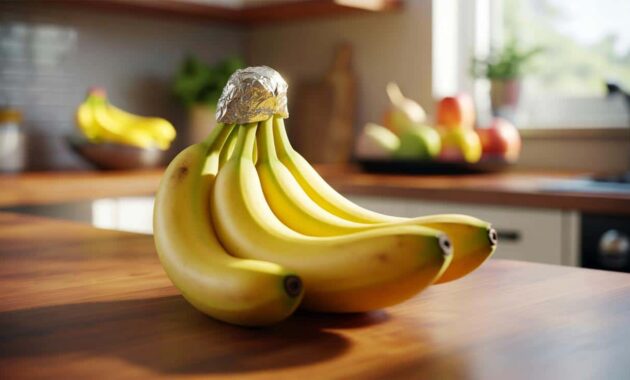
On the fruit shelf, the bananas always look so confident. Bright yellow, lined up like little suns. You pick a nice bunch, thinking it’ll last the week. Two days later, you find them covered in brown spots, soft at the tips, smelling a bit too sweet. The kids won’t touch them. You sigh and mentally throw a few euros in the trash. Again.
Then one day, you visit a friend and see something odd on her counter. A bunch of bananas, still perfectly yellow… with shiny aluminum foil wrapped around the stems. You laugh, a bit skeptical. She just shrugs and says, “Try it. You’ll see.”
A few days later, you’re still looking at those bananas. And your curiosity starts to itch.
Why bananas ripen so fast on your kitchen counter
Bananas are drama queens of the fruit bowl. One moment they’re firm and cheerful, the next they’re collapsing into banana bread material. The secret is in that little green or brown cluster where they’re attached: the stem. That’s where a gas called ethylene is produced, which tells the fruit to ripen.
When bananas sit together in a bunch, they kind of hype each other up with this gas. Ripen, ripen, ripen. The process snowballs and your “week’s worth” of fruit turns into a 48-hour countdown.
On a warm kitchen counter, things only speed up. You blink, and they’re already spotted.
One mother I interviewed had practically given up on buying bananas. She said they ripened so fast she could barely keep up with snack time. She’d buy a bunch on Monday, and by Wednesday they were only good for smoothies. Her kids loved them just at that perfect yellow stage, no freckles allowed.
Then she saw a video on social media about wrapping the stems in foil. Half amused, half desperate, she tried it. Same bunch size, same place on the counter, same week. But this time, by Thursday, her bananas were still firm and bright.
She didn’t turn into a food-storage guru overnight. She just stopped throwing away half the fruit she bought.
There’s a simple logic behind this little hack. The stem is like the command center of the banana. That’s where ethylene is released the most, then spreads down the fruit and to the neighbors in the bunch. By wrapping the stems in foil, you’re not magically freezing time. You’re just slowing the conversation between the bananas.
Less gas escaping, less chain reaction, less “overripe surprise” when you walk into the kitchen. It doesn’t stop ripening completely, nothing does. But it buys you those precious extra days when the banana is still creamy, not mushy.
*For a small roll of foil, that’s a fairly big payoff.*
The foil-around-the-stem trick, step by step
The method is surprisingly simple. You don’t need gadgets, special bags, or complicated routines. Take your bunch of bananas, as they come from the store. Dry the stems if they’re a bit damp. Then tear off a small piece of aluminum foil, about the size of your palm.
Wrap it snugly around the top cluster where the bananas join, like a little cap. You don’t need to mummify each stem separately unless the bunch is already breaking apart. Just cover that central “crown”.
Then place the bananas somewhere cool, away from direct sunlight, and not right next to other fruit bowls full of apples or ripe pears.
People often go overboard the first time. They wrap each banana individually, or cover half the fruit in foil, or keep moving the bunch from the fridge to the counter and back again. That’s when things get messy and disappointing.
The trick works best when you keep it simple and consistent. One wrap around the stems, one stable spot in the kitchen, and a bit of patience. Let the bananas do their slow thing.
Let’s be honest: nobody really does this every single day. But if you get into the habit when you unpack your groceries, it quickly becomes automatic.
There’s also a psychological side to this tiny gesture. When you wrap the stems, you’re basically telling yourself: “I intend to eat these, not throw them away.” It’s a small, quiet act that pushes back against food waste and frustration. You feel a little more in control of your kitchen, your wallet, and even your time.
“I thought it was one of those internet tricks that looks cute and changes nothing,” says Léa, 32, who started using foil on her bananas during a tight-budget month. “But at the end of the week, I had two bananas left that were still good. That never happened before. I know it’s just fruit, yet it made me feel like my home was finally a bit more under control.”
- Wrap only the stems, not the whole banana
- Keep the bunch away from apples and very ripe fruit
- Store at room temperature, not on a hot windowsill
- Use foil or cling film, but foil is easier to reuse
- Check them daily so you catch the perfect ripeness
Beyond the hack: what these small tricks change in daily life
Once you start paying attention to how fast bananas ripen, you often notice the rest of your kitchen differently. That forgotten cucumber at the back of the fridge. The bread that goes stale faster on humid days. The half lemon turning hard on the plate. These details aren’t dramatic on their own, yet they quietly nibble at your budget and your mental load.
The foil-on-the-stem trick is tiny, almost ridiculous in effort. But it creates a first crack in that “oh well, food waste just happens” mindset. You see results in three or four days. You buy a bunch on Sunday, and on Thursday you still have a nice yellow banana for breakfast. A small victory, yes, but a very concrete one.
We’ve all been there, that moment when you toss two overripe bananas in the bin and feel oddly annoyed with yourself.
| Key point | Detail | Value for the reader |
|---|---|---|
| Foil slows ripening | Wrapping stems reduces ethylene exposure | Bananas stay yellow and firm for several extra days |
| Simple daily gesture | Quick wrap of the crown when unpacking groceries | Less food waste and fewer last-minute “use it or lose it” snacks |
| Better storage habits | Keeping bananas away from heat and other ripe fruit | More control over ripeness, budget, and meal planning |
FAQ:
- Should I use foil or plastic wrap on banana stems?Both work, but foil is easier to shape, reuse, and remove. Many people find it more convenient on a daily basis.
- Does this trick stop bananas from ripening completely?No, it only slows the process. Your bananas will still ripen naturally, just at a more manageable pace.
- Can I put wrapped bananas in the fridge?You can once they’re at the ripeness you like. The peel may darken in the fridge, but the inside usually stays firmer and sweeter.
- Do I need to wrap each banana separately?Not usually. Wrapping the central crown where they join is enough, unless the bunch is already split into singles.
- How long will bananas last with foil on the stems?Results vary by season and room temperature, but many people gain between two and four extra days of good, yellow bananas.
➡️ China planted so many trees in the Taklamakan Desert that it now absorbs CO2