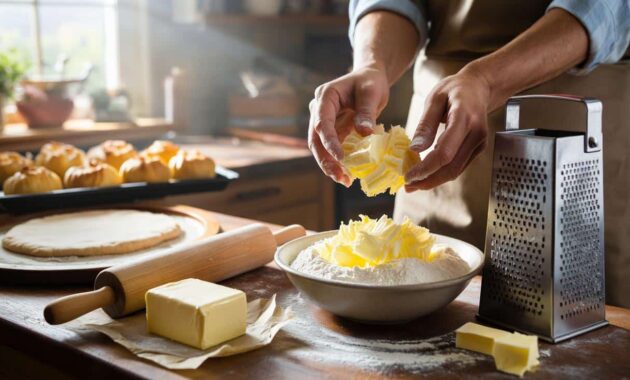
The kitchen was already too warm when the pastry dough started fighting back. The butter smeared into the flour like hand cream, my rolling pin glued to the counter, layers collapsing into one sad, beige sheet. The recipe photo promised a tower of flaky golden folds. My reality looked more like a damp pancake with dreams.
I scraped everything into the bin, half annoyed, half curious. How were people on Instagram casually whipping up croissants on a Tuesday night? What did they know that I clearly didn’t?
A few days later, a friend quietly slid a grater and a rock-hard stick of butter across my counter and said, “Freeze this first. Then try again.”
The dough that followed didn’t just behave.
It transformed.
Why frozen, grated butter changes everything
The first time you pull a tray of pastry from the oven after using frozen, grated butter, there’s a tiny moment of disbelief. The dough puffs. The edges blister and separate into visible layers. The surface looks almost like stacked tissue paper turning golden at the tips.
You haven’t become a professional baker overnight. You’ve just given butter a new job description.
Instead of smearing into the flour like lotion, it stays in hundreds of thin, cold shards. Each shred becomes a future air pocket, a small elevator ready to lift the dough.
Picture this: Sunday morning, you’re half awake, wearing the same T‑shirt you slept in, trying to roll out pie dough before the coffee even kicks in. The kitchen is warm, your hands are warm, the butter is soft. Within minutes, the dough is sticky, your patience is thinner than the crust, and you’re Googling “why is my pastry tough” with floured fingers.
Freezing and grating the butter throws a quiet reset into that scene.
You work faster because the butter stays cold longer. The dough feels cooler, cleaner, easier under the rolling pin.
There’s a simple reason this little hack works so well. Flaky pastry depends on contrast: cold butter and relatively warmer oven heat. Those thin shards of frozen butter stay intact as you mix and roll, staying discrete instead of dissolving into the flour.
When the pastry finally hits the oven, the water in those butter shards turns to steam. That steam pushes the dough layers apart, while the fat melts and coats them.
Result: stacked layers instead of dense, bread‑like crumb. *You’re not just making dough; you’re building tiny, edible architecture.*
How to freeze and grate butter for ultra‑flaky pastry
The method is almost embarrassingly simple. Start with unsalted butter straight from the fridge and cut it into sticks if it isn’t already. Wrap it and place it in the freezer for at least 30–45 minutes, until it’s firm all the way through but not a rock you can’t handle.
Grab the coarse side of a box grater and work quickly, grating the butter into a shallow bowl. Toss the curls lightly with a spoon to separate them, then slide the bowl back into the freezer while you scale your flour, salt, and any sugar.
When you’re ready, tip the icy shreds into your dry ingredients and toss like salad. Every pale strand should be lightly coated in flour, still cold and distinct.
This is where most pastry heartbreak starts: touching the dough too much, too long, too warmly. You don’t need to knead this like bread. You’re coaxing, not wrestling. Add your cold water gradually, turning the bowl, letting the flour and butter clump together into a rough mass. A few dry spots are fine; they’ll hydrate as the dough rests.
If the butter starts to soften or clump, pause and chill the bowl for ten minutes. No drama, no rush.
Let’s be honest: nobody really does this every single day. But on the days you do, the payoff is huge.
“I spent ten years blaming my oven for my flat pastries,” laughs Clara, a self‑taught baker who now teaches weekend workshops. “Turned out it was my butter. Once I started freezing and grating it, people thought I’d changed recipes. I hadn’t. I’d only changed temperature and texture.”
To lock this in, keep a simple mental checklist handy:
- Butter goes into the freezer before it goes into the dough.
- Grate on the coarse side only, and work fast.
- Chill everything again if the room feels warm.
- Handle the dough gently; stop as soon as it holds together.
- Rest the dough in the fridge before rolling, even if you’re in a hurry.
The quiet confidence of knowing your pastry will flake
There’s a small, private pleasure in sliding a tray of pastries into the oven and actually trusting what will come out. No bargaining with the timer, no peeking every two minutes, no last‑minute panic glaze to hide the flaws. Just calm expectation that the layers you built with that frozen, grated butter will do their job.
You notice other things too: the way the dough handles more cleanly, how your countertop looks less like a battlefield, how the kitchen smells as the butter melts between those thin sheets of flour. One small, low‑tech shift, and suddenly your kitchen feels like it’s on your side.
Some people bake to impress. Others bake to soothe themselves after a rough day. Either way, that first shattering bite of properly flaky pastry hits differently when you remember the messes that came before. You can almost taste all the failed pies and sad tarts that led you to this trick.
We’ve all been there, that moment when you stare at a dense crust and wonder if “flaky” is just food‑stylist fantasy.
Then you try frozen, grated butter once, and **the myth turns into muscle memory**.
➡️ Why people who apologize excessively are often carrying unseen pressure
➡️ A gardener explains how rainwater collection reconnects humans with cycles of renewal and patience
➡️ A breakthrough injection for head and neck cancers: promise of a therapeutic turning point
You might start small: a rustic galette, a simple cheese straw, a batch of rough‑puff sausage rolls. The kind of things that forgive imperfect shapes but celebrate great texture. Over time, this little butter ritual sneaks into your habits. A stick goes into the freezer while you clear the table. The grater lives a bit closer to the flour jar.
What began as a hack becomes a quiet kind of kitchen knowledge, the sort you don’t brag about but pass on casually, the way someone passed it on to you.
One day, you’ll be the person sliding a grater across a counter and saying, almost casually, “Freeze this first.”
| Key point | Detail | Value for the reader |
|---|---|---|
| Frozen butter stays in layers | Grated shards remain solid as you mix and roll, creating pockets between dough sheets | Leads to higher rise, visible flakiness, and lighter texture |
| Temperature buys you time | Colder fat melts more slowly, so you can work without rushing or overheating the dough | Reduces stress, less chance of tough, greasy pastry |
| Simple gear, big result | Uses a basic box grater and a home freezer, no special tools or pro skills needed | Makes bakery‑style pastry feel reachable for everyday home cooks |
FAQ:
- Question 1Can I use salted butter instead of unsalted for grating and freezing?Yes, you can, but reduce or omit the added salt in your recipe. Unsalted gives you more control over seasoning.
- Question 2How long can I keep grated butter in the freezer?Spread it in a thin layer in a sealed container and you can keep it for up to a month. Break it up before using if it clumps.
- Question 3Do I need to change the amount of butter when I grate it?No, the quantity stays the same. Only the shape and temperature change, not the weight.
- Question 4Will this method work for puff pastry and croissants?It helps for “rough puff” styles and quick laminated doughs. Traditional croissants still rely on block butter lamination, but grated butter is a great training step.
- Question 5My grated butter melts while I work. What should I do?Pop the bowl, and even your rolling pin, back into the fridge or freezer for 10–15 minutes. **Cold pauses are part of the process, not a failure.**