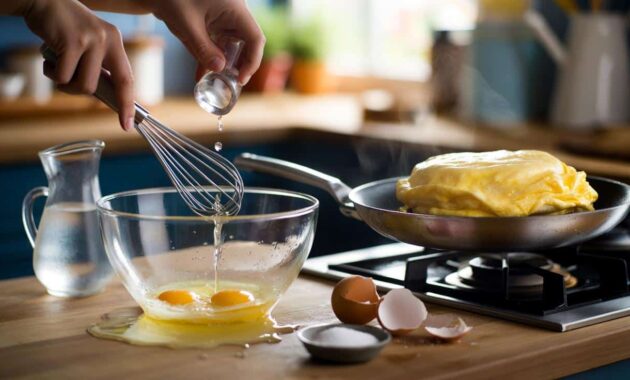
The pan is already too hot and the coffee is going cold. You crack two eggs into a bowl, grab a fork, and start whisking like you’ve done a thousand sleepy mornings. The omelet sticks. It comes out a bit dense, a bit rubbery, and you silently blame the pan, the eggs, the universe. Then one day, you watch someone in a tiny café kitchen casually pour a splash of cold water into their eggs. Whisk, whisk, into the pan… and the omelet puffs up like a yellow cloud.
You taste it and think: wait, how is this the same food?
Why a few drops of water change everything
There’s a strange moment the first time you see someone pour cold water into raw eggs. Your brain says, “That’s going to water it down.” Your mouth, a few minutes later, totally disagrees. Instead of a flat yellow sheet, the omelet billows, lifts, almost quivers when you slide the fork in.
It feels less like breakfast and more like a quiet magic trick.
Picture a small neighborhood diner at 8:30 a.m. The cook moves fast, one hand on the pan, the other on a metal bowl. Three eggs, a pinch of salt, then a short glug of cold water straight from a jug. He doesn’t measure, just knows. He whisks for maybe ten seconds, no more, and the mix turns pale and foamy.
A few minutes later, plates land on the counter. People who look half-awake take a bite and suddenly slow down. The omelet folds over on itself like a soft pillow, not a stiff envelope.
There’s real science behind that small, almost lazy-looking gesture. Eggs are mostly water and protein. When you whisk them, you trap tiny air bubbles inside, and those bubbles expand with heat. Adding cold water increases the steam that forms as the omelet cooks, lifting those bubbles and stretching the protein network.
What you get is less dense egg and more airy structure, the cooking equivalent of switching from a brick to a sponge.
The right way to add cold water to your eggs
The basic move is disarmingly simple: for each egg, add about a teaspoon of cold water. Not milk, not cream, plain cold water from the tap or fridge. Crack the eggs in a bowl, add salt, then the water.
Whisk with energy, not forever. Ten to fifteen seconds is enough to blend yolks and whites and pull in air without breaking everything down into a thin liquid.
Most home cooks either don’t add anything or they drown the eggs in milk. That’s when the omelet turns a bit tough or leaks liquid on the plate. The sweet spot is small: too much water and your eggs collapse, too little and nothing really changes.
➡️ France delivers a 500-tonne steel giant to power the UK’s new Hinkley Point C nuclear reactor
➡️ Elon Musk fired so many staff he had a 20-year-old student train an entire AI engineering team
➡️ The unnoticed benefit of predictable daily patterns
We’ve all been there, that moment when you flip an omelet and half of it tears or turns into scrambled eggs on contact with the pan.
There’s also the heat question. Start with a pan that’s hot enough to melt butter and bubble gently, not smoking like a grill. Pour your whisked eggs in one confident move, then lower the heat slightly. This gives the water inside time to turn to steam, pushing up the egg before the underside goes brown and hard.
*The trick is not just adding water, it’s giving that water the chance to become your secret leavening agent.*
- Use 1 teaspoon cold water per egg
- Whisk briskly for 10–15 seconds, no more
- Start hot, then lower the heat after you pour
- Stop cooking while the top is still just slightly moist
- Let the omelet rest 20–30 seconds before cutting in
What’s really happening inside that fluffy omelet
Think of an egg as a suitcase full of tightly folded proteins. When you apply heat, those proteins unfold and link together, forming a network that traps water and air. Cold water subtly changes that game. As the temperature in the pan climbs, that water flashes into steam and pushes on the softening protein web from the inside.
That’s why the omelet looks taller, and why your fork glides through instead of bouncing off.
There’s another detail: whisking. Not just stirring, but really beating the mixture until it lightens in color. Each stroke pulls air into the eggs, and that trapped air teams up with the steam from your added water. The more tiny bubbles, the more places for the steam to expand.
Let’s be honest: nobody really does this every single day. On rushed mornings, you’ll just crack, stir twice, and hope for the best.
Still, even on tired days, that teaspoon of water is an easy win. It doesn’t cost you flavor and doesn’t turn your omelet “watery” when you hit the right dose. Instead, it stretches the proteins so they don’t clench so hard around the heat. That’s what makes an omelet tender instead of squeaky.
The difference is subtle on paper, but on the plate, it feels like you suddenly upgraded your everyday eggs to something you’d expect in a small Paris hotel.
| Key point | Detail | Value for the reader |
|---|---|---|
| Cold water adds steam | About 1 tsp per egg turns to steam during cooking | Lighter, puffier omelets without extra ingredients |
| Proper whisking traps air | Short, energetic whisking creates tiny bubbles | Softer texture and more volume from the same eggs |
| Controlled heat finishes the job | Hot pan to start, then slightly lower heat | Prevents rubbery eggs and keeps the inside tender |
FAQ:
- Question 1Will adding water make my omelet taste bland?
- Answer 1No. The amount of water is small and only affects texture. Season with salt, pepper, herbs, or cheese for flavor.
- Question 2Can I use sparkling water instead of still water?
- Answer 2Yes, a splash of sparkling water can add even more lightness, though the effect is subtle and the bubbles fade quickly.
- Question 3Is cold water really better than room-temperature water?
- Answer 3Cold water slightly delays the cooking of the proteins and gives more time for steam to form, which helps with fluffiness.
- Question 4What if I already add milk or cream to my eggs?
- Answer 4You can still add a small splash of water, but reduce the dairy a bit. Too much liquid can make the omelet collapse.
- Question 5Does this trick work for scrambled eggs too?
- Answer 5Yes, the same principle applies. A little cold water makes scrambled eggs softer and lighter when cooked gently.