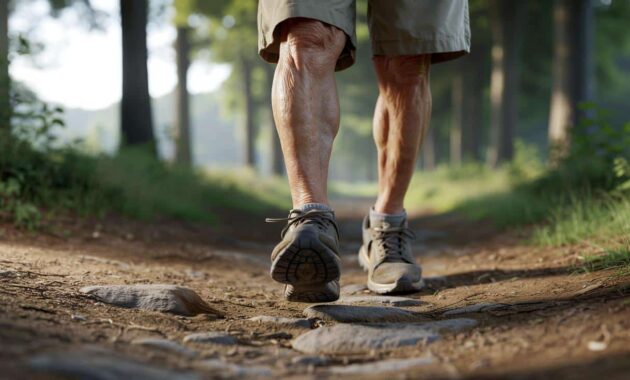
The first time it really scared me, I was walking on a forest path I’ve known for years. Same trees, same roots snaking across the ground. Except that day, at 63, each little stone felt like a trap door. My right foot slipped sideways on a patch of loose dirt, and my whole body jolted like someone had yanked a cable. I didn’t fall, but my heart hammered as if I’d just stepped off a moving train.
I stood there, pretending to admire the view, when really I was wondering: when did the ground start feeling so unreliable?
The path hadn’t changed.
My feet had.
When the world starts feeling uneven under your feet
You notice it first on the harmless stuff. A curb that seems a little higher than last year. A sloping driveway that demands your full attention. The tiled floor at the supermarket that suddenly feels a bit too shiny under your soles. You don’t tumble. You just… hesitate.
At 63, that hesitation becomes its own kind of companion. You slow down slightly, test the ground with your toes, adjust your steps like you’re walking on a wet deck. Nobody else sees it. Yet inside, you’re running silent calculations with every stride.
One man I spoke to, Alain, 67, told me about the day he realized something had shifted. He was on holiday with his grandchildren, walking along a rocky beach. The kind of place where children run barefoot with zero fear. He took three steps on the pebbles and felt his ankles wobble like jelly.
The kids hopped from rock to rock. Alain watched them from a safe patch of sand, pretending his back hurt. On the drive home, he confessed to his wife that he no longer trusted his feet. Not the muscles. Not the reflexes. Not the messages coming up from the soles.
That feeling has a technical name: sensory decline. Sight gets a bit fuzzier, hearing softens at the edges, and the nerves in our feet send slower, weaker signals. The balance system in the inner ear ages too, like an old gyroscope that needs more time to stabilize.
Put all that together and an uneven pavement becomes a puzzle your brain has to solve in real time. The information arrives late, the adjustments are slower, and the margin for error shrinks. You’re not suddenly clumsy. Your body is just working with a thinner safety net.
What you can actually do when the ground no longer feels friendly
The first small change often starts with a ridiculous-looking exercise: standing on one leg while brushing your teeth. It sounds silly, almost childish. Yet that tiny daily wobble session quietly trains the entire balance system. The foot muscles wake up. The ankle reacts faster. The brain relearns the micro-corrections that keep you upright on gravel, grass or cobblestones.
➡️ Neuroaesthetics revealed: brain science behind what we find beautiful
➡️ I made this dish when I was tired and it still delivered
➡️ This 12-Minute Teriyaki Salmon Bowl Makes a Perfect Quick Lunch
➡️ “I Make It In 10 Minutes For The Whole Family”: My Ultra‑Easy Leek, Apple And Bacon Skillet
➡️ Why unresolved emotional tension drains motivation silently
➡️ What it really means when someone walks ahead of you, according to psychology
➡️ Goodbye microwave: here’s the appliance that will replace it, and it’s much better
You can build from there. Walking barefoot at home on different surfaces. Practising slow heel-to-toe walking along a hallway. Spending 30 seconds with eyes closed, feet hip-width apart, just noticing the micro-sways of your body. None of this is glamorous. All of it is deeply effective.
Most people wait for a “serious” fall before they change anything. That’s the trap. By then, fear has already moved in and unpacked its suitcase. You start avoiding slopes, parks, old town centers with uneven stones. The world shrinks a little each week.
The gentle work needs to start earlier, in that quiet phase where you just feel slightly less steady. Looser shoes, worn soles, or carpets that fold at the edges don’t help either. Let’s be honest: nobody really inspects every pair of shoes and every rug in the house as if it were a safety plan. Yet one small change there can give you back a surprising sense of freedom.
At some point, you also need to say the thing out loud.
“I don’t feel stable on uneven ground anymore.”
The day you can tell a doctor, a physiotherapist, or even just a close friend that sentence without embarrassment, something important shifts. You move from quietly enduring to actively responding.
- Get your feet checked – A podiatrist can spot lost sensation, bad pressure points, or shoes that betray you at the worst moment.
- Train balance like a muscle – Short daily sessions beat occasional heroic workouts by a mile.
- Use your eyes on purpose – Scan ahead for changes in texture: gravel, grass, wet tiles, loose soil.
- Respect fatigue – Unsteady feet get worse when you’re tired, hungry, or mentally overloaded.
- Talk about it early – Naming the problem is not weakness. It’s your entry ticket to solutions.
Living with changing senses without giving up on the path
There’s a quiet grief that comes with sensory decline. You don’t wake up one morning “old”. You just realize, piece by piece, that your body no longer runs in the background like it used to. The light is harsher at dusk, voices blend in restaurants, and forest paths demand a level of concentration that used to be reserved for work meetings. *You start choosing routes not for their beauty, but for their flatness.*
Yet this same awareness can open a different way of moving through the world. Slower, yes. But more attentive. More deliberate. More honest about what your body needs on any given day.
We’ve all been there, that moment when you pretend you’re “just tired” while your brain is actually calculating every step. The pride is real. The fear too. You don’t want to be the person everyone waits for on a hike, or the one who clings to the rail on the stairs. You don’t want to give up spontaneity, or that simple pleasure of walking on a beach without a second thought.
Yet the body rarely responds well to denial. It responds to training, to small adjustments, to kindness. It responds to being listened to, rather than being pushed or ignored.
Some people find their own rituals. One woman I met wears slightly heavier walking shoes on rough ground, because she feels them anchor her better. Another always walks with a lightweight hiking pole on holidays, not as a symbol of frailty, but as a trusted third leg when trails get tricky. Someone else swears by tai chi, that slow choreography that quietly rewires balance with each shift of weight.
The question isn’t “How do I stop aging?” That battle is lost from the start. The real, daily question is: *how do I stay in conversation with my senses as they change?* Your feet, your eyes, your inner ear – they’re all sending new versions of old messages. Some softer, some slower, some slightly garbled. What you build between those signals and your choices on the ground will decide which paths you keep, and which ones you let go. For some, that’s the hardest part to admit. For others, strangely, it becomes a new way of paying attention to life itself.
| Key point | Detail | Value for the reader |
|---|---|---|
| Early sensory changes matter | Subtle wobbling or hesitation on uneven ground is often the first sign of declining sensory input from feet, eyes and inner ear | Helps readers recognize the issue before a serious fall and act sooner |
| Small daily habits | Simple balance exercises, better footwear, and safer home environments build stability over time | Offers concrete, realistic actions that fit into everyday life |
| Speaking up is a tool | Openly mentioning unsteadiness to professionals and loved ones unlocks tailored support and reduces silent fear | Encourages readers to move from shame and avoidance to solutions and shared understanding |
FAQ:
- Question 1Why do my feet feel less stable now even though I haven’t injured myself?
- Answer 1With age, the nerves in the feet can lose sensitivity, muscles around the ankles weaken, and balance systems in the inner ear slow down. The result is a vague sense of “wobbliness” on uneven ground, even without a clear accident or disease. It’s usually a combination of small changes, not one dramatic cause.
- Question 2Is this unsteadiness just “normal aging” that I have to accept?
- Answer 2Some sensory decline is common, but the level of impact is not fixed. You can’t rewind the years, yet you can strengthen muscles, retrain balance, choose better shoes, adjust your environment, and reduce the risk of falls. Acceptance doesn’t mean passivity; it means working with the body you have today.
- Question 3What kind of specialist should I see if I feel insecure on uneven ground?
- Answer 3A good starting point is your general practitioner, who can rule out medication side effects or underlying conditions. From there, you might be referred to a physiotherapist for balance and strength training, a podiatrist for foot and shoe assessment, or an ENT specialist if vertigo or dizziness are present.
- Question 4Can simple exercises at home really change anything at my age?
- Answer 4Yes, they can. Research shows that targeted balance and strength exercises improve stability well into the 70s and 80s. Short, regular sessions are more effective than occasional intense efforts. Think minutes, not hours: standing on one leg, heel-to-toe walking, and gentle calf and ankle work all add up over time.
- Question 5How do I handle the fear of falling without stopping activities I enjoy?
- Answer 5Start by adapting rather than cancelling. Choose safer shoes, use a walking pole on rough terrain, go out with someone you trust, and gradually re-expose yourself to more challenging surfaces. Working with a physiotherapist can rebuild confidence. Fear is a signal, not a sentence; it’s there to be listened to, then negotiated with, step by step.