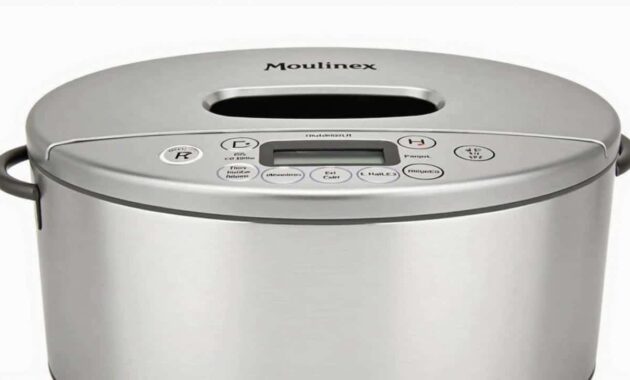
Into this context steps a discounted bread maker from Moulinex that promises more than just a basic loaf, targeting home cooks who want versatility without spending a small fortune. The Pain & Plaisir model, currently on offer on Amazon France, mixes, kneads and bakes a surprising variety of recipes with minimal hands-on work.
A family bread maker that goes far beyond a classic loaf
The Moulinex Pain & Plaisir is positioned as a compact, family-friendly bread maker capable of baking up to 1 kg of bread in one cycle. That size suits households that get through several slices every morning or like to batch-bake for the week.
At the time of writing, the model is listed at €119.99 on Amazon, down from a usual price of €159.99. That represents a 25% reduction, which places it in a competitive bracket against many entry- to mid-range bread makers.
Seventeen automatic programs, including gluten-free settings, aim to take the guesswork out of homemade bread and dough.
Moulinex has equipped the appliance with an LCD control panel on the top, using clearly labelled buttons and a small screen. Settings are chosen via pre-programmed options rather than manual temperature or time entry, making the machine approachable for beginners.
Seventeen programs for bread, cakes and more
Where older bread makers often stopped at standard white or wholemeal loaves, this model tries to be an all-round baking assistant. Moulinex’s 17 automatic programs cover several categories of preparation.
- Classic breads (white, country-style, wholemeal)
- Sweet recipes (brioche, cakes)
- Doughs (pizza, rolls, specialty breads)
- Gluten-free options for bread and bakes
- Jam and similar preparations
The user places ingredients in the non-stick pan, chooses a program and loaf size, and then lets the machine handle kneading, rising time and baking. The idea is to condense bakery-style processes into a single push-button device that can run unattended.
For households juggling work, school runs and evening activities, the ability to automate dough preparation can be as useful as the baking itself. Pizza night, for example, becomes less about planning dough the day before and more about pressing a button after breakfast.
Adjustable capacity and crust colour
Capacity is one of the key choices when buying a bread maker, and here the Pain & Plaisir offers three loaf sizes: 500 g, 750 g and 1 kg. That flexibility helps reduce waste for smaller households while still catering for larger families when needed.
➡️ In your fifties, weight loss also reshapes the brain
➡️ How boiling orange peels instantly freshens the whole house and leaves a long-lasting natural scent
➡️ Neither shampoo nor chemicals: how rye flour can change your hair care routine forever
➡️ After five centuries, the geometric riddle of the Vitruvian Man finally gets a mathematical answer
➡️ Danville Police Dept. warns public of extremely dangerous armed subjects
| Loaf size | Ideal for |
|---|---|
| 500 g | Singles or couples, occasional consumption |
| 750 g | Small families, regular breakfast bread |
| 1 kg | Larger households or batch baking |
The machine also offers several crust settings so users can choose between a lighter, softer finish or a darker, crunchier crust. That might sound like a minor tweak, but it can make a real difference when catering to different expectations at the same table.
The appliance lets you choose loaf weight and crust level, aligning each bake with your household’s tastes.
Gluten-free programs for specific diets
One of the more notable aspects of this Moulinex model is its focus on gluten-free baking. The bread maker includes three programs dedicated to gluten-free recipes, an area where texture and structure can be hard to master by hand.
Gluten-free doughs need different kneading and rising times because they lack the elasticity that wheat gluten provides. Pre-set cycles are designed to compensate for this, helping beginners obtain a decent loaf without extensive experimentation.
For families where only one person is gluten-intolerant, the machine can alternate between standard breads and gluten-free recipes by changing programs and carefully cleaning the pan, paddles and surrounding area. While that does not prevent every trace of cross-contamination, it can still reduce reliance on expensive specialist bakery products.
Timed starts, keep-warm mode and safety touches
Beyond recipes, a big part of this product’s appeal lies in its scheduling and safety functions. A delayed start of up to 15 hours lets owners load ingredients in the evening and time the bake so that the loaf finishes just before breakfast or a late return from work.
With its 15-hour delayed start, the Pain & Plaisir can deliver a freshly baked loaf right when you walk into the kitchen.
Once baking is complete, a keep-warm function maintains the bread at serving temperature for around an hour. For families that do not all eat at the same time, this can avoid that awkward window where bread cools down and the crust softens too quickly.
Moulinex has also included so‑called “cool-touch” walls. The exterior casing is designed to remain relatively cool while the internal baking chamber reaches high temperatures. That feature can reassure parents with young children who might reach up to the counter.
Cleaning and footprint on the worktop
On the practicality front, the appliance comes with a removable pan and kneading paddles, both coated with a non-stick layer. These parts are dishwasher-safe, which helps when dough sticks or jam preparation leaves sugary residues.
The machine is finished in black with a red trim, aiming for a more modern look than the beige boxes that dominated early bread-making devices. Its relatively compact design means it is more likely to fit on a standard worktop without monopolising space.
The included recipe booklet provides guidance on ingredient quantities and program selection. For beginners, that written support can shorten the learning curve and reduce the chance of dense, under-risen loaves in the first attempts.
How the discount changes its value proposition
Before the price cut, the Moulinex Pain & Plaisir sat in a segment where buyers had to choose between brand reassurance and aggressive pricing from lesser-known names. With a quarter knocked off its price on Amazon, that balance shifts.
At €119.99, the machine lands in a zone where some shoppers might previously have opted for more basic models with fewer programs. The presence of 17 automatic settings, gluten-free cycles and delayed start makes it more tempting for those willing to pay slightly more for extra comfort.
That said, potential buyers still need to weigh up how often they will use it. If bread making ends up as a once-a-month novelty, even a discounted price can feel like a poor investment, especially in smaller kitchens where cupboard space is limited.
Practical scenarios: when a bread maker pays off
For households that buy fresh bread daily, running a few rough calculations can help. Imagine a family spending around €1.50 per day on bakery bread. Across a month, that reaches about €45. Flour, yeast, salt and electricity for a homemade loaf generally cost significantly less per unit, depending on the ingredients chosen.
Over several months, the difference in cost between commercial bread and homemade loaves can gradually offset the cost of the machine. The balance tilts further in favour of the appliance when using it for pizza dough, cakes or brioches that would often be purchased at a premium from bakeries.
There are non-financial aspects too. Some users value the ability to control exactly what goes into their bread: salt levels, type of flour, seeds, oils and sugar. Those watching additives and emulsifiers often appreciate a short ingredient list they can pronounce.
Key terms and tips for first-time bread makers
New owners sometimes feel lost with technical vocabulary. A few concepts make the programs easier to understand:
- Kneading: The mechanical mixing and stretching of dough that develops structure. The machine handles this with its paddles.
- Proofing or rising: The resting period when yeast produces gas, causing the dough to expand.
- Hydration: The ratio of water to flour, which influences crumb texture. Recipe booklets usually fix this for you.
- Crust level: A setting that tweaks baking duration and temperature near the end to adjust colour and crunch.
For those starting out, experts often recommend using strong bread flour rather than generic multipurpose flour, measuring ingredients with digital scales, and avoiding opening the lid during proofing. Consistency in measuring water and yeast also makes program timings more reliable.
Combining a bread maker like the Moulinex Pain & Plaisir with basic pantry planning can change weekday meals. A Sunday batch of pizza dough, a midweek brioche for breakfast and a Saturday gluten-free loaf are all realistic routines when the machine shoulders most of the labour. The current Amazon discount simply makes that shift into home baking slightly easier to justify for hesitant buyers.