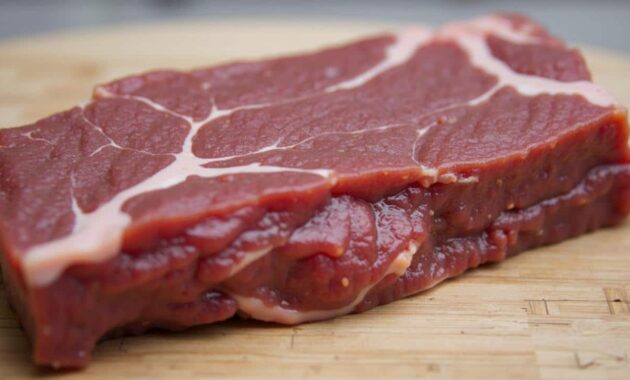
The butcher shop was almost empty, late on a rainy Tuesday, when I first heard someone order “beef shank for stew, with the marrow bone in.”
The request sliced through the quiet hum of the saw and the thud of knives on wood. The butcher looked up, actually smiled, and walked straight to a part of the counter most people never look at. The meat he pulled out wasn’t glamorous. No deep ruby steaks, no thick rib roasts. Just a rough-looking piece, streaked with sinew and wrapped around a round, pale bone.
Five minutes later, that customer walked out with a heavy bag and a secret I didn’t know yet.
A secret that turns cheap stew into something that tastes like Sunday at your grandmother’s table.
The humble cut hiding in plain sight at the butcher’s counter
Most of us walk into the meat aisle with tunnel vision. We reach for the same plastic trays every time: diced beef labeled “for stew,” maybe some mince, maybe a pack of chicken thighs. The tough-looking pieces, the ones with strange bones and silver skin, stay on the side, silently waiting for the few who know what they’re really worth.
Ask any old-school butcher, though, and they’ll nudge you toward the same thing: beef shank, the cross-cut slice of the animal’s leg that looks almost too gnarly to be good.
That’s the cut that quietly changes everything.
One London butcher told me he can almost guess who knows how to cook just by what they order. Young couples, he said, grab lean cubes from the fridge. “They want fast, tidy, low effort.” Older customers, or people who clearly grew up with slow-cooked meals, come straight to the counter and ask for shank, or for “a bit of leg with the marrow bone.”
He told me about a woman who feeds a family of five on a single kilo of beef shank. Long simmer, lots of vegetables, a handful of lentils. “They come back and tell me it tastes like restaurant food,” he shrugged, like this was the most obvious thing in the world.
The funny part? Shank is still often cheaper than the pre-cut “stew beef” sitting right next to it.
Why does this overlooked cut transform a basic stew so dramatically? It comes down to structure. The leg works hard all the animal’s life, so the meat is full of connective tissue and tendon. That’s exactly what makes it tough when cooked fast, and luxuriously silky when left to bubble away slowly. As it cooks, the collagen melts into gelatin, thickening the broth naturally.
The bone in the center, ringed with marrow, adds even more depth. You’re not just cooking meat. You’re slowly extracting flavor and texture into the entire pot.
*That’s why a stew made with shank tastes like it cost twice as much as it did.*
How to use beef shank to turn budget stew into a rich, slow-cooked feast
Here’s how a butcher will quietly tell you to handle beef shank if you ask. First, choose cross-cut shank pieces about 3–4 cm thick, with the bone in the middle and plenty of meat around it. You can use one thick slice per person, or mix one or two slices into a regular pot of diced beef to upgrade the whole thing.
At home, pat the shank very dry, salt it well, and brown it slowly in a heavy pot with a bit of oil. Don’t rush this step. Let both sides take on a deep, dark crust. That color you’re building on the bottom of the pan is pure flavor.
Once it’s golden, only then do you add your onions, garlic, and vegetables.
This is where most people feel they’re “doing something wrong.” They buy a cheap cut, cook it for an hour, taste it, and find it chewy. So they give up and say, “I guess I’m just bad at stews.”
The truth is almost boring: the meat simply hasn’t had enough time. Beef shank needs a gentle simmer, covered, for at least two and a half hours, sometimes three, sometimes more. At 60 minutes, it’s rubbery. At 120, it’s getting there. Somewhere after that, the magic happens.
Let’s be honest: nobody really does this every single day. But on the nights you can, it pays you back with leftovers that taste even better the next day.
Your butcher will often light up if you ask, “What’s your favorite way to cook shank?” One French butcher I spoke to didn’t hesitate.
“People think the expensive cuts are the best,” he said, trimming a thick piece of shank. “The best cut is the one that forgives you. Shank forgives you. You can let it bubble for hours. It just gets better.”
Then he scribbled a quick list on brown paper — barely a recipe, more like a roadmap:
- Brown shank in oil, both sides, until deeply colored.
- Add onions, garlic, and a carrot or two; cook until soft.
- Deglaze with a splash of wine, beer, or just water.
- Cover with stock or water, add bay leaf and thyme.
- Simmer on low heat, lid on, for 2.5–3 hours, until the meat surrenders.
He tapped the paper and said, “This is cheaper than a takeaway. But you’ll remember it longer.”
➡️ Goodbye olive oil : the healthiest and cheapest alternative to replace it
➡️ How rotating your mattress every 6 months can reduce hidden sleep issues
➡️ Your favorite color says a lot about you : what color psychology suggests
➡️ This baked recipe is perfect when you want something steady
Why this “poor” cut feels like a small act of quiet luxury
There’s something almost subversive about turning an inexpensive, overlooked cut into the dish everyone talks about. You’re not buying the show-off steak. You’re buying time, patience, and a deeper kind of flavor. When you ladle a glossy, rich stew onto the table and people mop up the sauce with bread in complete silence, you feel that rare satisfaction of having stretched a small budget into something generous.
We’ve all been there, that moment when you think, “I can’t afford to cook something impressive this week.” Then a pot of long-simmered shank proves you wrong.
It doesn’t scream luxury, but it quietly behaves like it.
| Key point | Detail | Value for the reader |
|---|---|---|
| Choose beef shank with bone | Cross-cut slices from the leg, with a central marrow bone and visible connective tissue | Access to deeper flavor and natural thickening without buying pricier cuts |
| Cook low and slow | At least 2.5–3 hours of gentle simmering, covered, after thorough browning | Transforms tough, cheap meat into tender, silky stew that tastes “restaurant-level” |
| Use the butcher as a guide | Ask for shank, stew tips, and cooking times tailored to the cut and your budget | Reduces guesswork, food waste, and frustration while boosting everyday cooking confidence |
FAQ:
- Is beef shank the same as “stew beef”?Not exactly. “Stew beef” is usually a mix of trimmings and random cuts, often too lean. Beef shank is a specific, hard-working leg cut with bone and connective tissue that melts into the sauce, giving you far better texture and flavor.
- Can I use beef shank in a slow cooker?Yes, it’s perfect for it. Brown the shank well in a pan first, then transfer to the slow cooker with vegetables and liquid. Cook on low for 8–10 hours until the meat is completely tender and falling off the bone.
- Do I need to remove the bone before serving?You can serve the shank whole, with the bone in, for a rustic look, or remove the bone and shred the meat into the sauce. The bone’s job is mostly done during cooking, when it releases flavor and marrow.
- How do I know when beef shank is ready?Forget the clock and test with a fork. When you can slide a fork into the meat and it pulls away in soft strands with almost no resistance, it’s done. If it’s still chewy, it simply needs more time.
- Is beef shank good for freezing?Very good. Cooked shank stew actually improves after a day or two, and it freezes well in portions. Cool it fully, pack in airtight containers, and freeze for up to three months for quick comfort meals.