There’s a way out.
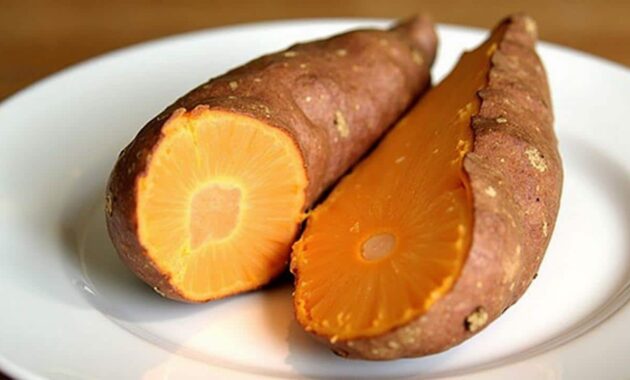
You don’t need to fire up the oven for nearly an hour to get soft, caramel-scented sweet potato flesh. With a standard microwave, a plate and a fork, you can turn a whole sweet potato into something spoon-tender in about the time it takes to scroll your phone. And there’s real food science behind this shortcut, not just a hack from social media.
Why sweet potatoes respond so well to the microwave
The microwave doesn’t just heat food from “the inside out”, as people often say. It targets water molecules inside the food, making them vibrate extremely fast. That vibration turns into heat.
Sweet potatoes are naturally rich in water, sitting at roughly three-quarters moisture. That makes them prime candidates for microwave cooking. When the waves hit, the water locked inside the dense flesh heats up quickly, softening the interior long before the outside has a chance to dry out.
Because a sweet potato contains so much water, the microwave turns it into its own mini steam oven, cooking it in its “own juices”.
This matters for nutrition too. Research from institutions such as Harvard Medical School has pointed out that fast cooking with very little added water tends to keep more vitamin C and antioxidants intact. When you boil a sweet potato, many of those water‑soluble nutrients leach into the cooking water you later pour away. In the microwave, most of them stay in the flesh you actually eat.
The 6-minute method for a whole sweet potato
This technique works best with a medium-sized sweet potato, about 250–300 g, with unbroken skin. That size cooks evenly without turning the ends stringy or leaving the centre underdone.
Step-by-step: from raw to meltingly soft
- Rinse the sweet potato under cold water and scrub off any dirt.
- Do not dry it completely: a thin film of surface moisture helps form steam.
- With a fork, pierce the skin 5–6 times, going about 1 cm deep each time.
- Place it on a microwave-safe plate.
- Cover with an upturned microwave-safe bowl, lid, or a sheet of damp kitchen paper.
- Microwave at high power (around 900 W) for 3 minutes.
- Turn the sweet potato over.
- Microwave again for 3 minutes on the other side.
Those fork holes work like tiny safety valves, so steam can escape gradually instead of building pressure and bursting the skin.
When the 6 minutes are up, resist the urge to cut into it straight away. Leave the sweet potato to rest on the plate, still covered, for about 2 minutes. Heat continues to travel from the hotter outer layers towards the centre. This short pause finishes the cooking gently and evens out the texture.
You can test doneness by pressing lightly on the middle. It should give easily, as if you were pressing on a very ripe avocado. A knife inserted into the thickest part should slide in with almost no resistance.
➡️ Restoring sight without major surgery: the quiet revolution behind a new clear eye gel
➡️ 3 ingredient microwave cake recipe: the 10 minute chocolate fix everyone’s arguing about
➡️ The return of the aircraft carrier Truman, a signal badly received by the US Navy facing future wars
What happens inside while it cooks
As the temperature rises towards just under 100°C, the starch in the sweet potato starts to gelatinise. That means the starch granules absorb water, swell up and turn from chalky to creamy. At the same time, pectins in the cell walls soften. This is what transforms the raw, firm tuber into that smooth, silky interior people love.
One thing the microwave does not do is brown the surface. For that you would need temperatures closer to 140°C or more, where the Maillard reaction kicks in and generates those toasted, caramel-like flavours. Since a microwave largely tops out around the boiling point of water, it can’t provide that by itself.
How to add a quick crispy finish
If you like a contrast between crunchy edges and soft flesh, you can add a one-minute step on the hob:
- Slice the cooked sweet potato in half lengthways.
- Heat a small knob of butter or a drizzle of oil in a hot frying pan.
- Place the cut sides face down in the pan.
- Leave them without moving for 30–60 seconds until the surface turns golden.
This quick sear brings some nutty flavour and texture, while the inside stays moist and tender thanks to the fast microwave cooking you already did.
Think of the microwave as the “engine room” that cooks the inside, and a hot pan as the finishing tool that adds flavour on the outside.
Timings, wattage and how to adapt the method
Not all microwaves are created equal, and neither are all sweet potatoes. A tiny, skinny tuber will be ready quicker than a hefty, football-shaped one. Power settings vary too.
| Microwave power | Medium sweet potato (250–300 g) | Larger sweet potato (350–450 g) |
|---|---|---|
| 900 W | 3 min + 3 min, then 2 min rest | 4 min + 4 min, then 2–3 min rest |
| 700–800 W | 4 min + 3 min, then 2 min rest | 4 min + 5 min, then 3 min rest |
Treat these figures as a starting point. If you cut into the sweet potato and find a firm core, just microwave in 30-second bursts, checking between each round. The good news: because the skin keeps the moisture in, it’s quite forgiving. You have a bit of margin before it dries out.
Nutrition, glycaemic impact and when to use this trick
Sweet potatoes have a reputation as a healthier carbohydrate, and the cooking method can influence that reputation. Shorter cooking times, especially without a water bath, tend to keep more of the naturally occurring antioxidants, such as beta-carotene. The orange-fleshed varieties are particularly rich in this vitamin A precursor.
There is also the question of glycaemic response, the way your blood sugar reacts to a meal. Very long cooking can break down more starch into simple sugars, nudging the glycaemic index upwards. Rapid, gentle heating in the microwave may moderate this a little, though the overall effect also depends on portion size and what you eat alongside.
Pairing your microwaved sweet potato with protein, fat and fibre – think beans, yoghurt or leafy greens – helps smooth out blood sugar swings.
For busy evenings, this method solves a common timing problem. Instead of starting dinner 45 minutes early so the oven can do its work, you can slot the sweet potato into the last stages of cooking. While it rotates in the microwave, you have just enough time to fry an egg, mix a yoghurt sauce or assemble a quick salad.
Ideas for toppings and simple meal combinations
Once you have that perfectly cooked base, most of the fun comes from what you put on top. A few combinations work especially well with the naturally sweet flesh:
- Savory comfort: Greek yoghurt, chopped spring onion, a squeeze of lemon, and a sprinkle of smoked paprika.
- Chili-style: Leftover chilli con carne or black bean chilli piled over the hot sweet potato, with grated cheese.
- Breakfast angle: Peanut butter, sliced banana and a dusting of cinnamon for a warm, filling start to the day.
- Quick “tray-free” roast: A spoon of miso, a little butter and sesame seeds pressed onto the cut side after pan-searing.
For those watching salt or saturated fat, olive oil and herbs make an easy swap for butter. A drizzle of tahini mixed with lemon juice creates a creamy sauce without dairy, and the sesame brings calcium and extra protein to the plate.
Safety tips, texture tweaks and when not to use the microwave
A couple of precautions matter. Always pierce the skin properly before cooking. An unvented sweet potato can build up serious steam pressure and split open with a messy, sometimes dangerous burst. Also, handle it carefully after cooking. The escaping steam when you first cut it can burn your fingers just as effectively as steam from a pan.
Texture-wise, the microwave gives you a very soft, almost soufflé-like interior. If you prefer a drier, fluffier result, you can let the cooked halves rest cut-side up for a few minutes after slicing, so some steam escapes before you add toppings.
There are times when the microwave isn’t the best choice. If you want lots of crispy skin for a dinner-party dish, a traditional oven bake still wins. The dry, high heat shrivels and browns the skin more effectively than any short pan finish. For everyday meals, though, the 6-minute trick covers most situations where speed and decent nutrition matter more than picture-perfect presentation.