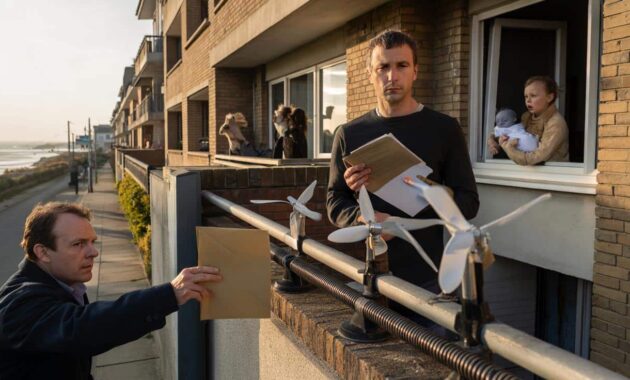
Then the shouting started, and the town showed up with a dismantling order. Eco-innovation or selfish overreach—where do we draw the line between private zeal and shared walls?
The late light hits the concrete like a warm hand when the inspector rings the bell. Two small vertical-axis turbines hum from a fourth-floor balcony, the blades catching gusts that snake down the street. A stroller waits in the stairwell, a neighbor’s dog barks, and someone leans out a window to watch.
The owner steps forward with printouts: carbon savings, wattage charts, a photo of a glacier they once visited. Across the landing, a new parent holds a sleeping baby and raises a finger to the lips. The hum is barely there. The tension isn’t.
Then the envelope appears—paper, official, final.
When eco-enthusiasm meets the balcony next door
In one mid-size coastal town, the council ordered several balcony wind turbines removed after weeks of neighbor disputes. It wasn’t a blanket ban; it was a reaction. Calls poured in about rattling at night, a low-frequency buzz, and the way the blades turned the block into a small theater. Energy on a tight street is intimate. Everyone hears your experiment.
On a brick building from the 1970s, a pair of turbines were bolted to a steel railing with rubber pads. The owner said they never topped 200 watts, but they felt like a small victory every windy evening. The nurse next door worked nights. Her phone recorded 38–45 dB on the bedroom side of the wall, and the baby startled at 3 a.m. The housing association forwarded the log to City Hall. The order landed a week later.
Here’s the tricky part: balconies aren’t open fields. Wind scrapes down façades, tumbles around corners, and turns gusty and chaotic. That chaos is energy, sure, yet it also means vibration, resonance, and whooshing that is hard to tame with off-the-shelf mounts. Town codes lean on noise thresholds, façade uniformity, and structural rules. Nuisance law weighs “reasonable enjoyment” of a home. Nobody wrote these rules for micro-turbines clamped to railings—and the gray zone breeds conflict.
How to micro-power without starting a civil war
Start with a quiet test week before you install anything permanent. Log baseline sound in the quietest hours with a free decibel app, then repeat with a temporary clamp mount and sandbags. If the reading at your neighbor’s side rises by more than 5 dB at night, rethink. Choose gear with certified sound levels under 35 dB at 3 meters. Add vibration isolation: layered neoprene pads, a mass plate, and flexible couplers. If you can, mount on a structural column, not a hollow railing. One last step: a written good-neighbor agreement with a trial period.
Don’t skip the talk. Knock on doors, share your plan, and set a review date after the first windy week. List when you’ll shut it off—storm gusts, nighttime if complaints arise, big family events next door. Think through the non-technical stuff: sightlines, light flicker, bird risk, property rules. We’ve all had that moment when what seems small to us feels huge to someone a meter away. Soyons honnêtes : nobody does that every day. But that quick conversation can save you months of friction.
Marketing promises often gloss over the urban wind reality. Turbulence slashes output while boosting noise. Many balcony turbines only earn a few kilowatt-hours per month, which can be erased by one grumpy committee meeting. The smarter move is a mix: micro-solar where allowed, then shared wind on proper rooftops or community sites.
➡️ Scandinavians Have A Fail-Safe Trick For Staying Warm At Night – And They Sleep Much Better
➡️ If your garden looks lush but feels unproductive, this imbalance is often the silent cause
➡️ The reason raised beds dry out faster and how to fix it long-term
➡️ The unexpected trick of cleaning cutting boards with coarse salt and lemon
“Energy transition isn’t a solo sport,” a city planner told me. “It’s a team game played in small courtyards.”
- What to check before you bolt anything: wind measurement for 14 days, written landlord/HOA consent, noise target under 35 dB at night, structural load letter, cutoff plan for storms, neighbor sign-off, and a maintenance schedule.
- Better alternatives for tight streets: plug-in balcony solar, a rooftop co-op share, green tariffs from your utility, or a battery plus demand-shifting.
- Red lines to respect: protected façades, safety clearances, bird nesting seasons, and emergency egress routes.
A bigger question: who owns the city’s wind?
There’s a deeper story hiding behind the hum of those little blades. City air is shared—like the view, the shade of the street trees, the echo of the courtyard. The urge to chip in on climate is real, personal, urgent. Yet balconies touch other people’s sleep, and sleep isn’t negotiable. We design cities by the conflicts we avoid as much as by the buildings we draw.
Maybe the next wave looks different. Quiet tech by design, not as an afterthought. Shared systems on rooftops with real engineering. Clear, fair permits that say yes when the data works and no when the setup screams trouble. *A rule of thumb: if your fix depends on your neighbors being saints, it’s not a plan.*
I keep thinking about the envelope on the landing. A better city would replace that with a door knock, a meter, a trial, and a map to where wind belongs. Not personal. Just grown-up. And maybe still a little brave.
| Point clé | Détail | Intérêt pour le lecteur |
|---|---|---|
| Balcony wind ≠ open field | Turbulence increases noise and slashes output | Sets realistic expectations before spending money |
| Neighbors are part of the system | Noise deltas over ~5 dB at night trigger disputes | Helps you avoid complaints and legal trouble |
| Choose the right pathway | Quiet gear, isolation mounts, or switch to balcony solar/community wind | Delivers clean energy with fewer headaches |
FAQ :
- Are balcony wind turbines legal?Usually they sit in a gray area. You’ll need building consent, landlord or HOA approval, and to meet local noise and safety rules. Many towns reserve wind for rooftops or dedicated masts.
- How loud are the small units, really?Specs often claim 30–40 dB at 3 m in smooth wind. On a façade, turbulence adds whoosh and vibration. Night readings can creep into 40s dB, which wakes light sleepers.
- Do they make meaningful power?In cities, average output is modest—often a few dozen kWh per year—because wind is choppy and slow. A single plug-in balcony solar panel usually out-produces a micro-turbine across the year.
- What’s a safer compromise?Go for quiet-first design: thick isolation pads, mass plates, flexible couplers, and a timer or manual cutoff at night. Pair with solar, then join a rooftop or community wind project for the bigger gains.
- What if my neighbors hate it anyway?Pause and offer a trial shutdown. Share sound logs, propose hours, and get a neutral inspection. If the vibe stays sour, pivot to **private green tech** that doesn’t travel through walls.
On paper, the dismantling orders look harsh. In hallways and bedrooms, they read as relief. That gap—the dream of urban self-reliance versus the reality of thin walls—is where most climate tech will live or die. The fix isn’t to stop tinkering. It’s to pick the right spots to tinker, and to invite people into the experiment before bolts touch metal.
There’s also a numbers case. Cities whisper at night; wind gear must whisper, too. The data can be your ally: noise floors, power curves, turbulence readings. If they show promise, neighbors become partners. If they don’t, you’ve saved friendships and cash. **Noise at night** is the line we don’t cross.
Planners I spoke to want a faster permitting lane: clear thresholds, clear maps, and a shared understanding that balconies hold lives, not just ideas. I’d add one thing—teach the craft. Publish the mounts that work, the specs that lie, the maintenance that matters. **Commonsense permit steps** beat courtroom drama every time.