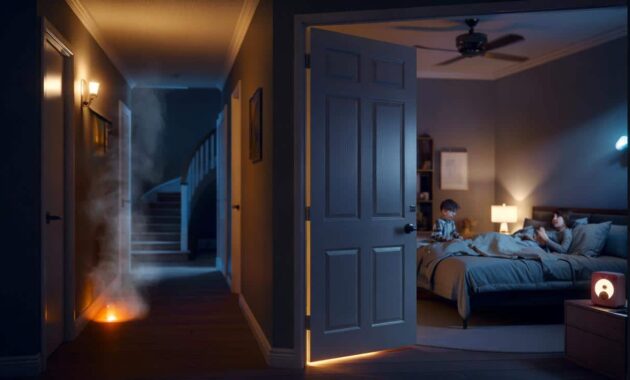
Many people sleep with their bedroom door wide open, thinking it helps them hear the kids, feel less trapped, or get more air. Firefighters, safety experts and even sleep specialists are increasingly saying the opposite: that one quick, low‑effort habit before bed can dramatically change your chances of surviving a house emergency and improve your rest at the same time.
Why that open door at night is a hidden safety risk
Most of us think of burglary when we think of home safety at night. Yet statistics show that fire and smoke are often the more immediate threat inside a house while you sleep.
Closing the bedroom door acts like a basic, built‑in safety device, slowing down fire, smoke and toxic gases long enough for you to wake up and escape.
Modern homes burn fast. Lightweight furniture, synthetic fabrics and plastics release huge amounts of toxic smoke when they catch fire. In many real incidents, the difference between a closed and an open door has been the difference between a survivable room and a lethal one.
Fire tests carried out by safety organisations in the US and Europe consistently show the same pattern: a bedroom with the door closed remains much cooler and clearer for far longer than one with the door open. That extra time matters, especially if the fire starts in another part of the home.
How a closed door slows fire and smoke
Think of a door as a simple barrier. It is not fireproof, but it buys you minutes. In a house fire, minutes are everything.
- Heat barrier: A closed door can keep temperatures in the bedroom hundreds of degrees lower on the fire side.
- Smoke barrier: Most fire deaths come from smoke inhalation, not flames. A closed door slows smoke entry.
- Toxic gas delay: Burning furniture and plastics release gases that can knock you unconscious. A door reduces and delays that exposure.
- Oxygen control: An open door can feed oxygen to a fire. A closed one can slightly slow fire growth by limiting airflow.
In many documented fires, rooms with closed doors had survivable air and low damage, while nearby open rooms were blackened and uninhabitable.
Firefighters often report walking through a badly burned home and opening a closed bedroom door to find almost untouched furniture and visible air inside. That image alone explains why they repeat the same advice: “Close before you doze.”
Safety isn’t the only reason: sleep quality changes too
The safety argument is strong on its own, but there is another angle: your rest. Sleep experts say the bedroom door position shapes noise levels, light exposure and even your sense of security.
➡️ Farewell to happiness : the age when it fades, according to science
➡️ This deadly invasive fish species in the Mediterranean is alarming experts
➡️ Ultra-soft cake ready in 10 minutes flat: just 3 simple, magical ingredients
➡️ Garden tax sparks fury as critics warn it punishes nature lovers and rewards concrete driveways
➡️ Why putting a spoonful of sugar in vases keeps flowers upright and hydrated
Less noise, less light, deeper rest
An open door lets hallway noise, kitchen sounds and street light spill into your bedroom. Even if you think you “sleep through anything”, your brain still reacts to every sound and flash of light, often pulling you into shallower phases of sleep.
A closed door creates a small, contained space that your brain begins to associate with rest. Once you shut the door, you cut off much of the background noise from televisions, appliances and traffic. That helps your body stay longer in deep and REM sleep, which are the stages that leave you feeling truly restored.
Psychological comfort and a sense of control
Some people feel slightly uneasy with the door closed, especially those who grew up in busy households. The habit of leaving it open can come from wanting to be available to others or a fear of being “shut in”.
Yet psychologists point out that feeling you can protect your space, even in small ways, can lower anxiety at night. A closed door can provide a clear boundary between “daytime” and “night-time”, signalling that you are off duty. Over time, that boundary often turns into a subtle sense of security that helps you fall asleep faster.
Parents, pets and partners: what about real life?
Of course, many homes are not quiet, controlled spaces. There are small children, anxious pets and partners on different schedules. Shutting the bedroom door can sound unrealistic.
Safety specialists suggest thinking in layers rather than perfection. The goal is not a sealed bunker, but slightly better odds and slightly better rest.
| Situation | Practical approach |
|---|---|
| Baby or toddler in another room | Use reliable baby monitors and keep both bedroom doors closed at night. |
| Teenagers coming home late | Agree they text when home; keep your bedroom door closed, theirs closed when they sleep. |
| Pet that wanders at night | Let the pet sleep in your room with the door closed, or use a pet gate and close your door once they settle. |
| Partner on night shifts | Use a closed door, blackout curtains and a doorbell silencer to protect daytime sleep as well. |
Coupling a closed door with basic night-time safety
A closed door works best as part of a simple, repeatable night routine. You do not need expensive gadgets for the basics.
- Check that smoke alarms are working on every floor and near bedrooms.
- Keep hallways, staircases and exits clear of clutter.
- Decide two ways out of each bedroom (door and window, for example).
- Charge phones away from the bed and avoid cheap or damaged chargers.
- Switch off unused candles, heaters and fairy lights before sleeping.
A closed bedroom door turns that routine into a last line of defence, giving alarms time to sound and giving you time to move.
Children in particular benefit from practising what to do if a smoke alarm goes off at night. Knowing that the default rule is “door closed at bedtime” makes instructions simpler: stay low, feel the door, and if it is hot, use the window or wait by the window for firefighters.
Addressing common worries about closing the door
“I won’t hear my kids or the alarm”
This is one of the most frequent objections. In reality, modern smoke alarms are designed to be loud enough to penetrate closed doors. For children, some experts suggest using low‑frequency alarms or even voice-recorded alarms, which research shows can wake them more reliably than a standard beep.
For parental reassurance, audio or video baby monitors allow you to keep tabs on a sleeping child while still giving both rooms the protection of closed doors.
“My room gets stuffy without the door open”
Many homes struggle with airflow, especially in older buildings or flats without modern ventilation systems. Sleeping with the door open can feel like the only way to get fresh air.
A few small adjustments can change that:
- Open windows briefly before bed to refresh the air.
- Use a quiet fan or ceiling fan to keep air moving within the room.
- Avoid drying laundry in the bedroom overnight, which adds moisture and odours.
- If possible, have a professional check blocked vents or poorly balanced heating systems.
Creating better airflow inside the room lets you shut the door without feeling trapped or overheated.
A simple night-time scenario
Imagine a small terrace house at 2:30 a.m. A phone charger in the living room fails and starts smouldering on the sofa. The adults are asleep upstairs with their bedroom door closed. Their teenager is in the next room, also with the door closed.
The smoke alarm in the hallway sounds as smoke thickens on the ground floor. Because both bedroom doors are closed, smoke takes longer to seep into the rooms. The parents wake, smell only a faint hint of smoke, and have time to rouse their teenager, stay low, and reach the front door. In this kind of timeline, the closed doors did not prevent escape; they made it possible.
Now picture the same house with the doors open. Smoke pours up the stairs rapidly, filling the landing. The alarm still sounds, but the air in the bedrooms turns harsh and toxic much faster. People may wake confused, breathe in more smoke, and lose precious seconds before they can even reach the hall.
Small habit, large effect
Most home safety advice involves spending money or changing routines. Closing the bedroom door takes a second and costs nothing, yet shifts the odds in your favour in both emergencies and everyday rest.
For families, this habit pairs well with teaching children simple terms like “smoke inhalation” and “escape route”, not to scare them, but to give them language for what is going on. When they understand that a closed door keeps heat and smoke out for longer, they are often more willing to accept it as a rule, even if it means slightly less hallway light at night.
Viewed together, the benefits stack up: lower fire and smoke risk, quieter nights, deeper sleep, clearer boundaries between day and night. The door you close at bedtime becomes more than a piece of wood on hinges; it acts as a modest but surprisingly powerful shield between you and the unexpected.