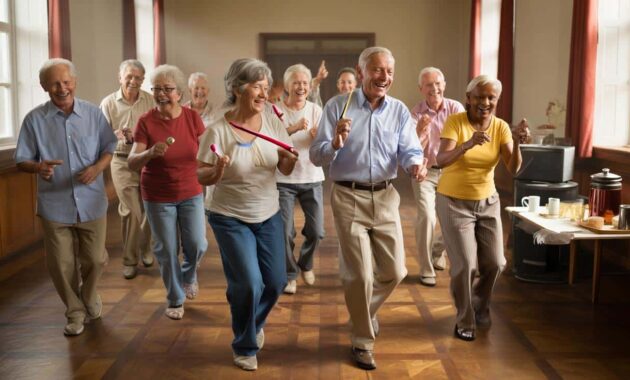
The church hall smells faintly of instant coffee and floor polish. Folding chairs scrape on the tiles as a dozen people over 65 lean forward, eyes bright, hands hovering over… tambourines and maracas. Not tablets. Not puzzle books. On the far wall, a small speaker crackles to life and an old Motown track spills into the room.
At first, their moves are stiff, cautious, almost shy. Then something shifts. A woman in a red cardigan starts to clap on the off-beat. A man who “never dances” taps his foot, then both feet, then laughs at himself. Names are remembered. Lyrics float back. Stories too.
This is brain training, but not the kind you expect.
The surprising activity that wakes the ageing brain up
Ask most people how to protect their memory after 65 and you hear the same list. Crosswords. Chess. Sudoku. “Keeping the mind active.” These things help, yes, but they’re only scratching the surface. The brain doesn’t just wake up when you sit very still and think very hard.
What really lights it up is something messier, more human. Moving your body. Listening to music. Responding to other people. Changing direction at the last second because the rhythm just shifted. That chaos is gold for an ageing brain. It forces new connections. It asks your memory to talk to your muscles, your balance, your hearing, your emotions, all at once.
Neurologists have a slightly boring name for it: “coordinated group movement to music.” The rest of us would call it dancing. Not ballroom competitions on TV. Not high-impact Zumba next to people in Lycra half your age. Just simple, structured dance sessions designed for older adults. Steps you can follow. Rhythms your knees forgive.
In one community center study in Germany, adults in their 60s and 70s who did weekly dance classes showed bigger improvements in memory and balance than those who did regular gym workouts. Their hippocampus – the part of the brain tied to memory – actually grew in volume. They didn’t feel like patients. They felt like people going out.
Why would dancing beat crosswords or chess for memory? Because it’s multitasking in disguise. You’re memorizing movement patterns, reacting to the music, navigating space, watching others. Your brain can’t go on autopilot. It must stay present.
You also get a shot of social connection and joy. That emotional charge is not a detail: positive feelings help the brain encode new information. You remember the silly mistake you made in the cha-cha far more clearly than the third crossword you did alone at the kitchen table. When the heart is in the room, the brain takes notes.
How to use dance as real memory training after 65
Start very small. Think “walking with rhythm” rather than “Strictly Come Dancing.” The goal is a weekly date with music and movement that nudges your brain slightly out of its comfort zone. Not pain, not panic, just gentle confusion followed by the quiet satisfaction of getting the step right on the third try.
➡️ 4 phrases to end a conversation intelligently
➡️ The grandmother’s old mix that makes floors shine the easy method proven over decades
➡️ Ramadan: why supermarkets ramp up offers and promotions every year
Look for “dance for seniors,” “silver dance,” or “movement to music” classes at local community centers, YMCAs, or church halls. Many are chair-based or low-impact. If going out feels like too much, begin in your living room. Put on a song you loved at 30. March on the spot. Add a side step. Then try a simple pattern: step-step-clap, step-step-clap. You’ve just created a mini choreography your brain has to store and retrieve.
The trap many over-65s fall into is perfectionism. “I have two left feet.” “I’ll look ridiculous.” Or quietly: “My memory isn’t what it was, I’ll only slow everyone down.” That inner critic is far more damaging than a missed step. The point is not elegance. The point is effort plus repetition.
We’ve all been there, that moment when you walk into a room and forget why you came in. After a few of those, any activity that exposes your forgetfulness can feel cruel. Dancing flips that script. Everyone stumbles. Everyone laughs. The mistakes become part of the game, not a verdict on your mind. And you walk out thinking, “I didn’t remember all of it, but I remembered more than last week.”
“People come for their balance,” says Anna, a 72-year-old volunteer instructor in a London community center. “They stay because they remember the steps, then the people’s names, then the stories they share during tea. The memory work sneaks in through the back door.”
- Sharpen the brain from all angles
Alternate slow and fast songs, forward and backward steps, arms and legs, so your memory can’t rely on one simple pattern. - Turn routine into a ritual
Pick the same two mornings a week for your “dance appointment,” even if it’s just 10 minutes in the kitchen with the radio on. - Use music with meaning
Old favorites light up emotional memory, which pulls the rest of your recall along for the ride. - Invite one other person
A neighbor, a partner, a grandchild. Social pressure keeps you showing up and conversation boosts verbal memory too. - *Respect the body you have today*
Sit to dance if standing is painful. Tap fingers, sway shoulders, nod your head. Your brain still has to track rhythm and sequence.
Beyond puzzles: what growing older and remembering well can really look like
Picture an afternoon where your memory workout doesn’t look like “homework.” It looks like a line of people your age trying to remember if it’s right-left-turn or left-right-turn, then collapsing into shared laughter when everyone gets it wrong at once. It looks like the woman who couldn’t recall her neighbor’s name last month now calling out, “Come on, Alan, you’re early on the beat!”
This kind of dancing won’t erase every senior moment. It won’t turn you into a memory champion. What it does is keep the pathways alive. It gives your brain reasons to stay flexible, reasons to store, reasons to retrieve. And it wraps all that dry science in something you might actually look forward to on a grey Tuesday. Let’s be honest: nobody really does this every single day. Yet once a week, or twice, is enough to start smelling the polish on that church hall floor and think, quietly, “My brain’s still learning. I’m still here.”
| Key point | Detail | Value for the reader |
|---|---|---|
| Dance beats passive puzzles | Combines memory, movement, balance, rhythm, and social interaction in one activity | Stronger, more resilient memory training than sitting alone with a crossword |
| Start simple and low-impact | Short weekly sessions, easy steps, chair-based options, familiar music | Makes the habit realistic, safe, and enjoyable even with health limits |
| Joy helps the brain remember | Positive emotions and shared laughter anchor new memories and routines | Makes “brain training” something you want to keep doing long term |
FAQ:
- Question 1Is dancing really better for memory than crosswords or chess after 65?
- Answer 1All three help, but dancing activates more brain areas at once: memory for steps, balance, rhythm, spatial awareness, and social skills. Studies show older adults in dance programs often see bigger gains in memory and brain volume than those doing only traditional puzzles.
- Question 2What if I have poor balance or joint pain?
- Answer 2Chair-based dance or seated movement to music still trains memory and coordination. You can tap your feet, move your arms, follow patterns with your hands. Always adapt steps to your comfort and talk with your doctor or physiotherapist before starting if you’re unsure.
- Question 3How often should I dance to help my memory?
- Answer 3One to two sessions a week of 30–60 minutes each already make a difference over time. On other days, even a single song in your kitchen where you repeat a few steps can help maintain the habit.
- Question 4Do I need a partner or can I go alone?
- Answer 4You can do both. Group classes are powerful because social interaction itself supports brain health, but solo dancing at home still benefits memory. Many senior classes are designed so you don’t need a fixed partner.
- Question 5What kind of music works best for brain health?
- Answer 5Songs you genuinely enjoy and remember from your past tend to work best. Familiar melodies trigger emotional and autobiographical memories, which helps your brain form new connections while you move.