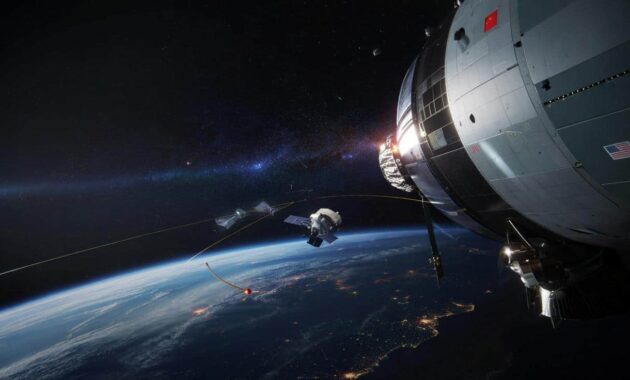
On a quiet night in Washington, the kind where the city hums but never truly sleeps, a small group of people watched a screen that looked almost boring. Just white dots sliding across a dark background. No soundtrack. No flashing red alarms. Yet in those few minutes, some of those dots carried the weight of two nuclear superpowers, locked in a dance neither of them could fully control.
In Beijing, on the other side of the world, a similar glow lit another control room. Different language, same tension. A Chinese satellite had just changed course. An American military satellite reacted. Then a third object appeared, moving too close, too fast.
Nobody outside those rooms knew it yet, but space had just edged a little closer to becoming a battlefield.
When a “routine” maneuver suddenly feels like a threat
From far below, space still feels like a distant, almost abstract place. A clean blue sky, a silent night, a string of bright dots silently crossing overhead. Up there though, it’s getting crowded, messy, and quietly angry. Every orbit, every course correction, every piece of metal is watched, logged, and filed as friendly, unknown, or suspicious.
When a Chinese satellite drifts a bit too close to an American one, that’s not just a technical line on a radar. It’s an eyebrow raised at the Pentagon. A tense phone call. A classified briefing on “potential hostile proximity operations.” The sort of euphemism that makes diplomats sweat.
One recent episode captured this new mood perfectly. In 2022, U.S. officials accused a Chinese satellite—Shijian-21—of grabbing a defunct satellite and towing it into a “graveyard” orbit. On paper, that sounds like a smart piece of space cleaning. A sign of responsibility. But what got Western analysts talking wasn’t the cleaning. It was the grabbing.
If you can dock with and move your own satellite, you might one day dock with and move someone else’s. Or disable it. Or drag it just a few degrees off its path so it stops working right when a crisis unfolds on Earth. A rescue operation suddenly looks, from a defense planner’s eyes, a lot like a rehearsal for attack.
This is why those small orbital maneuvers land with such a heavy geopolitical thud. The line between civilian and military in space is razor-thin. A satellite can be weather-monitoring and missile-spotting at the same time. A robotic arm can repair equipment or tear it apart. To American strategists, Chinese “space servicing” technologies fit perfectly into Beijing’s wider ambition to dominate critical infrastructure.
Chinese officials say the opposite. They insist their goals are peaceful, accuse Washington of paranoia, and point to decades of U.S. military reliance on space. Underneath the sharp statements, both sides quietly reach the same conclusion: whoever controls orbit controls a lot more than pretty images of Earth.
The invisible choreography of near-conflict in orbit
There’s a kind of unwritten method that governs how the U.S. and China move in orbit now. Both sides watch everything. Radar, telescopes, tracking stations: they all feed into giant databases that monitor thousands of objects circling the planet. When something shifts unexpectedly, analysts run simulations, check past behavior, and classify intent. Is this a test, a message, or just a mistake?
➡️ Food safety officials warn about a batch of imported canned goods sold this week
➡️ “No one explained how to do it”: their firewood stored for months was actually unusable
➡️ 9 things every senior did as a child that we no longer teach our grandchildren
➡️ Death cap mushroom: the world’s deadliest fungus may be evolving to unleash new toxins
➡️ “I saved $650 in four months by reducing decision fatigue”
➡️ A Simple Rustic Tomato Galette That Looks Beautiful Straight From the Oven
Then comes the choreography. The U.S. may nudge one of its satellites a few kilometers away. China might respond by adjusting its own. Military planners model worst-case scenarios: a collision, a broken satellite, cascading debris. Every small movement is weighed against the risk of overreacting and turning suspicion into confrontation.
The chilling part is how easy it is to misread a move in space. A navigation error can look like aggression. A debris-avoidance maneuver can be mistaken for stalking. We’ve all been there, that moment when a simple action gets interpreted in the worst possible way. Now transpose that feeling into a world of nuclear powers and classified intelligence, and you get a sense of the pressure on those satellite operators.
Let’s be honest: nobody really understands every object up there, every second of the day. Not the U.S., not China, not private companies. Data is patchy, models are not perfect, and the legal framework was written when there were only a few dozen satellites in the sky.
As one European diplomat put it quietly in a corridor conversation, *orbit has become a place where misunderstandings travel faster than formal messages*. That’s why some voices on both sides are pushing for clear “rules of the road” for space, even as hardliners talk more openly about “space dominance” and “space denial.”
“Space is no longer a sanctuary,” a retired U.S. Air Force general told a security forum. “It’s a contested domain, and everyone knows it, even when they pretend not to.”
- Close approaches between satellites are now tracked and debated in real time.
- Military space units in the U.S. and China train for offensive and defensive scenarios.
- Each test, each maneuver, feeds an arms race mindset that’s hard to reverse.
How close are we to a real space crisis between China and the U.S.?
If you talk to specialists, many quietly admit they’re less worried about a planned attack than about an accident that spirals out of control. A piece of debris hits a satellite at the wrong moment. An experimental Chinese satellite passes close to a U.S. military relay. A warning system misreads the situation. Suddenly, you have generals and presidents woken in the middle of the night with patchy information and a choice: respond, or risk looking weak.
One practical step often discussed in expert circles is a dedicated “space hotline” between Beijing and Washington. Not a vague diplomatic channel, but a direct technical line between the people who actually track and maneuver satellites. The idea is simple: when something strange happens in orbit, you get someone on the phone fast, before the narrative hardens into blame.
This is where many mistakes begin: in the gap between what was intended and what was perceived. Chinese planners might see a test as routine. U.S. analysts might see the same move as rehearsing an anti-satellite strike. Both are partly right, and partly trapped in their own threat scenarios.
There’s also a quieter mistake ordinary readers fall into: thinking space is still mostly about astronauts, flags, and heroic missions. Today, it’s about timing signals, encrypted communications, surveillance, and economic flows. If a serious space incident happened tomorrow, its first effects wouldn’t be poetic. They would be felt in banking networks, GPS disruptions, jittery markets, and military systems quietly shifting to higher alert.
“Space conflict won’t start with a Hollywood laser,” a Chinese academic once remarked off-record. “It will start with something that looks like a technical failure.”
- Watch for language shifts – When officials start saying “space superiority” more often than “space cooperation,” that’s a signal.
- Follow real incidents – Debris events, anti-satellite tests, close passes: they show where the stress points are.
- Listen to the quieter voices – Engineers, treaty negotiators, and independent trackers often see the risks before politicians do.
A sky full of satellites, and a question nobody wants to answer out loud
The unsettling truth is that space has already become a strategic front line, even if no one wants to hang the word “battlefield” over the night sky just yet. The U.S. has its new Space Force. China has integrated space deep into its military planning. Both test technologies that, politely described, could disable or blind the other’s assets in orbit.
At the same time, commercial constellations are exploding in number, blurring the line even further. A private company’s satellites might carry signals crucial for military operations. A cyberattack on an innocuous-sounding platform could ripple out into national security. The old Cold War image of two superpowers sitting opposite each other has been replaced by a crowded room full of state and non-state actors, all tapping the same fragile infrastructure.
| Key point | Detail | Value for the reader |
|---|---|---|
| Space is already militarized | U.S. and China rely on satellites for communication, navigation, and early warning | Helps you see why small incidents in orbit can escalate fast |
| Misunderstandings are dangerous | Routine maneuvers can be read as hostile moves in times of tension | Shows how fragile peace in space really is |
| Rules lag behind reality | Existing treaties were built for a simpler, less crowded space era | Explains why experts keep calling for new norms and “rules of the road” |
FAQ:
- Question 1Is orbit already considered a battlefield by the U.S. and China?Officially, both sides speak in careful language about “peaceful use of outer space.” In practice, their strategies, budgets, and doctrines treat space as a contested domain where military advantage matters a lot.
- Question 2Could a satellite collision really trigger an international crisis?Yes, especially if it affects a key military or communications satellite during a tense moment. The key risk is misattribution: if one side thinks an accident was an attack, escalation becomes much more likely.
- Question 3What types of space weapons are we actually talking about?Not just missiles. There are ground-launched anti-satellite weapons, cyber tools, jammers, and satellites capable of approaching, grabbing, or disabling other spacecraft without a dramatic explosion.
- Question 4Are there international rules that limit space warfare?There is the 1967 Outer Space Treaty, which bans nuclear weapons in orbit and claims space for “peaceful purposes.” Yet it says very little about modern dual-use technologies, proximity operations, or cyber interference.
- Question 5What can reduce the risk of a U.S.–China space crisis?More transparency, shared incident reporting, technical hotlines, and practical norms such as safe distance rules for satellites. None of that solves rivalry, but it can slow the slide from suspicion to disaster.