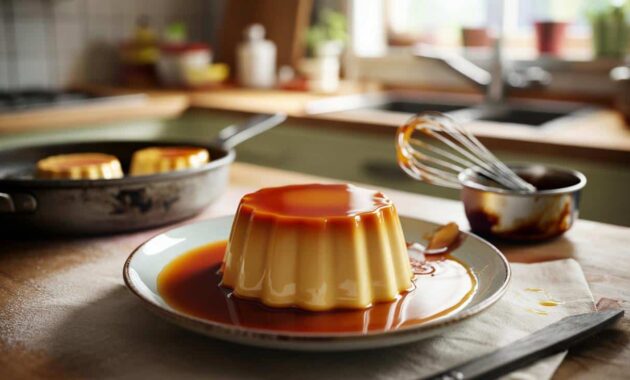
The first time you try to unmould a crème caramel, there’s always that tiny second of panic. You invert the dish, lift it a little, hear the soft “slurp” as the custard loosens… and you’re praying it won’t collapse into a beige puddle. The smell of baked vanilla and burnt sugar hangs in the kitchen, but your eyes are locked on that wobbling dessert like it’s a high-wire act.
Around you, there are traces of real life: a messy counter, a saucepan stuck with caramel, a used whisk leaning in the sink. This is not a food-styling studio, it’s just your home on a Thursday night, hoping to recreate the flavour of a dessert your grandmother made without a recipe or a thermometer.
The plate is turned. The flan lands. The caramel flows.
The real question is: why does it work some days and fail so badly on others?
The secret heart of a perfect crème caramel
Crème caramel looks simple: sugar, eggs, milk, vanilla. Four basic ingredients, nothing fancy, nothing intimidating on paper. Yet behind that gentle wobble, there’s a very precise balance between heat, time and patience. One small shift, and you jump from silky custard to scrambled-egg disaster.
What we’re chasing is that exact moment when the custard sets just enough to hold its shape, but not enough to lose its softness. The spoon should glide in with a quiet resistance, then give way like satin. The caramel on top needs to be bitter-sweet, fluid, and just thick enough to coat the plate in a dark, amber halo. One colour too pale, and it tastes flat. One shade too dark, and it turns acrid.
Picture this scene. A Sunday lunch, six people at the table, a big white platter emerging from the fridge. The crème caramel looks promising, golden around the edges, chilled for hours. Everyone leans in as it’s flipped dramatically onto a serving dish. A pause. Then the sound of air sliding in, the vacuum breaking.
The flan comes out… with a crack on the side. One guest laughs, another says, “Texture’s what counts!” You taste it anyway. The flavour is right, but the mouthfeel is off: slightly rubbery, too dense, not that gentle shimmy you had in mind. Later that evening, you scroll through recipes, wondering who is lying, because all of them claim to be “foolproof”.
There’s a reason so many “simple” crème caramels miss the mark. Eggs start to coagulate around 62–65°C and go firm by 80–85°C, while milk boils near 100°C. That gap is where the stress happens. Without control, the proteins stiffen unevenly, water separates, and you get those dreaded bubbles or a grainy texture.
The trick isn’t some magical hidden ingredient. It’s the way you treat the custard as it cooks: gentle, buffered, protected from brutal heat. That’s where the bain-marie, oven temperature, and even the depth of your ramekins quietly decide whether you’ll get that smooth restaurant-style texture or something closer to overcooked omelette with caramel.
➡️ Mega deal looming: one country may buy 114 Rafale jets from France to upgrade its air force
➡️ Extend the life of your washing machine: 7 simple steps
➡️ World-first laptop cooled not by a fan but by plasma
➡️ Pensions will rise from February 8, but only for retirees who submit the missing paperwork on time
The foolproof trick: a calm bain-marie and low, slow baking
Here’s the real game-changer: a cool, calm bain-marie that never boils, combined with a low oven. Sounds almost too simple, but this single choice transforms the custard. Line your ramekins or large dish in a deep roasting pan. Pour in hot tap water or just-off-the-boil water only halfway up the sides, not to the brim.
Then slide everything into an oven at 140–150°C, not the usual scorching 180°C. The water should stay just below a simmer, with maybe tiny bubbles, never raging. This gentle environment keeps the custard temperature stable, allowing the eggs to set slowly and evenly. The result is a flan without bubbles, without cracks, with that dreamlike tremble you see in pastry shops.
Most failed crème caramels are not about “bad cooks”, they’re about rushed heat. You come home tired, you’re hungry, you crank up the oven “just a bit” to speed things up. Then the water in the bain-marie starts to boil, and your custard edges turn into scrambled egg territory while the centre is still liquid.
We’ve all been there, that moment when you open the oven, tap the dish, and see a crater landscape full of holes. You blame the recipe, but the real culprit was the aggressive temperature. Let’s be honest: nobody really does this every single day. So when we finally attempt it, we go too fast, expecting the dessert to adapt to our schedule instead of the other way around.
*“The day I stopped boiling my bain-marie, my crème caramel suddenly tasted like my grandmother’s,”* says Clara, a 38-year-old home baker who tested eight different recipes in one winter. *“The flavour was the same as always, but the texture changed completely when I lowered the oven. It went from ‘homemade but clumsy’ to ‘I’d pay for this in a restaurant’.”*
- Use warm, not boiling water in the roasting pan so the temperature rises gradually.
- Cover the pan loosely with foil to avoid a tough skin and protect the surface from direct dry heat.
- Tap the filled ramekins lightly on the counter before baking to release air bubbles in the custard.
- Stop baking when the centre is just set with a visible wobble; it will finish setting as it cools.
- Chill at least 6 hours, ideally overnight, so the caramel melts fully and the flavours round out.
Authentic flavour lives in the details you don’t rush
What really makes a crème caramel taste “authentic” isn’t some secret brand of vanilla or a rare dairy product. It’s the quiet time you give to the ingredients to talk to each other. Heating the milk slowly with a real vanilla pod and letting it sit for ten minutes off the heat so the perfume deepens. Melting the sugar all the way to deep amber, watching the colour, smelling the sharper, nutty notes instead of panicking at the first sign of browning.
Then there’s the rest: cooling the caramel enough so it doesn’t shock the custard, whisking the eggs gently so you don’t foam them, straining the mixture once for extra smoothness. None of this is spectacular. It won’t look impressive on social media. But your spoon will notice instantly, and so will anyone who takes a second bite and goes quiet for a moment longer than usual.
| Key point | Detail | Value for the reader |
|---|---|---|
| Low, gentle baking | Oven at 140–150°C with a calm bain-marie that never boils | Prevents bubbles and rubbery texture, gives a smooth, creamy custard |
| Caramel colour | Cook sugar to a deep amber, not pale gold, then pour quickly into moulds | Balances sweetness with a subtle bitterness, like classic French desserts |
| Rest and chill time | Let custard cool, then chill at least 6 hours or overnight before unmoulding | Improves flavour, texture and unmoulding, with a glossy caramel sauce |
FAQ:
- Question 1My crème caramel is full of little bubbles. What went wrong?
- Question 2How dark should I cook the caramel for the best flavour?
- Question 3Can I use only egg yolks, or do I need whole eggs?
- Question 4How do I stop the caramel from hardening like glass at the bottom?
- Question 5How long can I keep homemade crème caramel in the fridge?