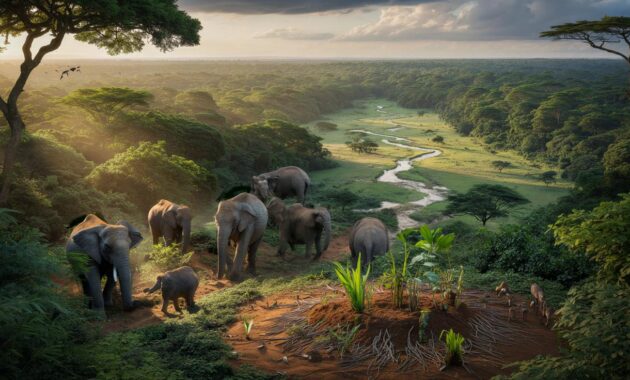
The first thing you notice is not the elephants. It’s the sound. A deep cracking of branches, a low rumble, and then the sudden opening of light in what was, just moments before, dense shadowed forest. Somewhere in northern Congo, a group of forest elephants pushes through a wall of vegetation as if it was made of paper. Behind them, sunlight spills onto the ground for the first time in years. Tiny green shoots already wait to claim it.
A ranger whispers that more than 100,000 elephants across Africa are doing this every day, in silence.
They are not just surviving. They are re-engineering their world.
The quiet bulldozers turning dark forests into living mosaics
Walk behind an elephant trail and the forest suddenly looks different. Trees are snapped, saplings flattened, and shafts of light pierce the canopy like spotlights on a stage. What looks like chaos at first glance is in fact a kind of rough, slow design. The elephants are carving corridors through the vegetation, opening galleries where birds can swoop and sunlight can feed young plants.
Without any blueprint, they are drafting a new layout for the forest.
Scientists following collared elephants in Central and West Africa mapped thousands of their daily routes. On satellite images, the paths show up as thin, pale lines curling through dense green, like veins through a leaf. Along these lines, researchers found more open patches, more young trees, and far more plant diversity than in untouched blocks of forest.
In Gabon’s Loango National Park, one study estimated that elephants have opened up as much as 30% of some forest areas into a patchwork of clearings and gaps. That’s not a minor detail of the landscape. That’s architecture.
What’s happening is simple: elephants eat and push and trample so much vegetation that they literally change how light and water move through the forest. Sunlight hits the ground. Rain reaches the soil instead of being caught high in the canopy. Seeds dropped in dung get exactly the warm, open spot they need to sprout.
These “elephant-made windows” shift entire ecosystems from dark, closed forests to more varied, breathable landscapes. That’s how a single species can redraw a continent, one broken branch at a time.
The 30-kilo lunch that replants the forest for free
If you walk long enough along those elephant paths, you find their real superpower: dung. Big, steaming piles of it, scattered like care packages from a generous giant. Inside each one are hundreds of seeds, wrapped in rich fertilizer. Some are from fruits that only elephants can swallow whole. Others are from trees with seeds too large for monkeys or birds.
➡️ Everyone does it, but heating water or milk in the microwave can be really bad
➡️ Your morning routine might be sabotaging your brain without you realising it
➡️ Neither seeds nor cuttings needed: this simple trick multiplies rosemary successfully every time
➡️ This economical use of wood ash is winning over more and more French households: a real home trick
➡️ People who constantly feel thirsty may miss this hydration signal
➡️ Rats will flee : the household ingredient that drives rodents out of your home for good
Every time an elephant eats, it is loading a future forest into its stomach.
A single adult elephant can eat up to 150 kilos of leaves, bark and fruit in a day. They can walk tens of kilometers before dropping that cargo back into the world. In Congo’s forests, researchers counted more than 90 different plant species growing out of elephant dung. Many of those seeds had traveled over 5 kilometers from their “parent” tree.
One famous example is the moabi tree, a giant of Central African forests. Its seeds are huge and heavy, far too big for most animals to carry. Elephants swallow them in sticky fruits and drop them far away in nutrient-rich dung. In some regions, moabi almost stops regenerating when elephants disappear. The forest literally loses its giants.
Ecologists now call elephants “mega-gardeners of the forest” for a reason. By spreading seeds widely, they keep tree populations mixed, avoid inbreeding, and help rare species colonize new areas. Their dung creates mini oases of fertility in poor soils, accelerating young tree growth.
And there’s a climate twist. Studies show that forests with elephants tend to have more large, dense-wood trees, which store far more carbon. When elephants vanish, the forest slowly shifts toward smaller, lighter-wood trees, and carbon storage can drop by as much as 7%. That’s a quiet, invisible loss we barely notice on the news ticker.
Protecting 100,000 elephants: how guards, tech and locals rewrite their future
On the ground, protecting elephants starts with something almost unglamorous: walking. Day after day, rangers and community scouts patrol huge areas, following tracks, checking snares, listening for distant gunshots. In some African parks, new tools now slip into this old routine: GPS collars, drones, acoustic sensors that pick up the echo of gunfire. But the basic method is still stubbornly human. Boots, sweat, notes in a dog-eared field notebook.
The goal is simple: keep elephants alive long enough for them to keep doing their quiet work.
Most people imagine protection as a heroic movie scene, but the reality is slower and more fragile. Rangers underpaid or not paid at all, families living next to parks afraid their crops will be trampled at night, local youth torn between illegal hunting money and the promise of jobs in tourism or conservation.
We’ve all been there, that moment when we know what would help long term, yet something short term feels more urgent. In elephant landscapes, that tension is daily life. When conservation projects ignore this and just point at laws and fences, they tend to fail fast. The places that keep more elephants on the ground are usually the ones that turn neighbors into partners, not enemies.
“People talk about saving elephants,” one community leader in northern Kenya told me, “but for us, saving elephants started the day we felt they were also saving us.”
- Community conservancies – Shared management areas where locals co-own tourism, grazing rules and wildlife decisions.
- Smart anti-poaching tech – GPS collars, camera traps and AI sound sensors that alert teams before shots become carcasses.
- Compensation schemes – Funds that repay farmers for lost crops, turning revenge killings into phone calls and paperwork.
- Alternative incomes – Jobs as guides, rangers, artisans or lodge staff that mean a living elephant is worth more than ivory.
- *Education and pride* – School programs and cultural projects that reconnect younger generations with elephant stories and identities.
Landscapes with elephants, and landscapes without them
Stand at the edge of an African forest that has lost its elephants and the difference creeps up on you. The air feels stiller. Under the trees, the vegetation is thick, almost choking. Fewer open glades, fewer young clearings, fewer paths. Birds and small antelopes are there, but in lower numbers. The forest looks “intact” in photos, yet something in its pulse is weaker.
Now walk into a forest where elephants still roam. The contrast is subtle, but your body senses it.
You notice more patches of light on the ground, like a mosaic. You see clusters of seedlings springing out of old dung piles, some already knee-high young trees. Paths thread the undergrowth, making it easier for buffalo, duikers, even humans to move. Fruit trees seem more abundant along these routes. It feels like a place in motion, not a museum piece under glass.
Let’s be honest: nobody really thinks about elephants when they scroll through a climate headline on their phone at 7 a.m. Yet these animals are part of the hidden machinery behind the numbers.
The protection of those 100,000-plus elephants still surviving in Africa is not just about avoiding a sad, empty picture book for our kids. It shapes how forests store carbon, how water flows, how fruit and timber trees regenerate, how local communities can build economies around wildlife instead of against it.
When you realize that a creature capable of knocking down a tree is also quietly holding up the climate, the story shifts. It becomes harder to see elephants as distant, exotic giants and easier to see them as rough, generous engineers, still at work while we argue about emissions targets.
| Key point | Detail | Value for the reader |
|---|---|---|
| Elephants reshape forests | By opening clearings and breaking dense vegetation, they let light and water reach the ground. | Helps understand why protecting elephants directly supports healthier, more resilient ecosystems. |
| They are major seed dispersers | They transport large seeds over long distances and “plant” them in nutrient-rich dung. | Shows how one species sustains tree diversity, big timber species and long-term carbon storage. |
| Protection is people-centered | Effective conservation mixes rangers, tech, local jobs and fair compensation for damage. | Offers a practical lens on what works on the ground and where individual support can matter. |
FAQ:
- How many elephants are left in Africa today?Rough estimates suggest around 400,000 to 450,000 African elephants remain, split between savanna and forest populations. Not all are well protected, which is why the survival of the 100,000-plus in secure areas is such a big deal.
- Do elephants really help fight climate change?Yes. By favoring large, dense-wood trees and spreading their seeds, elephants boost forest carbon storage. Studies show that losing elephants can reduce a forest’s carbon stock by several percent, on a planetary scale that’s huge.
- What’s the difference between forest and savanna elephants?Forest elephants are smaller, darker, and have straighter tusks. They live in dense rainforests of Central and West Africa, while savanna elephants roam more open grasslands and woodlands in East and Southern Africa.
- Why are elephants still being poached if ivory trade is banned?Illegal markets, weak law enforcement, corruption and poverty combine into a powerful incentive. Ivory prices remain high in some countries, and trafficking networks are well organized, so poaching pressure hasn’t disappeared.
- What can I realistically do to help elephants from far away?Supporting trusted field-based organizations, choosing tourism operators that work with local communities, reducing demand for products tied to deforestation, and amplifying accurate stories about elephants all add up more than most people think.