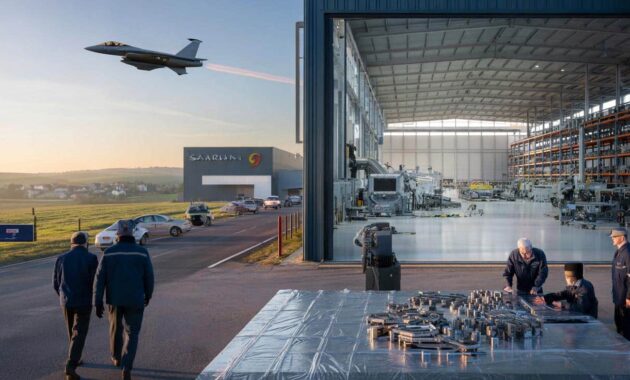
On a cold morning in eastern France, the factory gates at Seurre open before the sun is fully up. Workers in navy-blue jackets stream past the security badge readers, the air thick with the smell of metal, oil and coffee. Inside, bright white lights bounce off raw aluminum parts stacked on trolleys — future pieces of Rafale fighter jets that, for now, look strangely ordinary.
In a corner of the vast hall, a new concrete slab is curing under plastic sheeting. Someone points to it and says quietly: “That’s where the new line will be.” There’s a mix of pride and pressure in the room that you can almost touch.
€70 million is about to redraw the skyline of this quiet Burgundy town.
This sleepy Burgundy site is about to become a Rafale powerhouse
For years, the Seurre plant, owned by French aerospace group Safran, has lived a double life. Outside, you see a calm rural landscape: fields, a river, a bypass road where tractors share space with trucks. Inside, the factory hums at a different speed, producing high-precision components that end up on missiles, aircraft engines and, more and more, on Dassault’s Rafale fighter jets.
Now the gap between the sleepy façade and the real industrial heartbeat is about to get much bigger. The group is pumping **€70 million** into expanding and modernising the site. New buildings, new machines, new jobs. On paper, it sounds like a standard investment. On the shop floor, it feels like a bet on the next 20 years of French air power.
The turning point came with a wave of Rafale export contracts. Egypt, Qatar, India, Greece, Croatia, Indonesia… Suddenly, a fighter jet that once struggled to find buyers became one of Europe’s hottest defence products. Orders piled up, production schedules tightened, and every link in the supply chain was asked the same question: “Can you deliver more?”
At Seurre, managers drew circles on site maps, measuring where they could extend workshops without swallowing the parking lot. CNC machines were rescheduled to run longer, recruitment ads popped up at the town entrance, and temp workers found themselves trained on parts that would fly at twice the speed of sound. *You don’t really forget the first time someone tells you a piece you’re machining will end up on a fighter jet.*
The logic behind this €70 million push is painfully simple. Rafale deliveries need to ramp up, from a few units per year to a steady flow that can last a decade or more. To keep that pace, you don’t just need better machines; you need a whole ecosystem that can absorb peaks without collapsing.
Seurre is ideally placed. In the middle of Burgundy, far from Parisian rents but close to the dense aerospace network around Dijon and the Rhône valley, the plant can grow horizontally. There’s land, there are transport links, and there’s a local tradition of metalworking. The idea is clear: turn this once secondary site into **one of France’s biggest Rafale production hubs**, a backbone quietly feeding parts into a national flagship program.
How Safran plans to turn Seurre into a modern Rafale factory
On the planning boards, the project looks almost like a video game level: new assembly lines here, an automated storage system there, an extra logistics bay at the back. The €70 million package is spread across several layers. New high-speed machining centres to shave microns off titanium parts. Climate-controlled areas to assemble sensitive sub-systems. Digital traceability so every component can be tracked from raw bar to flying jet.
➡️ Why vinegar helps dissolve mineral deposits on kettles
➡️ How all-you-can-eat buffets make money despite overflowing plates
➡️ Rihanna celebrates her birthday with A$AP Rocky following their recent court win
➡️ Fed up with serving the same quiche? This carrot and ham spiral tart changes everything
➡️ This Creamy Coconut Chickpea Curry Comes Together in One Pot in 20 Minutes
The method is precise: start by unclogging the bottlenecks. If a single old machine is slowing deliveries, replace it. If operators walk 200 metres per hour between stations, redesign the layout. The plant isn’t just getting bigger; it’s being redrawn around Rafale rhythms, from supplier deliveries to truck departures for Dassault assembly sites.
On the human side, the shift is just as radical. Recruiting CNC operators and quality controllers in a small town is not exactly an easy mode challenge. Some workers are coming from the automotive sector, others from local workshops or straight out of vocational schools.
There’s a learning curve, and everyone knows it. One young operator says he still sends photos of his parts to his father, a retired metalworker, asking, “Would you accept this surface finish?” Another, who used to work in food processing, jokes that “at least these products don’t melt if you leave them out of the fridge”. The factory has opened its doors to local high schools, hoping teenagers will feel the spark when they see their first Rafale part fresh off the machine.
Behind the marketing speeches about “sovereignty” and “reindustrialisation”, the strategy is quietly pragmatic. Rafale production is set to stretch well into the 2030s. That means a rare thing in modern industry: long-term visibility. With a clear order book, Safran can justify sinking tens of millions into bricks, steel and robots.
From a business point of view, concentrating more Rafale work in Burgundy also spreads the risk. Not everything sits around Paris or on the Atlantic coast. If one site is disrupted, others can pick up the slack. There’s a political subtext too: bringing qualified jobs to mid-sized towns rather than stacking them in already saturated metropolitan areas. Let’s be honest: nobody really reads a €70 million press release for fun. What people here care about is whether their kids will still find good jobs locally in ten years.
What this huge bet means for jobs, skills and the region
On the ground, the transformation starts with small gestures. The HR team spends weekends at student fairs in Dijon and Chalon-sur-Saône, explaining that “yes, aerospace exists in Burgundy”. Factory supervisors are rewriting training modules so recruits can move from basic machining to defence-grade quality standards in months, not years.
The method is almost artisanal: pair new hires with veterans, let them shadow each step, from clamping the raw part to signing the final inspection. Bit by bit, the habits change. Safety briefings mention fighter jet programs by name. Internal emails talk about workload forecasts linked directly to Rafale export batches. The plant slowly stops thinking of itself as “just another workshop” and leans into its future role as a strategic node.
There are, of course, fears and false steps. Some locals still remember factories that grew fast… then vanished when a big client pulled the plug. Others are uneasy about the idea of working on military hardware at all, even if the contracts bring stable paycheques.
You also see routine mistakes in communication. A project like this can’t just be sold with glossy photos of shiny jets and smiling engineers. People want answers to down-to-earth questions: “Will there be night shifts? What kind of wages are we talking about? Can someone in their forties still retrain for these jobs?” The most productive conversations happen not at official press conferences but over coffee in the canteen, where doubts are aired without filters and managers, for once, drop the corporate jargon.
“Everyone talks about Rafale as this national symbol,” says a mid-level manager in his fifties. “For us, it’s also the difference between wondering if we’ll still be here in five years, and planning apprenticeships for the next generation.”
- New industrial jobs – Operators, technicians, maintenance and logistics roles anchored in a rural area that usually exports its young workers to big cities.
- Skills transfer – Older machinists passing on hands-on know-how that no textbook can really capture, before retirement takes them off the shop floor.
- Regional ecosystem – Cafés, rental housing, small suppliers and vocational schools quietly adjusting to a factory that suddenly has long-term visibility.
- Technological leap – From manual paperwork to digital twins and real-time production tracking, the plant is dragged into a more connected industrial era.
- National signal – A concrete case of “reindustrialisation” that goes beyond slogans and shows what it looks like when billions in defence orders hit real streets and real families.
Beyond Seurre: a window on France’s new industrial story
The story of this Burgundy plant sits at the crossroads of a lot of today’s big conversations. How do you rebuild industrial capacity in a country that spent decades offshoring? How do you talk honestly about defence jobs when public opinion swings between pacifist reflexes and a renewed sense of threat? And what does it mean, in everyday life, when a town quietly becomes part of a global fighter jet supply chain?
There are no neat answers here, only fragments. The pride of a young apprentice sending a photo of “his” Rafale part to family WhatsApp groups. The unease of a neighbour who wonders out loud what happens when the current export wave ends. The simple relief of a machinist who says, “For once, we’re not talking about layoffs, we’re talking about building something.”
Whether you’re fascinated by defence issues, worried about the climate impact of jets, or just curious about how money turns into metal and salaries, this €70 million bet invites questions. About the kind of industries we want on our soil. About the value we give to manual skills in a digital age. About what it really feels like when a so-called “strategic program” stops being an abstract acronym and starts shaping the morning traffic outside your own front door.
| Key point | Detail | Value for the reader |
|---|---|---|
| €70 million investment | Safran is expanding and modernising its Seurre plant in Burgundy to serve Rafale production | Gives a concrete sense of where French defence budgets and export orders land in real life |
| New Rafale hub | The site is set to become one of France’s main industrial platforms for Rafale components | Helps readers understand how a “flagship” fighter jet relies on a hidden regional ecosystem |
| Jobs and skills | Recruitment, retraining and long-term industrial visibility in a rural area | Shows potential opportunities and challenges for workers, students and local communities |
FAQ:
- Question 1Who is investing €70 million in the Burgundy plant?
- Answer 1The investment is led by Safran, the French aerospace and defence group, which operates the Seurre plant and supplies key components for the Rafale fighter jet program.
- Question 2What exactly will be produced at this site for Rafale?
- Answer 2The plant focuses on high-precision metal parts and sub-assemblies linked to Rafale systems, such as structural components and elements tied to engines and equipment, which then feed into Dassault’s final assembly lines.
- Question 3Will this investment create new jobs in the region?
- Answer 3Yes, the expansion is associated with new operator, technician, quality and logistics positions, as well as apprenticeships, though exact numbers depend on how Rafale export schedules evolve in the coming years.
- Question 4Why was a Burgundy plant chosen instead of a major aerospace city?
- Answer 4Seurre offers available land, existing industrial know-how, and good links to the wider aerospace network, while also supporting government goals to spread high-value jobs beyond already saturated metropolitan hubs like Paris or Toulouse.
- Question 5Could this boom be temporary if Rafale orders slow down?
- Answer 5The current order book runs well into the 2030s, giving rare long-term visibility, but like any defence program the outlook depends on export deals and political choices, which is why the plant is also investing in transferable skills and flexible production tools.