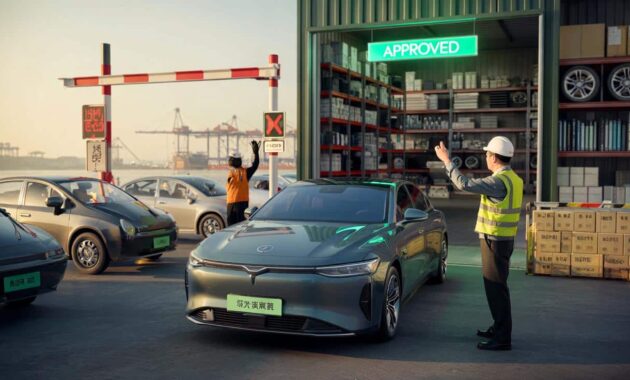
That tension is about to be addressed at the source. Beijing plans to tighten the tap on who can ship cars overseas, and under what conditions, with a clear push toward reliability, parts supply and proper after‑sales care.
Beijing draws a line under the export free‑for‑all
From 1 January 2026, China will introduce export licences for battery‑electric cars, mirroring rules already used for combustion and hybrid models. This is not a symbolic move. Only official manufacturers and companies appointed by those brands will be allowed to export vehicles.
The target is a shadowy slice of the trade that has grown fast. Independent brokers have been buying new Chinese EVs, relabelling them as second‑hand, and shipping them into Europe, the Middle East and Africa. Many buyers then discovered there was no service network, no validated warranty, and no reliable source of spare parts.
From 2026, cars that leave China for foreign markets must sit inside an official channel, with parts, service and software support accounted for before they ship.
French drivers have felt the consequences. Bargain prices sometimes came with long waits for simple components, or confusion over who would handle a fault. That experience hurts brand perception more than any ad campaign can fix.
Why now: image, margins and market access
China’s carmakers have the volume, the tech and, increasingly, the design talent. What they lack in many regions is trust. Regulators in the EU and the US are also taking a sharper look at trade practices, subsidies and safety compliance. Clamping down on grey exports signals a willingness to tidy up the messier edges of the boom.
There’s a financial angle too. When brokers dump cars at cut‑throat prices, official distributors must react. That pushes margins down across the board and makes it harder to fund service centres, parts depots and software updates. Higher quality and a cleaner export pipeline allow brands to defend prices and reinvest in support.
Quality before quantity
The policy shift nudges manufacturers to raise their game rather than flood markets. Standardised processes, documented parts flows and accountable after‑sales plans should become the baseline, not a nice‑to‑have. Think multi‑year battery warranties that are honoured locally, realistic lead times for body and electronic parts, and clear software roadmaps for security and features.
The bet is simple: fewer orphaned cars, fewer broken promises, and more confidence in “Made in China” badges even as tariffs rise.
- Licensing: each export must link to a manufacturer or a brand‑mandated partner.
- Parts availability: proof of inventory and delivery timelines before cars ship.
- Aftersales: named service providers, warranty terms and recall procedures.
- Software: commitment to over‑the‑air updates and cybersecurity compliance.
- Documentation: full conformity packs for local type approval and repairs.
What it means for buyers in france and europe
Expect fewer too‑good‑to‑be‑true deals from brokers. Prices may edge higher as unofficial channels shrink, but owners should get clearer warranties, faster parts and a real person to call when something breaks. Delivery times could stretch during the transition while brands consolidate distribution and build parts hubs in the EU and the UK.
➡️ Banana peels in the garden: they only boost plants if you put them in this exact spot
➡️ Kate Middleton sparks debate after copying Duchess Sophie’s gesture and bending royal protocol
➡️ If your flowers fade quickly, temperature stress is often the reason
➡️ Why people feel drained after constantly monitoring their own reactions
Independent garages gain, too. With proper documentation and parts access, they can service more models without relying on patchy grey‑market sources. Insurers may also smile; cars with stable repair pathways tend to get back on the road sooner and suffer fewer total losses from minor damage.
| Date | Measure | Who is affected |
|---|---|---|
| 1 Jan 2026 | Export licence required for EVs | Chinese OEMs and authorized exporters |
| 2026 onward | Documented after‑sales and parts supply | Buyers, dealers, service networks |
| Immediate signal | Grey‑market clampdown | Independent traders and price‑led importers |
Winners and losers
Official brands stand to win. BYD, SAIC’s MG, Geely’s umbrella and others have already built European distributor networks, signed dealer groups and stocked regional warehouses. A level field punishes undercutters and boosts long‑term brand equity.
Grey traders lose. The margin from arbitrage vanishes when they can’t ship new cars as “used” or ignore service obligations. Some fleet buyers who chased the lowest price may face higher total costs as the real cost of support gets priced in.
Knock‑on effects beyond europe
The US remains tightly shut to Chinese EVs due to steep tariffs. The bigger swing could land in the Middle East, Latin America and parts of Africa, where rapid EV growth has sometimes outpaced the build‑out of service networks. Licensed exports should send cars with a clearer support chain into those markets, too.
Logistics will adapt. Expect more regional parts hubs, more training for local technicians and wider availability of diagnostic tools. Brands that already invested in right‑hand‑drive engineering for the UK and other markets will likely move faster.
What to watch next
Implementation details matter. Regulators must define how brands prove parts availability, how long they must support hardware and software, and how audits will work. Watch for minimum warranty lengths, battery health guarantees, and commitments to keep critical components in stock for a set number of years.
Pricing is the wild card. Cleaner distribution supports higher list prices, but stronger resale values and fewer repair delays can compensate for buyers. Some makers may accelerate local assembly in Europe to blunt tariffs and cut shipping times, which also helps with parts commonality.
Practical tips for would‑be buyers
Before signing for a Chinese EV, ask a few direct questions. Get the VIN checked in the brand’s regional system and confirm that the car will be supported locally. Verify the nearest approved service point and typical wait times for high‑voltage components, body panels and glass. Ask how long over‑the‑air updates will be provided and whether major features require paid subscriptions. Check that the charging port standard matches your region and that the manufacturer stocks adapters if needed.
Grey imports carry specific risks. A car registered as “used” abroad may not receive software updates, roadside assistance or recall fixes in France. Insurers can flag non‑homologated equipment. Resale values often fall if the car can’t be serviced in the official network. The upcoming licensing regime aims to remove those traps from the market.
One last angle deserves attention: parts policy after the warranty. Many mainstream manufacturers aim for at least ten years of parts supply for common items. Buyers should ask for written confirmation of spares availability windows, including battery modules, high‑voltage contactors, inverters and infotainment screens. A clear commitment there can matter more than a temporary discount on the sticker price.