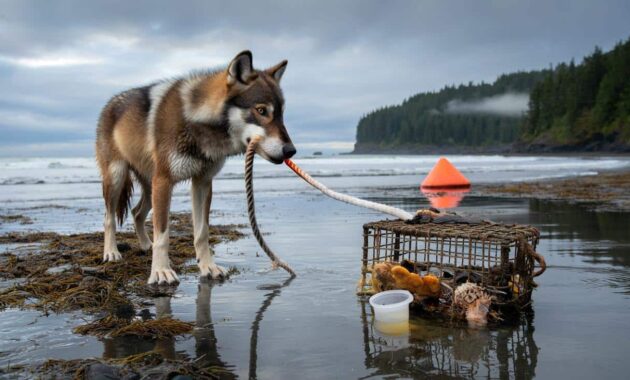
On a remote stretch of Canada’s Pacific coast, an automatic camera recorded a lone coastal wolf performing a sequence of actions so precise that researchers briefly wondered if they were watching a staged scene. They were not. The video has now become one of the most intriguing pieces of evidence challenging how scientists assess animal logic, planning, and even the boundaries of what counts as using a tool.
A three-minute scene that stunned field biologists
The event unfolded on the shores of the Haíɫzaqv (Heiltsuk) First Nation territory in British Columbia. The area is known for its rich marine life and for a unique population of “sea wolves” that spend much of their time patrolling beaches and foraging in the intertidal zone.
In broad daylight, a solitary wolf appears in the camera frame already in the shallows. In its jaws, it holds a bright fishing buoy. Instead of simply chewing on the buoy or abandoning it, the animal walks steadily up the beach.
Once on firmer ground, the wolf begins pulling the rope attached to the buoy, step by step. It bites the line, walks backwards, drops it, and repeats. Each movement shortens the distance between the shore and what lies unseen beneath the waves.
After less than three minutes, the wolf has hauled a full crab pot out of the water. It then focuses on the trap’s bait cup, a small plastic container at the centre of the device. With careful movements, the animal extracts the bait, eats it, and wanders away, leaving the damaged trap behind.
This was not a random tug on a rope but a logical chain of actions aimed at reaching an invisible reward.
The scene answered a practical mystery for local Indigenous Guardians. Working to control invasive European green crabs, they had deployed numerous traps along the shore. Many had been turning up empty, dislodged, or broken without clear explanation. Bears, otters, marine mammals and even human interference were suspected. The camera footage pointed instead to an unexpected culprit: a wild wolf with a knack for problem-solving.
Why this wolf’s actions matter to science
The sequence was analysed and described in the journal Ecology and Evolution by researchers Kyle A. Artelle and Paul C. Paquet. For them, the power of the clip lies not in its drama but in its structure.
From a cognitive point of view, the wolf needed to link several elements:
➡️ What if the key to fighting Alzheimer’s wasn’t in the brain, but in the muscles?
➡️ An extraordinary archaeological find in Kenya could rewrite human history
➡️ A High-Fat Diet Can Harm Memory, Mouse Study Finds
➡️ Turkey goes toe-to-toe with France as it unveils the ideal partner for its next-gen Kaan fighter
➡️ A study analyzed LED headlight power in cars, and the conclusion is what every driver already knows
➡️ No more streaky ceilings: this little‑known roller move gives you a uniform white with no touch‑ups
➡️ It’s lighter than Bolognese: Italians are obsessed with this budget sauce for spaghetti
- The buoy floating at the surface
- The rope leading from buoy to trap
- The crab pot sitting out of sight under the water
- The bait concealed inside a small plastic cup
The food was not visible from the shore. There was no direct sensory cue like the smell of an exposed carcass or the sight of a trapped crab. The wolf’s behaviour implies that it either learned or inferred that pulling the buoy and rope was a reliable path to something edible at the other end.
The animal followed a multi-step plan involving objects, distance and cause-and-effect, all within a couple of minutes.
Researchers have seen captive canids such as dingoes and domestic dogs pull ropes to get food during experiments. Wild wolves, under natural conditions and without human training, are a different story. Until now, no published study had recorded a free-ranging wolf manipulating human fishing gear in this way.
Does this count as using a tool?
The observation feeds into a long-running argument in animal behaviour research: what should be called “tool use”?
Some scientists argue for a broad definition. For them, any situation where an animal uses an external object to reach a goal can qualify. Under that lens, pulling on a rope attached to an underwater trap would count as tool use.
Others prefer a stricter view. They reserve the term for more elaborate manipulation, such as a crow bending a wire into a hook or a chimpanzee stripping leaves from a twig to fish for termites. From this angle, the wolf might not meet the threshold.
Regardless of labels, the behaviour shows advanced problem-solving. The wolf did not simply paw at the buoy or give up after a few seconds. It repeated the pulling sequence with clear focus until the trap emerged, then targeted the bait container rather than randomly attacking the metal frame.
Learning, culture, and the wolf pack question
Artelle and Paquet suspect this may not be the only wolf that has cracked the code of crab pots in the area. They and local monitors have seen other traps dragged, opened, or stripped of bait in ways that resemble the filmed case.
This raises a provocative possibility: coastal wolves may be learning from each other. Social learning, where one animal picks up a technique by watching another, is well documented in primates, dolphins and some birds. In canids, evidence exists in captivity but is harder to pin down in the wild.
If a single innovator in a pack figures out how to turn fishing gear into a buffet, the technique might spread through observation and imitation. Over time, this could create a kind of “micro-culture” of trap-raiding behaviour passed across generations.
Freedom from persecution and room for curiosity
The rarity of such observations does not necessarily mean the abilities are rare. They may simply be hard to witness. The wolves of the Haíɫzaqv territory live in a relatively protected context. Hunting pressure is low, and direct human harassment is limited compared with many other regions.
Researchers argue that this calmer environment likely encourages curiosity. An animal constantly on edge, fleeing gunshots or traps, has fewer chances to experiment with new strategies. Risky or time-consuming behaviours, like working out how to retrieve a hidden bait from a complex object, carry too much danger when humans pose a constant threat.
Where predators are allowed to live with less fear, their minds have more space for experimentation and learning.
This point has broader implications for how conservation is framed. Protecting large carnivores does not only preserve their bodies and genes. It also preserves their behavioural diversity and cognitive potential, from hunting tactics to inventive interactions with human-made objects.
What this means for fishers, managers and coastal communities
For local crab fishers and Indigenous stewardship teams, the crafty wolf is not just a curiosity; it has real-world consequences. Traps cost money, require labour to set and check, and play a role in managing invasive species like the European green crab.
If wolves begin to associate certain buoys or shorelines with effortless meals, conflicts could intensify. Fishers may be tempted to use deterrents or relocate their gear. Managers might need to rethink how and where traps are deployed.
| Potential response | Benefit | Risk or drawback |
|---|---|---|
| Using heavier traps or shorter lines | Harder for wolves to haul to shore | More difficult for humans to retrieve and maintain |
| Changing buoy design | Less tempting or graspable for wolves | Could reduce visibility and safety for boats |
| Moving traps farther offshore | Lower access for coastal predators | Higher costs and more dangerous working conditions |
Any changes must balance animal welfare, conservation goals, and livelihoods. The wolf is not “cheating”; it is doing what predators do best: exploiting opportunities.
Understanding key ideas: cognition, planning and “instinct”
The British Columbia wolf case is a good moment to clarify some common terms. When scientists talk about “cognition” in animals, they refer to mental processes such as attention, memory, learning, problem-solving and decision-making. These can be simple or quite complex.
“Planning” suggests the animal is not just reacting in the moment but anticipating a future outcome. In the video, the wolf repeatedly tugs the rope even though the reward is delayed and hidden. That persistence hints at some expectation of what will happen next, built from past experience.
People often contrast this with “instinct”, as if natural behaviours are rigid, pre-programmed scripts. In reality, most wild species operate with a blend of inherited tendencies and flexible learning. A wolf is predisposed to search for food along shorelines, pay attention to moving objects, and investigate new smells. Turning that predisposition into a four-step technique for raiding crab pots requires learning layered on top of instinct.
If wolves can do this, what else might be happening unseen?
The coastal crab-pot heist inevitably leads to wider questions. How many similar cases never reach a camera? Could other predators be quietly hacking human systems in ways that go unreported?
There are hints from elsewhere. Foxes have been filmed manipulating automatic feeders on farms. Bears learn to open car doors by pulling handles. Raccoons in cities routinely defeat bin locks that were never designed with their nimble paws in mind.
Each of these behaviours adds to a growing picture of wildlife not as passive victims of human change, but as active agents constantly testing, learning and adjusting. The Canadian wolf, standing on a tide-washed beach with a crab trap at its feet, is a particularly clear reminder of that adaptability.
For anyone working in conservation, fisheries, or coastal planning, such cases argue for thinking of wild animals as problem-solvers, not just background elements. When human ingenuity meets animal ingenuity, the results can reshape both science and management strategies, one stolen bait cup at a time.