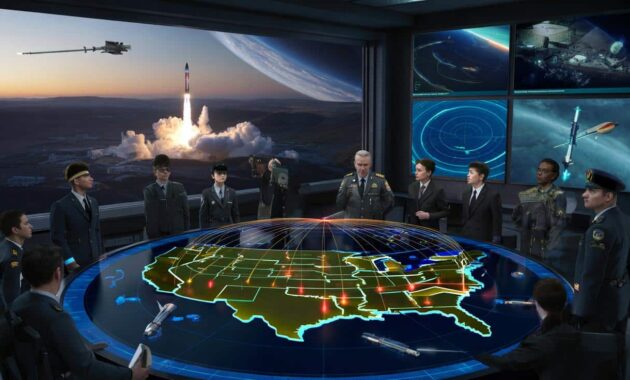
The Pentagon’s Missile Defense Agency has quietly shortlisted more than a thousand companies for Golden Dome, the United States’ planned national air and missile defence shield, laying the groundwork for tens of billions of dollars in potential work over the next decade.
Golden Dome shifts from concept to contracts
Golden Dome began as a campaign promise and is now becoming a sprawling procurement effort. Just days after taking the oath for a second term, President Donald Trump signed an executive order directing the creation of a multi-layered air and missile defence system for the US homeland. The order called not only for ground- and sea-based interceptors, but also for weapons in orbit capable of striking enemy missiles in the first minutes of flight.
The initiative was later branded Golden Dome and assigned to US Space Force General Michael Guetlein, who was charged with designing the overarching architecture and coordinating across the armed services. In September, Guetlein presented his vision to senior Pentagon leaders, outlining how sensors, command-and-control networks and interceptors on land, at sea and in space might be combined into a single integrated shield.
Golden Dome is intended to knit together multiple layers of defence — from early warning satellites to space-based interceptors — under one coordinated architecture.
While broader policy debates continue in Washington, the Missile Defense Agency (MDA) has begun the more prosaic work of hiring industry to build the pieces.
Over 1,000 initial winners for SHIELD vehicle
The contracting backbone for Golden Dome is called the Scalable Homeland Innovative Enterprise Layered Defense, or SHIELD. MDA structured SHIELD as a long-term contracting “vehicle” that the Pentagon can use to issue rapid task orders across many types of work.
The response from industry was intense. MDA received 2,463 offers for the first phase of SHIELD, ranging from defence giants to smaller technology firms. After evaluation, the agency named 1,014 “qualifying offerors” — companies now eligible to compete for follow-on orders under the umbrella contract. The full list was posted to the US government’s central contracting portal.
The umbrella SHIELD vehicle could steer up to $151 billion in work over ten years, but only firms that win future task orders will see any revenue.
MDA stressed that the initial selections simply create a pool of approved vendors. Money will flow only through specific orders placed over time, each competed among relevant companies inside that pool.
➡️ Boiling lemon peel, cinnamon and ginger : why people recommend it and what it’s really for
➡️ China ‘resurrects’ a 50?year?old technology that uses 200 times less energy than digital
➡️ I don’t make mash or gratin at Christmas anymore since I found this potato recipe – it’s a 5/5
➡️ This Creamy Potato Leek Soup Becomes Silky With One Simple Blending Step
➡️ Perfect chestnuts with no mess: the simple method street vendors use
What SHIELD is designed to buy
According to presentation slides shown to industry in Huntsville, Alabama, SHIELD is meant to be a highly flexible tool. The contract can run for up to ten years and cover at least 19 different work areas, from early-stage research to operational support.
Broad categories mentioned in those briefings include:
- Prototyping and rapid experimentation
- Weapon design and integration
- Cybersecurity and resilience testing
- Systems engineering and architecture work
- Data mining, analytics and AI-enabled applications
MDA’s formal announcement emphasised speed and software-heavy methods. Officials highlighted the use of artificial intelligence, machine learning, model-based systems engineering and “open systems architectures” — all buzzwords in current US defence procurement. Agile development processes, common in commercial tech, are being written into the contract language to shorten timelines between concept and fielded capability.
AI, digital engineering and rapid delivery
Golden Dome is arriving at a moment when the Pentagon is under pressure to move faster against rapidly evolving missile threats, including hypersonic weapons and low-flying cruise missiles that can slip past older radar networks.
MDA officials say SHIELD is intended to avoid the slow, bespoke acquisition cycles of past missile defence projects. Instead of crafting a new contract from scratch for each subsystem, the Department of Defense can issue a task order under SHIELD, select from a pre-vetted pool of suppliers and focus competition on technical solutions.
By front-loading the competition, MDA hopes to shorten the gap between recognising a threat and fielding a countermeasure.
Digital engineering is central to that push. Under model-based systems engineering, engineers build detailed digital twins of radars, interceptors and networks, allowing them to run simulations, identify integration problems and test upgrades without waiting for expensive hardware builds. When combined with open architectures, this approach should make it easier to swap components, insert new sensors or plug in better algorithms without redesigning the whole system.
Space-based interceptors: the most controversial layer
One of the most politically sensitive aspects of Golden Dome is its space layer. The administration has directed the Pentagon to pursue space-based interceptors (SBIs) capable of shooting down enemy missiles during their boost phase, just after launch when they are still climbing and relatively bright against the cold of space.
Last week, the US Space Force quietly made its first prototype awards for SBIs. The contracts are comparatively small and many details are classified. Pentagon officials have not publicly named the winning companies, citing security concerns and the early, experimental nature of the work.
Boost-phase intercept has long been described as technically challenging and expensive. Interceptors must be positioned close enough to potential launch sites and react within minutes. Proponents argue that hitting missiles before they release warheads or decoys simplifies the defensive problem later on. Critics warn of escalation risks and question whether orbiting interceptors would prove resilient against anti-satellite weapons.
Pentagon leadership weighing implementation plan
Golden Dome’s future scale still depends on political decisions. At a recent White House cabinet meeting, Defense Secretary Pete Hegseth said he had reviewed the Golden Dome plans. He did not state publicly whether he had signed off on the formal implementation roadmap, which is expected to pass through his office after review by Deputy Defense Secretary Steve Feinberg.
That implementation plan will influence everything from the number of interceptors in each layer, to the pace of deployment, to the balance between classified and unclassified work. It will also help determine which services — Space Force, Army, Navy or Air Force — take the lead on specific elements.
What this means for industry and taxpayers
For defence companies, SHIELD represents one of the largest potential revenue streams of the decade. The notional ceiling of $151 billion reflects the possibility of many different task orders across research, hardware, software and sustainment. Large primes are expected to lead complex systems work, while mid-size and smaller firms may find niches in analytics, cyber, specialised sensors and AI tools.
Taxpayers may see both benefits and risks. A well-designed layered defence could reduce the country’s vulnerability to limited missile attacks or accidental launches and provide political leaders with more options in a crisis. At the same time, critics worry that ambitious missile defence projects can encourage arms races, as adversaries invest in more warheads, decoys, or offensive cyber tools to overwhelm or blind the shield.
| Aspect | Potential benefit | Potential risk |
|---|---|---|
| Layered defence | Multiple chances to defeat incoming missiles | Adversaries respond by building larger arsenals |
| Space-based interceptors | Early kill before warheads and decoys separate | Higher costs, vulnerability to anti-satellite attacks |
| AI and automation | Faster tracking and engagement decisions | Algorithmic errors, cyber vulnerabilities |
| Open architectures | Easier upgrades and competition | Complex integration and standards management |
Key concepts behind Golden Dome
Several technical phrases used in the Golden Dome discussion can sound opaque. “Open systems architecture” means designing hardware and software using common, published standards, so different vendors’ components can be mixed and matched. This reduces lock-in to any one supplier and should allow cheaper upgrades.
“Model-based systems engineering” refers to replacing thick paper specification documents with living digital models that represent how a system behaves. In a missile defence context, engineers can, for example, adjust radar parameters in the model and instantly see how that affects detection ranges or tracking accuracy in different weather conditions.
“Agile processes” are borrowed from the software industry. Instead of spending years writing requirements and building one large deliverable, teams deliver smaller increments, get user feedback, and iterate. For a system like Golden Dome, that might mean regularly rolling out improvements to tracking software or data fusion algorithms, rather than waiting for rare, monolithic upgrades.
Future scenarios and challenges
One practical scenario often discussed by strategists involves a limited salvo of cruise missiles launched from offshore. Golden Dome’s vision would see satellites detect the launch platform, over-the-horizon radars cue regional sensors, and a mix of fighter aircraft, ground-based interceptors and perhaps directed-energy weapons engage the incoming missiles. All of that would rely on fast, secure data-sharing across services and command centres.
Another scenario centres on a rogue state firing a small number of ballistic missiles toward US territory. Space-based sensors would spot the launch, space-based interceptors might attempt an early kill in boost phase, and midcourse interceptors on land could provide a second layer of protection. Terminal defence systems close to likely targets would offer a final line. Golden Dome aims to orchestrate that sequence without confusion or delay.
Several risks stand out. Software-heavy systems can be attractive targets for hackers, so cybersecurity will shape every layer, from satellite links to command consoles. Human decision-making also remains central: even with AI-enabled tools, commanders need clear, reliable information and training to avoid miscalculation. Arms control debates may intensify, as rivals interpret a more robust US shield as a reason to adjust their own nuclear strategies.
For now, the practical story lies in the numbers: over a thousand companies have been invited into the tent, a decade-long contract vehicle is in place, and early money is beginning to flow. Whether Golden Dome becomes a cornerstone of US defence or a cautionary tale about ambition and complexity will depend on choices made in the next few years, far from the cameras, in budget drills, design reviews and classified test ranges.
Originally posted 2026-03-09 00:36:00.