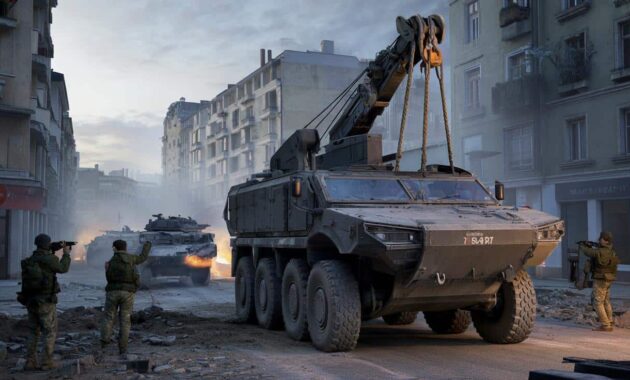
France has just signed a major deal for a new fleet of armoured heavy recovery vehicles, designed to keep its cutting‑edge SCORPION combat brigades moving under fire. Behind the dry language of procurement sits a clear message: breakdowns and battle damage can no longer be allowed to halt an armoured advance.
From breakdown to breakthrough: why France wants heavy recovery colossi
The contract, notified on 22 January 2026 by France’s defence procurement agency (DGA), awards Alsace‑based company Soframe a strategic framework agreement for new Engins Lourds de Dépannage (ELD) – heavy recovery vehicles tailored to the SCORPION programme.
The initial order covers 20 vehicles to be delivered in 2027, with five due before the end of the first half of the year. An option allows the French Army to acquire up to 80 more, creating what officers already liken to an “army of colossi” dedicated to rescuing stricken armour.
The new recovery vehicles are treated as combat assets in their own right, not just logistics trucks with a winch.
The logic is simple. SCORPION’s latest armoured vehicles – the Griffon troop carrier, Serval light multi‑role vehicle, Jaguar reconnaissance vehicle, and upgraded Leclerc XLR tanks – are heavier, more complex and packed with electronics. They operate in high‑threat environments where recovery often happens under enemy observation, or direct attack. Traditional recovery trucks are reaching their limits.
Old workhorses under strain
For roughly a decade, French heavy recovery has rested on two main platforms: the Renault Kerax 420, a tough but fairly conventional truck, and the Porteur Polyvalent Lourd de Dépannage (PPLD), a protected recovery truck introduced from 2014 and co‑developed by Iveco and Soframe.
France fields around 50 PPLD vehicles. They are capable machines, with a crane able to lift 12 tonnes, an 18‑tonne main winch, an additional spooling winch, and a MAG 58 7.62 mm machine gun for self‑defence.
Yet the weight class and complexity of SCORPION systems, plus the shift towards combat in cluttered, urban or semi‑urban terrain, have exposed the limits of these older designs. Recovery units must now operate closer to the frontline and under harsher conditions than during the counter‑insurgency campaigns of the 2000s and 2010s.
Stopping a column because one vehicle throws a track or loses power is no longer acceptable in high‑intensity war planning.
➡️ Car experts share the winter tire-pressure rule most drivers forget
➡️ Panettone and pandoro: do you really know the difference between the two?
➡️ People who struggle with vulnerability often associate it with loss of stability
➡️ This small habit helps keep everyday items accessible
➡️ A tourist left a bag of cheese chips in the biggest US cave. Nobody expected what happened next
DGA’s brief: a proven heavy lifter, ready for war
A “simple” but demanding specification
The DGA’s call for tenders sounded straightforward on paper: provide a heavy recovery vehicle that can extract, lift and tow all wheeled vehicles in the SCORPION programme, while keeping its crew alive in a contested battlespace.
This meant an armoured cabin, serious lifting gear, high‑capacity winches, and the ability to contribute directly to maintenance operations in the field. The formal specification does not dwell on weaponry, but survivability for the three‑person crew is treated as a central requirement.
One less visible condition was just as strict. The DGA wanted a system already proven in service, not a prototype. Bidders had to show they had produced and delivered comparable vehicles in the previous five years. That criterion favoured companies with export success and recent production runs, not paper projects.
Soframe’s win and the SCORPION timetable
When the competition launched in spring 2025, several European manufacturers were seen as possible contenders. Soframe’s proposal emerged on top and was formally selected on 22 January 2026.
The timeline is tightly linked to SCORPION’s broader ambitions. France aims to field a fully equipped “combat division” by around 2027, with thousands of Griffon, Serval and Jaguar vehicles integrated into a digitised command network. If that division is to manoeuvre at pace, its maintenance and recovery chain has to arrive on the same calendar.
The ELD fleet is being synchronised with the rollout of SCORPION brigades, not treated as an afterthought.
The contract structure allows for a rapid ramp‑up. If all options are exercised, France could have up to 100 of these heavy recovery vehicles, dramatically reinforcing its ability to keep armoured formations on the move during prolonged, high‑intensity engagements.
A close cousin of Belgium’s protected recovery vehicle
The future French ELD is not an unknown quantity. It is closely derived from the Protected Recovery Vehicle (PRV) that Soframe has already supplied to the Belgian armed forces under their CAMO partnership with France.
That family link offers two advantages. First, it gives France a system that has already been built, tested and delivered. Second, it boosts Franco‑Belgian interoperability. Units from both countries will be able to operate side by side using almost identical tools, simplifying joint exercises and potential deployments.
What these “colossi” can actually do
Soframe’s PRV is designed as a frontline workhorse. It is built on an 8×8 all‑terrain chassis, with a powerful lifting and towing system, plus an armoured, pressurised cabin to shield the crew from small‑arms fire, mines and improvised explosive devices.
Key technical characteristics of the PRV, which strongly indicate what France’s ELD will look like, include:
| Key feature | Specification (PRV baseline) |
|---|---|
| Primary role | Extraction and recovery of armoured vehicles on the frontline |
| Configuration | 8×8 off‑road truck |
| Crew | 3 personnel |
| Protected cabin | Against ballistic threats, mines and IEDs |
| Maximum vehicle mass to be recovered | Up to 50 tonnes |
| Recovery boom | Lift up to 14 tonnes |
| Main winch | 20 tonnes, 80‑metre cable |
| Top speed | Approx. 90 km/h |
| Range | About 800 km |
| Off‑road capability | Gradients up to 60%, fording depth around 70 cm |
| Dimensions | Roughly 10.4 m long, 2.5 m wide |
This gives recovery crews the ability to winch or tow anything from a stuck Griffon to a badly damaged Jaguar out of danger, then either bring it back to a repair point or at least clear the route for following vehicles.
Soframe and the business behind the battlefield
Soframe itself is not a household name, even in France, but its fingerprints are all over European military logistics. The company, founded in 1978 in Alsace, specialises in protected tactical and logistical vehicles.
It is part of the Lohr group, which earns around 400 million euros a year in revenue, roughly 80% from exports. Lohr operates six factories on three continents and employs about 2,000 people, making it a sizeable mid‑tier player in the defence and transport sector.
By leaning on a mid‑sized national champion, Paris is also signalling that defence industrial sovereignty extends beyond tanks and missiles.
The ELD contract gives Soframe a long‑term production horizon, while offering the French Army a partner already familiar with military standards and export regulations. It also positions the firm to compete for similar recovery and support contracts elsewhere in Europe, especially among countries buying French‑designed armoured vehicles.
SCORPION: reshaping how France fights on land
The heavy recovery deal sits inside a much larger transformation. Launched in 2014, the SCORPION programme is France’s 15‑year effort to renew its land forces. More than nine billion euros are being invested in new armoured vehicles, sensors, radios and digital command systems.
By 2030, France plans to have roughly 4,500 new combat platforms in service, including:
- Griffon armoured troop carriers for frontline transport and command roles
- Serval lighter vehicles for reconnaissance and patrol missions
- Jaguar reconnaissance and combat vehicles equipped with a 40 mm gun and anti‑tank missiles
- Leclerc XLR upgraded main battle tanks with new electronics and protection
All of these are linked through a shared digital combat system, designed for “collaborative combat”. Vehicles, drones and command posts exchange data in near real time, spotting threats and coordinating fire far faster than legacy systems.
That digital backbone adds another twist for recovery crews. A damaged vehicle is no longer just steel and optics; it is a node in a network. Losing it can break situational awareness for the whole unit.
What this means on tomorrow’s battlefield
On paper, a heavy recovery truck is not glamorous. In practice, it can be the difference between a stalled battlegroup and one that keeps rolling.
Imagine a SCORPION‑equipped brigade pushing through a contested town. A Griffon hits a mine at a crossroads. In the past, recovery might have waited for enemy fire to ease off, or the column might have detoured. Now, with faster enemy sensors and drones, delays are dangerous. A protected 8×8 ELD can push forward under armour, winch the wreck out of the way, and clear the route in minutes, while its crew remains under protection.
Recovery vehicles act as battlefield firefighters, racing towards trouble instead of away from it.
There are risks. Heavy recovery vehicles are large, high‑value targets. If they are knocked out or their numbers are too limited, an army’s freedom of manoeuvre shrinks rapidly. Training, doctrine and the integration of these assets into combat planning are as crucial as the hardware itself.
For non‑specialists, a couple of terms are worth unpacking. When French officers talk about “maintenance in operation”, they mean fixing what can be fixed on the spot – changing damaged wheels, repairing basic systems, or stabilising a vehicle before it is towed. “High‑intensity conflict” refers to warfare against a capable, well‑armed enemy, with heavy artillery, drones and electronic warfare, closer to Ukraine than to Afghanistan. In that environment, any delay on a road or any stationary target can be lethal.
The French decision to invest in an “army of colossi” for recovery hints at a broader trend. As Western militaries prepare for tougher wars, the less visible pieces of the puzzle – logistics, repair and rescue – are moving closer to the centre of strategy. Shiny new tanks and armoured cars may grab more attention, but without hulking recovery giants right behind them, they may not get very far.