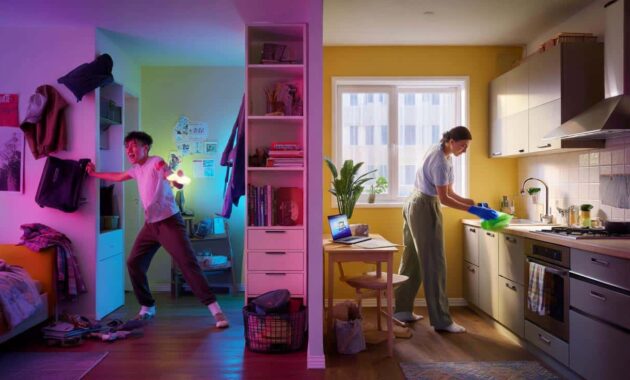
The other night I watched my neighbor’s teenager clean their room with a kind of violent determination. Clothes flying onto the bed, drawers slamming, music at full volume. Two floors down, an older woman in our building was slowly dusting the same shelf for the third time, as if it were a ritual. And there I was in the middle, wiping the kitchen counter because I couldn’t think straight until the crumbs were gone.
We were all cleaning.
But we were clearly not doing the same thing.
At different ages, cleaning stops being only about hygiene and starts to say something quiet and deep about who we are, what we fear, and what we’re trying to control.
The sponge, oddly enough, grows up with us.
When cleaning is really about identity
As a child, cleaning usually starts as something imposed. Your parents shout from the hallway: “Tidy your room before dinner!” and you, reluctantly, shove toys under the bed, calling it a day. The gesture feels unfair and slightly absurd. You don’t really care where your socks end up, as long as you can find your favorite one-eyed teddy bear.
Then adolescence hits, and the mess becomes a flag.
The chair buried under hoodies, the carpet you haven’t seen in three weeks, the sink with three cups of ramen stuck in a silent protest against adulthood.
Your room is not dirty, it’s “creative chaos”.
Or at least that’s what you tell yourself.
Think of a university dorm on a Sunday afternoon. Someone is running around with a bin liner, trying to recover lost cutlery. Another student is “deep-cleaning” for the first time in months because their parents are visiting. You can practically smell the panic through the disinfectant spray.
Then a bit later, in your first apartment, every wipe of the counter has a new meaning.
Suddenly, you’re buying your own sponge.
You almost feel proud of your dish soap.
There’s a quiet thrill in seeing your bathroom look like something out of a rental listing photo, even if it lasts barely 24 hours. This is the moment when cleaning stops being only a punishment and starts to feel like proof you can somehow handle life.
What really shifts is not the dust, but the story your brain tells about it. As a teen, mess can feel like territory, a space that says “this is mine, and I won’t be policed”. In your twenties, order starts to equal competence. A tidy studio is a subtle announcement: I may be broke, but I’m not lost. Then, as the years pile up, cleaning becomes a way to draw lines around your time, your energy, your mental health.
We don’t just clean our floors.
We clean our anxiety, our shame, our need to feel in control of at least one tiny corner of the world.
How life stages quietly rewrite your cleaning rituals
One simple method to notice the shift is to track what triggers you to clean at different ages. As a student, you often clean in bursts right before an exam, a date, or a visit. The mess grows, grows, grows… and then one night you look around and attack everything in a two-hour frenzy. Later, when you share a place with a partner or roommates, cleaning becomes negotiation.
You start saying things like: “If I cook, can you do the dishes?”
Suddenly, the shape of your relationship is visible in the grease on the stove and the crumbs in the sink.
Then come the years when you’re possibly living with young kids, pets, or both. You clean in loops. You pick up toys, fold laundry, wipe jam from the table, and five minutes later the living room looks like you did nothing. This is usually when people invent “good enough” cleaning. One corner of the house turns into the sacred tidy zone, the one you photograph if someone asks how things are going. The rest? It’s lived-in, chaotic, sticky in places.
Let’s be honest: nobody really does this every single day.
Even the influencers with perfect white couches crop the mess out of frame.
Later, when the kids (if you have them) grow up or when you live alone again, the tempo shifts yet another time. You’re no longer chasing after sticky fingers. You might notice yourself cleaning slower, with more attention. The same shelf you used to dust once a month becomes part of a weekly ritual. The sound of the vacuum cleaner on a Saturday morning becomes oddly reassuring.
That’s when cleaning starts to mean continuity.
It’s a way to say: I am still here, this is still my home, and I’m taking care of it.
*The gestures haven’t changed, but the emotional weight behind them has completely transformed.*
Turning cleaning from burden into quiet self-respect
One practical shift that helps at every age: shrink the battlefield. As a teenager, the idea of “clean your room” feels huge, almost philosophical. As an adult, “deep-clean the whole apartment” on a Sunday can kill your mood before you’ve even finished your coffee. Instead, choose one tiny, visible area and give it your full focus.
The bedside table.
The kitchen sink.
The desk you work at every day.
Spend 10–15 minutes making just that one spot genuinely pleasant. Very often, your brain reads this tiny island of order as a huge internal victory.
Another thing that quietly sabotages us is comparison. You look at a friend’s minimalist living room and suddenly your home feels like a storage unit. Or you visit a relative whose house smells like lemon cleanser and childhood discipline, and you leave feeling guilty about the crumbs on your own sofa. This is where age plays tricks: we keep judging our current life with past or future standards.
If you’re parenting toddlers and working full-time, your home will not look like your retired aunt’s.
And that’s not a failure, it’s physics.
Cleaning at 25, 40, or 70 simply doesn’t happen with the same body, the same schedule, or the same priorities. The dust doesn’t change, but you do.
At some point, a therapist told me, “Your house doesn’t need to be ready for guests. It needs to be ready for you.”
That sentence hit me harder than any cleaning checklist.➡️ Satellite Images Reveal the Reality of Saudi Arabia’s $2 Trillion Megacity in the Desert
➡️ 3I/ATLAS: a strange radio signal was detected from the interstellar comet
➡️ He hid an AirTag in his sneakers before donating them: and traced them to a market stall
➡️ Soon a driving licence withdrawal for senior motorists after a certain age ?
➡️ If your mornings feel heavy, this first action makes a difference
➡️ This forgotten breakfast recipe combines eggs and bread in a surprisingly comforting way
- Define your current season
Are you in a study-til-2 a.m. phase, a baby-years phase, a sandwich-generation phase? Clean for that reality, not for a fantasy life. - Pick a “non-negotiable” micro-task
One load of laundry, cleared sink at night, swept hallway. One thing that signals to your brain: I took care of my space today. - Create one pride corner
A shelf, a coffee table, part of your bedroom. Keep just that spot consistently calm and nice. It gives you a reference point on chaotic days. - Drop the museum standard
Homes are for living, not for impressing visitors. A little visible life is normal. Dust is not a moral failure. - Notice what cleaning soothes
Are you scrubbing when you’re anxious? Folding when you’re sad? Once you see the pattern, you can decide if that habit helps or hides something.
What your way of cleaning is trying to tell you
The more you pay attention, the more you realize that your cleaning patterns are like a quiet diary. The phase when you left dishes for days might line up with a period of burnout or heartbreak. The sudden urge to reorganize your closet often arrives right before a big decision. And when older relatives start fussing over tiny details, like the precise angle of framed photos or the order of coffee cups, it can be a way of holding onto structure when health, mobility, or relationships are shifting under their feet.
We’ve all been there, that moment when wiping a surface feels easier than facing a difficult conversation.
Across all these stages, one plain-truth sentence keeps emerging: cleaning is rarely just about cleaning. For a teen, it can be silent rebellion. For a young adult, a performance of competence. For a stressed parent, a losing battle that they still fight because love often looks like picking up the same toy twenty times. For someone aging alone, it can be the last solid routine in a week that changed too much.
When you look at it this way, the question stops being “Why am I still not more organized?” and becomes something softer, like “What do I need, really, when I start scrubbing the bathroom at 11 p.m.?”
Once you start listening to your own habits, the guilt loses some of its power. You might notice you clean obsessively when you feel out of control at work. Or that you stop cleaning at all when you’re overwhelmed by sadness. Neither makes you a “messy” or “neat” person. They simply mark chapters. The sponge, the vacuum, the folded towels in the closet — they’re small props in a much bigger story about growing up, changing, grieving, hoping.
And that story, unlike your floors, never really gets finished.
| Key point | Detail | Value for the reader |
|---|---|---|
| Cleaning changes with life stages | From childhood obedience to teen rebellion to adult ritual | Helps you stop judging your current habits by outdated standards |
| Small zones beat total control | Focusing on one visible area creates a sense of progress | Reduces overwhelm and makes tidying feel actually doable |
| Mess and order carry emotions | Patterns of cleaning often mirror stress, identity, or transitions | Lets you use cleaning as a signal, not just a chore |
FAQ:
- Why did I love cleaning as a kid but hate it now?As a child, cleaning can feel like a game or shared time with an adult. Later, it starts to carry the weight of responsibility, and that shift can turn a playful task into a pressure point.
- Is it normal to clean more when I’m stressed?Yes, many people use cleaning as a way to regain control when life feels unpredictable. It can be soothing, as long as it doesn’t become the only way you cope.
- Why does my parents’ house always feel cleaner than mine?They may have different time, habits, or standards based on their life stage. Comparing a busy, early-career or kid-filled home to a quieter, established one is rarely fair.
- How can I stop feeling guilty about my messy place?Shift the question from “Is my home spotless?” to “Can I live and rest here?” Start with one small area, and remember your worth isn’t measured in dust bunnies.
- Will my relationship with cleaning keep changing?Almost certainly. As your health, work, relationships, and priorities evolve, your way of caring for your space will follow — and that’s a sign of life, not failure.