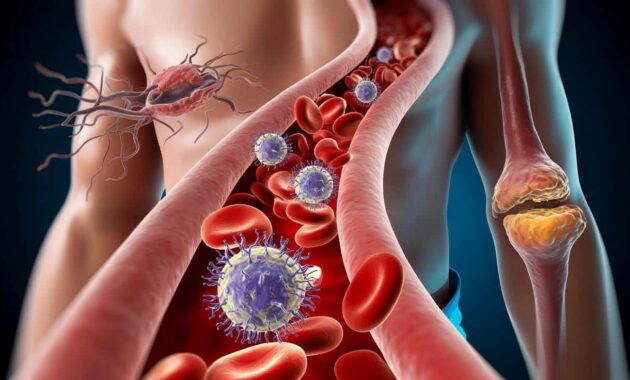
Now fresh research suggests that this almost universal infection, the Epstein–Barr virus, could quietly tilt some people’s immune systems toward serious disease.
Epstein–Barr: the virus almost everyone carries
Epstein–Barr virus, often shortened to EBV, is one of the most widespread human viruses on the planet. More than nine in ten adults carry it.
Most people catch EBV in childhood or adolescence. Many never realise they were infected at all. Others develop glandular fever, also known as infectious mononucleosis: a few weeks of sore throat, swollen glands and exhaustion, then a return to normal life.
For a long time, that was thought to be the end of the story. The virus stays in the body in a “latent” state inside certain immune cells, but without obvious symptoms.
New large-scale genetic data now point to EBV as a possible trigger for autoimmune diseases in a vulnerable minority.
Autoimmune diseases happen when the immune system, designed to attack germs and cancer cells, starts attacking healthy tissues. Multiple sclerosis, lupus and rheumatoid arthritis are some of the better-known examples.
Not everyone exposed to EBV is at risk. What separates the many who live peacefully with the virus from the few who later develop autoimmune disease has been a long-standing mystery.
A huge study spots a dangerous persistence
An international team recently sifted through health and genetic data from more than 700,000 people, using major research programmes such as the UK Biobank and the US All of Us project.
They looked for traces of EBV in blood samples long after the initial infection should have settled.
➡️ This nostalgic vanilla custard recipe tastes like something from a classic bakery
➡️ Why chefs often taste sauces repeatedly while cooking
➡️ How redefining “leftover money” changed my savings approach
➡️ For perfectly golden, tender scallops, top chefs swear by this simple step before cooking
Around 10% of participants still carried noticeable levels of viral material in their blood. For them, EBV was not just sleeping quietly in a corner of the immune system; it was lingering in a measurable way.
Persistent EBV in the bloodstream appears linked to a higher risk of later autoimmune disease, especially in people with certain genetic variants.
This persistence matters because the immune system is not designed to be on red alert all the time. Constant exposure to viral DNA can keep immune cells activated in a low, simmering way for years.
That ongoing stimulation may slowly twist the system out of shape. In people whose genes already make their defences a little jumpy or poorly regulated, EBV could push things over the edge.
The genetic fingerprints of risk
To understand why some people struggle to control EBV, researchers examined participants’ genomes. They identified 22 regions of DNA that appear to influence how well the body keeps the virus in check.
Several of these regions sit in or near genes involved in immunity, especially a cluster known as the major histocompatibility complex (MHC). This system helps the body distinguish “self” from “non-self”.
Immune cells use MHC molecules to present viral fragments at their surface, effectively waving a flag that says “this cell is infected, attack here”. If the MHC system carries certain variants, that signalling process may be less efficient.
When EBV slips through that surveillance, it can stay active longer. The immune system does not simply give up; instead, it keeps trying, sending up wave after wave of cells and signalling proteins.
Over the years, this constant crossfire can blur the lines between invader and self. Some immune cells start reacting to the body’s own proteins, leading to autoimmune damage.
From a common infection to lupus and multiple sclerosis
Research has long hinted at a link between EBV and diseases such as lupus and multiple sclerosis (MS). People with MS almost always have a history of EBV infection, and high levels of EBV antibodies often appear years before MS symptoms.
The new genetic findings add another piece to the puzzle. They suggest that EBV does not cause autoimmune disease on its own, but acts as a powerful spark in people whose genes and possibly other factors prime them for trouble.
- EBV infection: nearly universal, usually mild or silent
- Genetic susceptibility: variants in immune-related genes, especially MHC
- Viral persistence: measurable EBV traces years after infection
- Chronic immune activation: immune cells kept in a constant low-grade battle
- Autoimmune shift: immune responses start targeting healthy tissues
This “multi-hit” model fits with what doctors see in clinics. Family history, sex, hormones, environmental exposures and infections all combine to influence who eventually develops an autoimmune condition.
Why only a minority get seriously ill
One of the striking aspects of EBV is that nearly everyone carries it, yet only a small fraction develop severe autoimmune disease. That contrast raises a natural question: should people be worried about their own risk?
For most, the answer is no. The vast majority of EBV infections cause no lasting harm. The new studies do not suggest that everyone with past glandular fever is heading towards lupus or MS.
EBV seems to act as a risk amplifier rather than a simple cause: it increases the odds of autoimmune disease in those who are already predisposed.
Still, for scientists, this common virus has become a valuable window into how autoimmunity begins. By tracking who carries persistent EBV and which genetic variants they hold, researchers can map out pathways that might be targeted with drugs or vaccines.
A new target for future treatments and vaccines
The idea that a single, very common virus can nudge the immune system towards long-term disease is changing how scientists think about prevention.
One obvious route is vaccination. Several pharmaceutical companies are now testing experimental EBV vaccines. Most are designed to prevent the initial infection or at least blunt its severity.
No vaccine is yet licensed for the general public, and researchers still need to show that preventing EBV infection truly cuts the risk of autoimmune disease decades later. That type of proof demands long, careful follow-up.
Another approach is precision medicine. By studying the 22 genetic regions tied to EBV persistence, scientists hope to spot people whose immune systems struggle the most with the virus.
| Strategy | Goal | Current status |
|---|---|---|
| EBV vaccination | Prevent or reduce primary infection | In early-stage human trials |
| Genetic risk profiling | Identify individuals prone to persistent EBV | Research use only for now |
| Immune-modulating drugs | Calm chronic activation linked to EBV | Concept supported by data, drugs in development |
In theory, people at higher risk could receive tailored monitoring or preventative drugs that nudge their immune system back into balance before symptoms appear.
What terms like “autoimmune” and “latent virus” really mean
Much of the discussion around EBV rests on concepts that sound abstract but have very concrete effects on health.
An autoimmune disease is one where the body’s defence system mistakenly targets its own tissues. That can mean joints, nerves, skin, kidneys, or almost any organ. The symptoms depend on what is under attack, from muscle weakness to vision loss or disabling fatigue.
A latent virus is a different kind of problem. Instead of constantly replicating and making people acutely ill, it hides inside cells and reactivates occasionally. EBV does this in B cells, a type of white blood cell. Most of the time, the immune system keeps this low-level reactivation under control.
When control slips, even slightly, years of small flare‑ups can slowly reshape how the immune system behaves. That long game is what researchers are now starting to trace with detailed genetic and blood data.
What this means for everyday life and future risk
For individuals, there is no routine test in a GP surgery that can currently say, “your EBV is persistent and you will get an autoimmune disease”. The research is not yet at that stage.
What it does suggest is that preventing severe infections, supporting general immune health and diagnosing autoimmune disease early still matter a great deal.
Doctors are watching the EBV story closely. If future trials show that vaccination or early antiviral strategies reduce MS or lupus cases, guidelines for adolescents and young adults could shift dramatically.
There is also a broader lesson: other common viruses, not just EBV, might leave similar long shadows in the immune system. As large biobank projects mature, scientists may find additional links between everyday infections and long‑term chronic conditions.
For now, EBV has moved from a background character in medical education to a central suspect in the complex chain of events that leads some immune systems to turn on their owners. The next decade of research will show how much of that risk can be prevented—or even reversed.