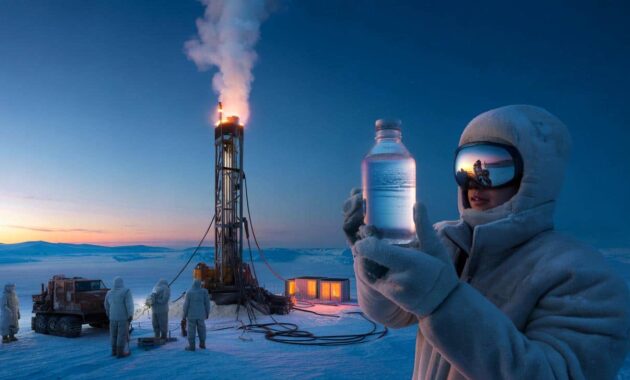
The drill hums like a distant beehive under a sky that never really gets dark. At the edge of the world, on a patch of Antarctic ice that looks almost painfully clean, a cluster of container labs glows orange against the blue-white emptiness. Breath freezes on eyelashes. Coffee cools in seconds. On a laptop screen inside one of those containers, a green line suddenly spikes: the drill has broken through. Two kilometers of ancient ice, gone. Below, a pocket of water that last saw the sun when forests still fringed this frozen continent, 34 million years ago.
Minutes later, a photo leaks online. Someone writes “playing god” in the comments. Another: “We can’t even handle the climate crisis and now we’re poking at lost worlds?”
The scientists are cheering anyway.
Inside the day they pierced a 34-million-year time capsule
On a good day in Antarctica, the wind only screams instead of roars. The morning they broke through the ice, the temperature hovered around –25°C, which counts as almost gentle here. A line of yellow drilling rigs hunched against the wind, steel teeth biting into ice that started forming when our ancestors were furry insect-eaters.
Inside the control cabin, everyone watched the monitor like a heart-rate screen in an ICU. One scientist, an early-career glaciologist from New Zealand, clutched a cracked ceramic mug she’d brought from home. When the data suddenly shifted, she dropped it. It shattered on the steel floor just as the drill punched into the hidden lake. The room went quiet. Nobody breathed. Then the radios crackled: “We’re in.”
The project, which took years of planning and almost a decade of politics, aims to reach a buried subglacial lake sealed off since the dawn of the modern Antarctic ice sheet. Think of it as a natural vault: water trapped beneath 2,000 meters of ice, isolated since a time when global temperatures were several degrees warmer and palm-like plants grew much closer to the poles.
The drill they used is not a simple metal screw. It’s a hot-water drilling system that melts its way down, recycling melted ice as it goes. The team drilled around the clock in shifts, living among humming generators and the constant smell of diesel. Each meter down meant thousands of years into the past. Each pause to clean filters or fix a hose meant precious hours lost in a race against refreezing. It was brutal, repetitive, and oddly intimate work—chipping away at deep time, centimeter by centimeter.
What they’re really hunting isn’t a monster or some cartoonish “ancient virus.” It’s a record. Trapped in that isolated water might be old DNA, rare microbes, traces of volcanic eruptions, clues to how ice sheets respond when the planet warms fast and hard. Antarctica has long been the planet’s slow, silent hard drive. You read it not with a USB cable, but with drills and patience.
Yet the moment that drill broke through, the story stopped belonging only to the scientists. Climate anxiety is now part of everyone’s mental wallpaper. We watch cities flood on TikTok, count heatwaves on our calendars, and then see a headline about humans punching into an untouched ecosystem under a continent already destabilizing. For some, the research looks like genius. For others, like arrogance with a lab coat on.
How do you “touch” a lost world without contaminating it or the rest of us?
On paper, the method is almost obsessively careful. Before the drill ever met the ice, every hose, nozzle, and pipe was scrubbed, baked, and bathed in disinfectant. The water used for drilling was triple-filtered, UV-treated, and heated to melt the borehole while staying as “clean” as humanly possible.
➡️ Not in the fridge or the fruit bowl: the best place to keep strawberries so they don’t rot
➡️ “No one explained how to do it”: their firewood stored for months was actually unusable
➡️ How a single rubber band can help you open stubborn jars instantly
➡️ Birdwatchers say this one winter fruit keeps robins loyal to your garden
The crew moved like a surgical team. Gloves, masks, full-body suits, endless swabbing of surfaces. The first liters of water that came back from the hidden lake weren’t triumphantly poured into beakers. They were collected like precious crime-scene evidence, sealed in sterile containers, logged, barcoded, and tucked into mobile freezers as if the slightest breath could rewrite the story of this ancient water.
Outside the field camp, though, the story looked different. Environmental groups shared drone images of the borehole site: scars in the snow, tracks from heavy vehicles, stacks of fuel barrels. Commentators asked how many tons of CO₂ the mission generated just to reach a pocket of water that had quietly minded its own business for tens of millions of years.
One viral post read: “We’ve warmed the planet, melted the ice, and now we’re drilling into what’s left. What could possibly go wrong?” It wasn’t a scientific question; it was an emotional one. A lot of people feel like we’ve been lied to for decades about risk, safety, and “manageable” impacts. So when experts say, “The protocols are rigorous, contamination is extremely unlikely,” some readers hear something else: “Trust us. Again.”
Scientifically, the logic is straightforward. Knowing how this ancient lake ecosystem works could help refine models of how ice sheets collapse and oceans rise in a world that’s heating faster than predicted. If scientists understand how Antarctica behaved during past warm periods, they can better forecast which coastal cities are in danger and when.
Ethically, things are messier. The idea of a “right” to untouched ecosystems is more philosophy than law. International agreements like the Antarctic Treaty demand that human disturbance be minimized and carefully justified. Yet there’s no global referendum on whether humanity wants to open a lost world under the ice. Let’s be honest: nobody really reads the environmental assessment before the drill starts spinning. Decisions that could nudge the fate of millions are often made in quiet rooms, by committees most of us have never heard of.
Are scientists really ‘playing god’ – or are they trying to stop a bigger disaster?
There is a kind of choreography to responsible exploration. One of the first unwritten rules: you never assume nature will behave the way your models say it should. So the team set up multiple barriers. Backflow preventers to keep lake water from rushing up and spraying everywhere. Closed systems for collecting samples so nothing touched open air. Strict rules about who could go near the drill head, when, and in what gear.
Even the data is quarantined, in a way. Raw samples are split: some stay deep-frozen near the site, some travel via refrigerated containers to labs thousands of kilometers away. Every time a vial moves, someone logs the transfer, temperature, and chain of custody. This isn’t sci-fi containment with lasers and sliding metal doors. It’s worse: endless spreadsheets and quiet paranoia about stray skin cells. *Real-world safety often looks less like Hollywood and more like good housekeeping dialed up to eleven.*
Still, anxiety seeps through the cracks. People worry about frozen microbes waking up, about unknown bacteria “escaping” and triggering some new global problem. Most microbiologists will tell you the risk is vanishingly small. A microbe adapted to the pitch-dark, high-pressure, nutrient-poor world beneath Antarctic ice is radically unlikely to thrive in your lungs or on a city sidewalk. The odds make more sense when you imagine trying to plant a coral reef in the middle of a desert.
Yet the fear isn’t only about biology. It’s also about pattern recognition. We’ve all lived through an era where human tinkering—fossil fuels, deforestation, industrial farming—has repeatedly triggered side effects that were dismissed at first, then quietly admitted, then called “unavoidable.” People look at a project this extreme and hear an echo of those earlier promises: “We’ve got this. It’s under control.”
A glaciologist on the mission told me over a crackly satellite call: “People say we’re playing god. I get that. But the real god here is physics. The ice is already melting because of what we’ve done. We’re not choosing between touching a pristine world and leaving it alone. We’re choosing between understanding what’s coming or walking into it blind.”
- Risk isn’t zero, but scientists work under strict international rules to keep both the hidden lake and the outside world as safe as possible.
- Most of the danger facing our coasts doesn’t come from ancient microbes. It comes from well-known forces: rising temperatures, greenhouse gases, and accelerating ice loss we can already measure.
- For you as a reader, the value lies in context: knowing that arguments about “playing god” aren’t just clickbait drama, but part of a deep, uneasy debate about how far we’re willing to go to understand a planet we’ve already pushed to the edge.
A lost world, a warming planet, and the question nobody can dodge
When the first clear sample bottles finally lined up on a stainless-steel bench, they didn’t look like the stuff of moral panic. Just pale vials of water and wet sediment. Yet inside those dull containers are molecules that remember a very different Earth, and tools to help decode the one we’re hurtling into. Some of what they find will end up in technical journals. Some will trickle into climate reports, then into city planning and insurance policies, then into your rent and your next airline ticket.
There’s a plain-truth tension here: we want guarantees in a world that runs on probabilities. We want curiosity without risk, exploration without footprints, solutions without trade-offs. The scientists in Antarctica don’t have that luxury. Neither do the coastal families checking sea-level maps for their kids’ lifetimes.
The bigger question lurking behind the “playing god” accusation is less about a single borehole and more about who gets to decide how we interact with a rapidly changing planet. Do we lean into radical research, geoengineering trials, wild new tools to slow the damage? Or do we draw hard red lines around what’s left untouched and accept that some answers will stay buried under the ice?
These choices won’t stay confined to Antarctica or climate summits. They’ll filter into the way cities are built, how food is grown, where people can afford to live, and what kind of future feels possible. You don’t need to understand the chemistry of subglacial lakes to feel the weight of that. This isn’t just about a lost world under two kilometers of ice. It’s about whether, faced with a planet already breaking down, we’re still capable of using knowledge as a form of care rather than control.
| Key point | Detail | Value for the reader |
|---|---|---|
| Ancient lake unlocked | Scientists drilled through 2 km of Antarctic ice to reach a 34-million-year-old subglacial lake | Gives a tangible sense of how far climate and polar research is now willing to go |
| High-stakes ethics | Fierce debate over contamination, “playing god,” and who decides how untouched ecosystems are explored | Helps you understand why this mission sparks anger, fascination, and fear at the same time |
| Climate link | Data from the lake may refine sea-level rise forecasts and future climate scenarios | Shows how obscure polar science can end up shaping everyday life, from housing to insurance |
FAQ:
- Question 1Are scientists really risking a new pandemic by drilling into this lost world?Most experts say the risk is extremely low. Microbes adapted to the dark, high-pressure, nutrient-poor environment under Antarctic ice are unlikely to survive, let alone thrive, in human bodies or city environments. The project also uses strict containment and sterilization protocols to keep samples isolated.
- Question 2Why drill there at all when the climate is already in crisis?The goal is to understand how Antarctica behaved in past warm periods so we can better predict ice-sheet collapse and sea-level rise now. That knowledge can guide coastal defenses, urban planning, and global climate policy, potentially reducing future human suffering.
- Question 3Is this legal under the Antarctic Treaty?Yes. The project went through environmental and ethical reviews under the Antarctic Treaty System, which governs activity on the continent. It must show that the scientific value justifies the disturbance and that impacts are minimized and carefully monitored.
- Question 4What kinds of things are they expecting to find in the lake?They’re looking for ancient DNA, unusual microbes, and chemical traces that reveal past climate conditions and ice-sheet behavior. Even if the life forms are simple, they could radically improve our understanding of how ecosystems adapt—or fail—under extreme, long-term isolation.
- Question 5Does this mean more extreme climate engineering projects are coming?Not directly, but this mission is part of a broader shift toward high-risk, high-reward climate research. As the planet warms and impacts intensify, pressure grows to explore bolder interventions and deeper forms of planetary “management,” raising similar questions about power, consent, and unintended consequences.