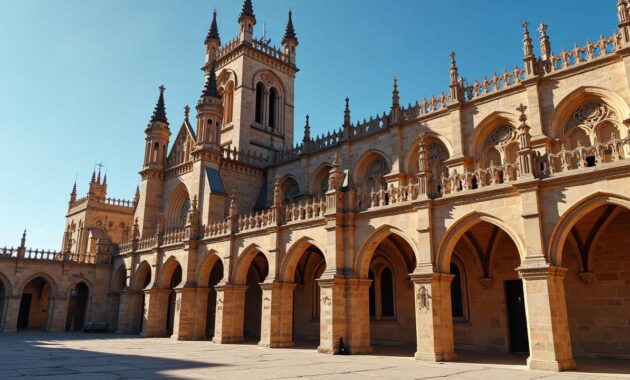
The first thing you notice is the silence. Not the staged silence of a museum, but the thick, living quiet of a place that still breathes. You step out of the car in the cold air of Sigüenza, 100 kilometers from Madrid, and the cathedral suddenly appears at the end of a narrow street, massive and pinkish in the morning light. A woman walks her dog past the fortress-like façade as if she does this every day, without even looking up. You do, though. You can’t not. The twin towers loom like a castle from another century, and behind the stone, something unexpected is waiting – something you won’t find in any other Gothic cathedral in Europe.
You push the heavy door, and the past hits you in the face like incense.
Spain’s oldest Gothic cathedral that hides in plain sight
From Madrid, most people speed north on the A-2 toward Zaragoza or Barcelona without thinking about the quiet province of Guadalajara. Yet barely an hour from the capital stands what many historians consider **Spain’s oldest Gothic cathedral**: the Catedral de Santa María de Sigüenza. From the outside, it doesn’t even look purely Gothic at first glance. Its façade feels half fortress, half church, built in that rough, reddish local stone that absorbs the winter light. You can almost imagine archers posted on the battlements in the 12th century.
Then you step inside, and the space suddenly stretches upward like a stone forest.
The story begins around 1124, when the bishop of Sigüenza, Bernardo de Agén, a French clergyman who came with the Reconquista, decided to rebuild the old Visigothic-Mozarabic church. Construction started in the Romanesque style, solid and heavy. But little by little, something new crept in from France: pointed arches, slimmer columns, an obsession with height and light. By the middle of the 12th century, Sigüenza was experimenting with Gothic lines while most of Spain was still anchored in Romanesque traditions. If Burgos and León later became the poster children of Spanish Gothic, Sigüenza was the quiet pioneer that got there first.
Walk down the central nave and you can literally read this evolution in the stone like a timeline.
Architecturally, the cathedral is a hybrid, and that’s exactly what makes it fascinating. The oldest parts show thick Romanesque walls and semi-circular arches, but then the ribs start to curve into pointed vaults, guiding your eyes upward. *This is where the Middle Ages starts to flirt with vertical ambition.* The design is still cautious, not as daring as the soaring French cathedrals, yet the idea is already there: bring the heavens a little closer to earth. That mix is what earns Sigüenza its unofficial title as the cradle of Spanish Gothic. The building becomes a physical explanation of how Gothic style took root in the Iberian Peninsula, step by experimental step.
You don’t need a degree in architecture; your neck craning upward does all the analysis for you.
The only cathedral in Europe with this royal secret
Hidden behind the main altar, past chapels dimly lit by votive candles, lies the cathedral’s most surprising feature: a kings’ pantheon that exists nowhere else in Europe in quite this way. Sigüenza’s cathedral houses the Pantheon of the Bishops and, just as striking, the Pantheon of the Princes of Bourbon-Two Sicilies, tied to Spain’s own royal Bourbon dynasty. In one relatively small city, in one relatively overlooked cathedral, you find a miniature royal necropolis, carved into chapels adorned with marble, coats of arms, and quiet portraits in stone. This isn’t a sprawling royal monastery like El Escorial, built on purpose for kings.
It’s a living parish cathedral… that also happens to guard royal blood.
➡️ “This slow cooker meal is what I start in the morning when I know the day will be long”
➡️ Garden specialists say applying this mixture to soil before planting improves yields
➡️ When silence speaks volumes: what psychology reveals about people who speak little
➡️ Why putting a lemon in boiling water can help refresh a dull kettle
➡️ The Ultra-Crispy Roast Chicken Trick That Professional Chefs Often Use
The unique twist is this: no other Gothic cathedral in Europe combines such early Gothic experimentation with an active, intimate royal pantheon still connected to a reigning European dynasty. In Sigüenza’s Bourbon chapel rest members of the Two Sicilies branch, a cadet line of the Spanish Bourbons with roots in Naples and Palermo. We’ve all been there, that moment when a place seems small on the map but turns out to be huge in stories. Under the cathedral’s ribs, you’re not only walking among medieval bishops and local nobles, but also among princes whose family tree still branches into modern Spain and Italy.
A guide will tell you these names in a low voice, almost as if sharing a secret gossip from three centuries ago.
This unusual presence shifts how you feel in the building. What looks like a provincial cathedral suddenly becomes a crossroads of Spanish history: Reconquista stone, French Gothic influence, and Bourbon politics all layered in dim light. Let’s be honest: nobody really comes here expecting to bump into a royal pantheon. Tourists aim for Toledo, Segovia, Burgos, because those cities are on the classic circuits. Yet Sigüenza quietly keeps this **unique feature in Europe**: an early Gothic cathedral functioning as a parish church, a fortress of faith, and a discreet royal burial place at the same time. The result is a more intimate experience of royalty, closer to a family chapel than a grand national shrine.
You stand in front of these tombs and realize that history, here, is about proximity, not spectacle.
How to visit Sigüenza Cathedral like you actually mean it
The best way to meet this cathedral is to arrive early, before the day-tripper buses from Madrid roll in. Park on the upper side of town and walk down slowly, letting the towers appear and disappear between stone houses. At the entrance, grab the simple leaflet or rent the audio guide, but don’t rush. Start by just standing in the central nave for a full minute, eyes adjusting, ears catching the echo of footsteps. Then move like you’re peeling an onion: main nave first, then transept, then lateral chapels, then the choir and pantheons.
Think of it as a slow conversation with the building rather than a checklist of things to “do”.
A common mistake is to focus only on the famous “Doncel de Sigüenza” – the sculpted knight lying in one of the chapels, reading a book instead of clutching a sword. He’s extraordinary, yes, and totally deserves his fame, but he’s not the whole story. Many visitors also breeze past the sacristy and the cloister, where some of the finest Renaissance details and painted ceilings hide in plain sight. Another frequent slip is skipping the guided visits because “I just want to walk around on my own.” I get that. Yet in Sigüenza a good guide will quietly unlock dates, names, and anecdotes that transform random chapels into episodes of a family saga.
You leave feeling less like a tourist and more like you’ve eavesdropped on eight centuries of local life.
“One of the most moving moments,” a local guide told me, “is when people realize this isn’t a museum about the past. It’s a cathedral that never stopped being used – the kings, the bishops, the villagers, they all share these same stones.”
- Start at the façade and towersNotice the fortress design and the mix of Romanesque roots and early Gothic lines.
- Seek out the royal and episcopal pantheonsSpend a few quiet minutes reading the names and imagining the links to today.
- Visit the Doncel and the cloister lastEnd on that introspective note, with the reading knight and the silent inner courtyard.
A small city, a long memory
When you finally step back outside, blinking in the Castilian sunlight, Sigüenza feels both smaller and bigger than before. Smaller, because you now know the pattern of its streets, the slope toward the plaza, the café where the locals drift for a mid-morning coffee. Bigger, because the cathedral has quietly rewired your sense of scale. A place you might have dismissed as “a stop on the way to somewhere else” turns out to contain an architectural experiment, a spiritual stronghold, and a royal family story folded into one. You start to see this not as a detour from Madrid, but as a corrective to the capital’s noise.
*Sometimes the most unexpected chapters of a country’s history are written in towns that barely appear on the tourist radar.*
| Key point | Detail | Value for the reader |
|---|---|---|
| Sigüenza Cathedral’s pioneering Gothic | Blend of Romanesque base with early Gothic features from the 12th century | Helps you understand where Spanish Gothic really begins, beyond the famous big names |
| Unique royal and episcopal pantheons | Resting place of Bourbon-Two Sicilies princes and local bishops within an active parish cathedral | Offers a rare, intimate encounter with royal history you won’t get at larger monuments |
| Strategic visit from Madrid | About 100 km from Madrid, easily reachable for a day trip by car or train | Makes it a practical, original escape from the capital’s usual cultural circuit |
FAQ:
- Is Sigüenza Cathedral really the oldest Gothic cathedral in Spain?Many art historians consider it one of the earliest places where Gothic architecture appears in Spain, especially in its nave and vaults, though it keeps strong Romanesque elements.
- What makes its royal pantheon unique in Europe?The cathedral combines early Gothic architecture with an active royal pantheon linked to the Bourbon-Two Sicilies line, something not found in other European Gothic cathedrals.
- How far is Sigüenza from Madrid and how can I get there?It’s about 100 kilometers; you can drive in roughly 1 hour 15 minutes or take a regional train from Chamartín or Atocha to Sigüenza station and walk up into the old town.
- Do I need a guided tour to enjoy the cathedral?You can visit freely, but a guided tour or audio guide helps decode the royal tombs, chapels, and the transition from Romanesque to Gothic that you might otherwise miss.
- What else can I see in Sigüenza besides the cathedral?The medieval castle (now a Parador), the steep old streets, Romanesque churches like San Vicente, and the views over the valley turn the trip into a full day of quiet discoveries.