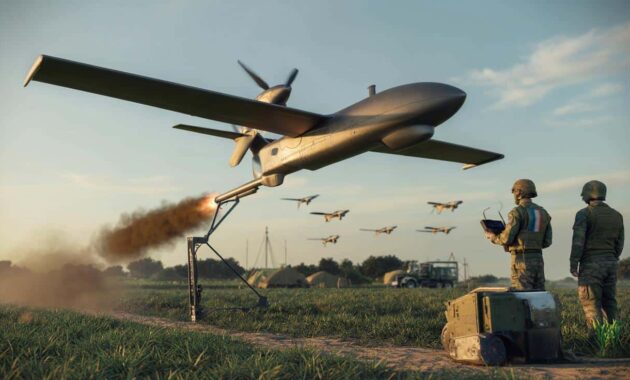
Small drones now nudge decisions once reserved for billion‑euro missiles.
Paris has quietly championed a new long‑range loitering munition designed to hit deep targets without breaking the bank. Nicknamed Rodeur 330, it mixes reach, persistence and modular control in a package light enough to toss from a field catapult.
A small airframe with long reach
The system weighs about 25 kilograms at takeoff and carries a four‑kilogram charge. A piston engine keeps it aloft for up to five hours at roughly 120 km/h. That endurance gives commanders options: patrol an area, retask mid‑flight, or prosecute a pinpoint strike during a fleeting window.
The airframe spans 3.3 meters, a pragmatic size for stability and transport. Operators assemble it in under 10 minutes and launch it by catapult, no runway or truck bed required. The manufacturer pitches it as rugged, cheap to field, and quick to learn.
Five hours of persistence, 500 km of reach and a four‑kilogram warhead shift the cost curve of deep strikes.
Range, payload and propulsion
Range extends to about 500 km under optimal conditions, which moves it from tactical nuisance to operational tool. The warhead suits command posts, relay stations, radar sets, and lightly protected logistics sites. A piston engine favors fuel efficiency and acoustic discretion over raw speed, which complements a loitering concept better than a sprint.
Deployment and control
Two operators can build, check and launch a drone in minutes from a small ground kit that fits into a ruggedized case. A laptop‑based ground station handles planning, while hand controllers allow manual intervention. The software supports waypoint routes, circular “racetrack” patterns over a box of interest, and human‑authorized terminal guidance.
Navigation and survivability
The package includes reduced‑emission modes to limit the radio signature and a navigation suite designed to ride through GPS disruption. That matters in Europe’s contested airspace, where jamming and spoofing are no longer exotic. If a strike is aborted, the aircraft can return to base rather than waste a scarce airframe.
One station can supervise swarms—up to dozens of airframes—enabling saturation attacks and multi‑axis pressure on defenses.
How it might be used in a european fight
Recent combat has shown how low‑cost loitering munitions force expensive defenses to play whack‑a‑mole. France’s concept layers roles: fast drones punch open holes by hunting emitters, while persistent types like this one drift into gaps and strike nodes that keep an army moving. The result is pressure in depth without a single big‑ticket missile volley.
➡️ Why cleaning more doesn’t always mean living cleaner
➡️ Every major galaxy is speeding away from the Milky Way, except one — and we finally know why
➡️ How allies of AI are ramping up their political donations for the midterms
➡️ Forget frying pans as chefs test magnetic surfaces that cook food evenly without oil
Likely target set
- Field headquarters and relay vans coordinating brigades
- Mobile radar and short‑range air defense units after they radiate
- Fuel bladders, ammunition caches and temporary depots
- Bridges, ferries or rail chokepoints during a movement window
- Electronic warfare trucks that jam GPS or radios
From demo to doctrine
The drone surfaced publicly during a Franco‑Ukrainian forum at the Elysée in autumn 2025, highlighting where demand is hottest. Ukraine’s battlefield has become a laboratory for attritable systems and jamming‑resistant navigation. European forces are watching, rewriting playbooks, and looking for kit that scales fast and integrates into existing command networks.
The numbers that matter
| Range | Up to 500 km |
| Endurance | Up to 5 hours |
| Cruise speed | Approx. 120 km/h |
| Stall speed | Approx. 80 km/h |
| Ceiling | About 5,000 m |
| Maximum takeoff mass | 25 kg |
| Warhead | 4 kg |
| Wingspan | 3.3 m |
| Assembly time | Under 10 minutes |
| Multi‑drone control | Up to 30 units per station |
The economics behind the buzz
Cost drives adoption as much as capability. A single cruise missile can cost in the seven‑figure range. A small loitering munition costs a fraction, and a swarm forces an adversary to expend interceptors priced far higher than the inbound. That exchange favors the attacker and stretches the defender’s magazine depth.
Industrial capacity will decide who wins this race. France’s bet leans on modular airframes, common electronics and commercial‑grade components where feasible. The challenge is steady supply of batteries, engines and secure navigation units. Export demand could surge, but controls will shape who buys and how they field it.
What could blunt it
Short‑range air defenses sharpened by the Ukraine war pose a real threat: radar‑guided guns, IR missiles, and growing numbers of electronic‑warfare nodes. Directed‑energy projects and smarter fuzes for proximity airbursts add pressure. Expect the drone’s road map to emphasize better acoustic and thermal signatures, smarter routing, and decoy tactics that force defenders to reveal themselves.
Electronic warfare remains the biggest swing factor. If defenders can jam or spoof with precision, loitering munitions lose their edge. That is why low‑emission modes, inertial backup, and rapid retasking from a human operator sit at the heart of the concept.
The wider play: teaming and timing
On a typical mission set, operators could time a wave of persistent drones with cyber or electronic disruption. While jammers blind radars and shut down cell coverage, the airframes hold in racetracks until a human cues terminal guidance. The aim is not shock and awe. It is paralysis at the right moment—breaking a brigade’s rhythm without a huge signature.
What sets it apart from a cruise missile
A cruise missile flies fast and flat to a preplanned target. A loitering munition flies slower and waits. That waiting, plus two‑way control, allows a strike to shift to a more critical node that appears late. It also helps avoid wasted hits when a target packs up or decoys. The trade‑off is vulnerability to layered defenses and weather.
Scenarios, risks and practical add‑ons
Consider a corps‑level HQ moving behind the front. A swarm of persistent drones arrives staggered over 30 minutes. Two circle a relay mast, three sit above a fuel point, others watch for emitters. The moment radios spike, operators green‑light terminal runs. The damage is surgical, but the operational effect is real: command tempo slows, logistics stop, and defenses chase ghosts.
Risks remain. Misidentification in dense urban areas, fratricide near friendly emitters, and escalation from cross‑border strikes require disciplined rules and reliable identification tools. Training must cover electromagnetic hygiene, deconfliction with crewed aircraft, and recovery procedures when strikes are aborted.
There is a maritime angle as well. Persistence and small warheads suit pier equipment, fast attack craft at anchor, or radars on austere islands. The same features carry over to counter‑battery tasks on land, holding above a suspected firing point until a sensor confirms a signature.
Future variants could add interchangeable seekers, improved anti‑jamming navigation, and better data links, while keeping a human decision in the loop. Pairing with cheap decoys or fast “door‑openers” would stress defenses further. The core idea does not change: buy time over a target, spend little per shot, and make every defender choose between exposing themselves or letting the strike land.
Originally posted 2026-03-09 00:19:00.