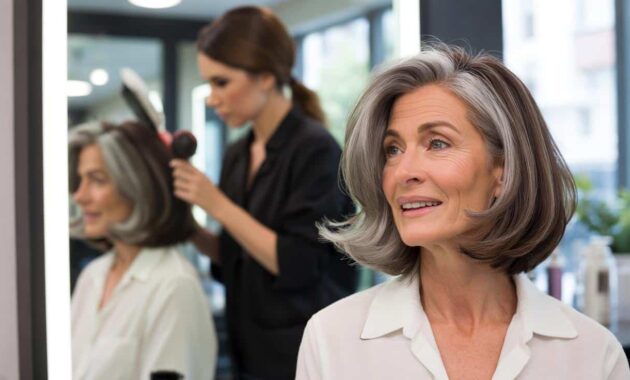
The woman in front of the mirror is 57. Her hairdresser has just clipped the cape around her neck, and she lets out a small sigh you only hear in salons: half resignation, half hope. Her Pinterest board is full of “rejuvenating cuts after 50,” but her daily reality is thin ends, a crown that’s starting to flatten, and a fringe that never behaves the same way twice.
She scrolls on her phone while the color sets and laughs: “Apparently I should have a shag, a pixie, or… shave everything.” The hairdresser smiles, comb in hand. “Or,” she says, “we could do the best cut for your age… the one nobody wants to hear about.”
A shape appears in the mirror as the blow-dryer starts. Familiar. Almost old-fashioned.
And suddenly, it looks unexpectedly modern.
The “old-fashioned” cut that secretly flatters almost every woman over 50
Ask three women over 50 what hairstyle they never want again, and two will answer without thinking: “A bob. I’ve done that my whole life.” The word alone smells like outdated offices and boxy suits. Yet walk into any good salon and ask a seasoned stylist what they’d recommend past menopause, and the answer often comes back to the same place: a bob… but reimagined.
Not the stiff helmet your mother wore. A lived-in, airy, layered bob that moves when you walk and doesn’t scream “I tried too hard.”
Take Claire, 62, who arrived at her appointment convinced she wanted a radical pixie. “I want a change,” she told her hairdresser, hiding behind long, thinning, shoulder-length hair that did nothing for her jawline. The stylist listened, nodded, then gently proposed a soft, chin-length bob, slightly longer at the front, with tiny internal layers you barely see.
When Claire left the salon, she didn’t look “different.” She looked awake. Her cheekbones came out. Her neck seemed slimmer. Her grey streaks suddenly looked intentional, not neglected. She admitted a week later that people kept asking if she’d lost weight.
This is why so many professionals quietly come back to the bob for women over 50. Short pixies demand daily styling; long hair can drag the face down when density starts to drop. The bob sits in that sweet spot: short enough to lift, long enough to soften. The key lies in the cut itself. **No more blunt, heavy lines** that block the movement. Instead, invisible graduation at the back, slightly irregular ends, a length that hits exactly where your face needs support: at the cheekbone, at the jaw, or at the base of the neck.
What sounds “classic” on paper can, in the right hands, look more current than any Instagram trend.
➡️ Drying laundry in winter: why you should only take clothes down after the frost phase
➡️ One simple gesture is enough as DJI launches a new drone that almost flies itself
➡️ Venezuela’s opposition says party leader kidnapped hours after being freed
How to ask for the right bob after 50 (without leaving the salon in tears)
The first thing a good hairdresser looks at is not your age, but your posture and how you hold your head when you talk. That tells them where your hair should stop. For many women over 50, a bob that ends between the lower cheekbone and the top of the shoulders works best. Shorter in the back to give a little push, slightly longer in front to slim the outline.
Bring photos, yes, but of women with a similar hair texture and neck length. Ask for a “soft, graduated bob with movement,” not a “perfect line.” The word “soft” changes everything.
One of the worst traps is going too geometric. That sharp, French-girl rectangle cut to the millimeter? On very fine or very thick hair after 50, it can harden your traits and exaggerate any small asymmetry. You end up looking like you’re wearing your hair, instead of living in it.
Your hairdresser’s scissors should slide and chip, not stamp out a helmet. A tiny fringe or a long curtain bang can help blur forehead lines and lift the eyes. Be wary of photos filtered to death or styles that require 30 minutes of curling iron every morning. Let’s be honest: nobody really does this every single day.
There’s also the emotional side: hair at 50 often carries stories of illness, divorce, career changes, grown kids. A bob can feel like “going back,” like erasing the past. Many stylists know this and take their time.
“Women tell me they want a big change,” confides Léa, a hairdresser in Lyon, “but what they really want is to recognize themselves again. The bob works because it’s familiar, but I tailor the length and texture so they look like the 2026 version of themselves, not the 1998 one.”
- Ask for softness, not sharpness: words like “airy,” “textured,” “graduated” guide the scissors more than you think.
- Avoid ultra-short napes if you dislike your neck: a slightly longer back can feel safer and more feminine.
- Think lifestyle: if you tie your hair for yoga or work, ask for a bob that still catches in a mini-clip.
- Talk about your cowlicks and habits: the right bob adapts to you, not the opposite.
- *Accept a tiny margin of imperfection*: that’s what makes the cut look alive, not plastic.
Living with a bob after 50: low effort, high effect
The quiet genius of a well-done bob is in the everyday. You wake up, shake your head, pass a brush, a dab of product in the ends, and you’re basically done. On fine hair, a lightweight volumizing spray at the roots, then a quick blow-dry with the head down, is often enough. On thicker hair, a smoothing cream and a wide brush keep the silhouette under control.
Most women discover they spend less time “fighting” their hair and more time letting it behave. The cut does the lifting; you just add a bit of polish.
There’s a myth that once you cut a bob, you’re stuck. That’s only true if the cut is too rigid. A modern bob actually evolves nicely. You can let it grow a few centimeters for a longer, swinging version. You can add a side fringe at the next appointment. You can shorten the back and leave the front longer for a subtle “lob” effect.
The real enemy is skipping trims for a year. That’s when the pretty bob collapses into a triangle that widens the bottom of the face. A tiny refresh every 8–10 weeks keeps the structure, without feeling like a big chop each time.
Some women notice something else with this cut: a small psychological shift. They hold their head a bit higher. Earrings suddenly show. Lipstick looks brighter. The face is no longer hidden behind long strands that you constantly pull forward like a curtain.
Friends might say, “You look rested,” or “You’ve done something… but I can’t tell what.” Hairdressers know this code. **A good bob doesn’t shout. It whispers that you’re still here, very much alive, and not ready to fade into the background.**
| Key point | Detail | Value for the reader |
|---|---|---|
| Modern bob, not “helmet” bob | Soft graduation, discreet layers, movement in the ends | A cut that rejuvenates without looking old-fashioned |
| Length tailored to the face | Ends placed at cheekbone, jaw, or base of neck depending on features | Visually lifts the face and slims the silhouette |
| Easy daily styling | Simple blow-dry, light products, trims every 8–10 weeks | Less time in front of the mirror, more consistent good-hair days |
FAQ:
- Question 1Isn’t a bob going to make me look older or too “proper”?
- Answer 1That risk comes from blunt, rigid, perfectly straight bobs. A modern, slightly textured version with movement actually softens features and brings energy to the face, giving a fresher, lighter look.
- Question 2Can I really wear a bob if I have fine, thinning hair?
- Answer 2Yes, and that’s exactly why many hairdressers recommend it. On fine hair, cutting to the right length with internal layers can create the illusion of density and lift, instead of long, see-through ends.
- Question 3What if I have curly or wavy hair?
- Answer 3A bob works very well on curls, as long as it’s cut dry or with your natural texture in mind. The hairdresser should respect the curl pattern, avoid over-thinning, and place the length where the curl springs, not where it hangs wet.
- Question 4How often should I trim a bob after 50?
- Answer 4Every 8 to 10 weeks is ideal to keep the structure without feeling constantly in “fresh cut” mode. Past 12 weeks, the shape tends to drop and widen the face.
- Question 5What do I tell my hairdresser so we understand each other?
- Answer 5Mention that you want a soft, modern bob with movement, not a strict line. Explain your daily routine, styling tools you actually use, and show one or two realistic photos with similar hair to yours, not celebrity filters.