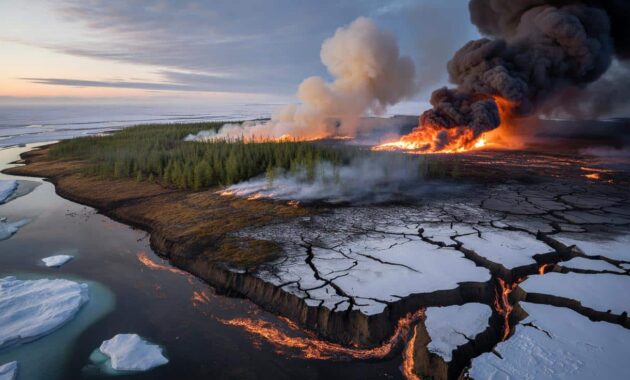
As the far north warms faster than the rest of the planet, researchers now fear a tipping point where the Arctic, long thought of as a giant freezer, begins behaving more like a fire-prone landscape. New climate simulations suggest that the ground itself could set the stage for intense forest and tundra fires by the middle or end of this century.
Arctic fires are no longer a rare anomaly
Over the past decade, satellite images have revealed something that used to be almost unthinkable: smoke plumes rising repeatedly from Siberia and northern Canada. Boreal forests have always burned from time to time, but scientists are now tracking fires creeping further north, into regions that historically stayed too wet and cold to ignite easily.
These fires are not just small grass blazes. Some are so large and long‑lasting that they have earned the nickname “zombie fires” because embers can smoulder underground through the winter and flare up again when spring arrives.
What used to be considered a once‑in‑a‑lifetime Arctic fire season is now starting to look like a pattern.
An international team of climatologists, using new generations of Earth system models, has been trying to understand what is driving this shift. Their latest work suggests the answer lies not only in rising air temperatures, but deep in the frozen soils that underlie much of the Arctic: the permafrost.
When permafrost melts, the Arctic changes character
Permafrost is soil that has remained frozen for at least two years in a row, often for centuries or even millennia. In practice, large parts of Arctic permafrost have stayed frozen continuously since the last Ice Age. This frozen ground acts like a huge lock on water, carbon and heat.
As global emissions push temperatures higher, that lock is starting to fail. Ice inside the soil melts, the ground subsides and cracks, and previously frozen organic matter becomes exposed. Until recently, the main concern was that this thaw would release additional greenhouse gases, especially carbon dioxide and methane.
The new modelling work adds another, more immediate risk: once permafrost thaws past a certain threshold, the soil itself dries out quickly, even in places that initially became wetter when the ice first melted.
A powerful Earth system model points to a tipping point
The team used one of the most advanced tools available, the Community Earth System Model, which links atmosphere, oceans, sea ice, vegetation, soils and human‑driven emissions into a single framework. They ran 50 simulations spanning 1850 to 2100, under a scenario where greenhouse gas emissions keep rising strongly (known as SSP3‑7.0).
➡️ Psychology highlights the three colors most often chosen by people struggling with low self-esteem
➡️ The niche method for removing wallpaper with fabric softener spray
➡️ Infantry careers: roles, ranks and specialities in ground combat
That ensemble approach let them separate random climate swings from the clearer signal of human‑driven warming. Across simulations, a consistent pattern emerged for high‑latitude regions of Siberia and northern Canada.
The model shows a sharp shift from almost no fires to extremely intense fire seasons within just a few years in the second half of this century.
According to the study, anthropogenic permafrost thaw reaches a critical level by mid‑century or slightly later. At that point, the moisture content of the soil drops suddenly. Surface temperatures rise further, and the air near the ground becomes markedly drier. Together, these conditions create ideal fuel for wildfires: warm, dry vegetation rooted in increasingly flammable soil.
How frozen ground ends up feeding fire
The chain reaction uncovered by the researchers can be summarised in a few key steps:
- Rising greenhouse gas concentrations warm the Arctic atmosphere.
- Permafrost begins to thaw, initially creating soggy ground and new ponds.
- Over time, drainage channels form and water runs off or sinks deeper.
- The surface layer dries, and vegetation growth accelerates in the warmer conditions.
- More plants and shrubs mean more burnable fuel during hot, dry summers.
- Once ignited, fires can penetrate deep into peat‑rich soils and previously frozen layers.
This sequence helps explain why an Arctic once dominated by ice and low‑lying mosses is slowly turning into a patchwork of shrubs, young trees and exposed peat. It also explains why some areas that look greener from space might in reality be more vulnerable to fire.
Greening of the tundra: blessing and risk
As the climate warms, plants that once struggled in harsh Arctic conditions can now survive and even thrive. Shrubs grow taller, small trees push northwards and the tundra becomes more productive biologically. At first glance, this greening trend might sound like good news for carbon storage.
Yet that extra vegetation is also dry matter waiting to burn during heatwaves. In many places, new plant growth sits on top of carbon‑rich peat and previously frozen organic layers. When a fire sweeps through, it does not only consume the leaves and branches; it can burn down into the soil, releasing carbon that has been stored for thousands of years.
Permafrost thaw means losing the structural backbone of northern ecosystems, and turning them into landscapes that can support large, recurring fires.
Why abrupt change matters more than slow warming
The simulations highlight that the biggest concern is not a gentle increase in fires, but a rapid jump. The model suggests that some Arctic and sub‑Arctic regions could shift from low‑fire to high‑fire regimes within a decade.
Such abrupt transitions leave little time for communities, wildlife or infrastructure to adapt. Roads built on frozen ground may buckle as permafrost collapses. Villages could face multiple large fires in a short period, instead of isolated incidents every few decades.
| Before tipping point | After tipping point |
|---|---|
| Permafrost mostly intact | Widespread permafrost thaw |
| Soils relatively moist and cool | Soils drier and warmer |
| Sparse, low‑lying vegetation | Denser shrubs and young trees |
| Fires infrequent and limited | Frequent, intense fires, including peat fires |
Once this new regime sets in, fires themselves speed up the warming process. Burning peat and thawed soils emit vast amounts of carbon dioxide and methane. Soot from these fires can darken snow and ice, making them absorb more sunlight and melt faster. The Arctic then traps even less cold, reinforcing the original problem.
Global consequences of an Arctic that burns
Changes in the far north do not stay there. The Arctic acts as a key regulator of the planet’s climate, helping to balance heat between the poles and the tropics. When permafrost thaws and burns, it adds extra greenhouse gases on top of human emissions from industry and agriculture.
Climate scientists refer to this as a feedback loop: warming causes permafrost thaw and fires, which release more greenhouse gases, which then cause additional warming. Once the loop grows strong enough, cutting emissions becomes harder because part of the warming is now driven by the Earth system itself.
Smoke from northern fires can also travel long distances, affecting air quality in cities thousands of kilometres away. In past fire seasons, hazy skies and elevated pollution levels have been recorded across North America and parts of Europe when Siberian or Canadian boreal forests were burning.
What scientists still need to clarify
Despite the stark picture painted by the simulations, there are still uncertainties. Models struggle to capture the fine detail of Arctic landscapes, where small variations in slope and soil type can decide whether an area drains or stays waterlogged.
Researchers are also working to better estimate how quickly new vegetation will grow in warming regions, and how easily lightning, human activity or other sources could ignite fires in these emerging ecosystems. Direct observations, including field campaigns and satellite data, will be crucial to refine the models.
One key challenge is timing: whether the tipping point arrives closer to 2050 or nearer the end of the century depends heavily on future emissions. A faster global transition away from fossil fuels would reduce the likelihood of the most extreme fire scenarios.
Understanding some key terms and scenarios
Two technical ideas sit at the heart of this research: permafrost thaw and fire regimes.
Permafrost thaw does not mean that all frozen ground melts at once. It typically starts with the “active layer” at the surface, which thaws each summer and refreezes in winter. As the climate warms, this active layer deepens, and patches of formerly permanent ice vanish. That process can trigger landslides, ground collapse and shifts in hydrology.
Fire regimes describe the typical pattern of fires in a region: how often they occur, how intense they are, and how much area they burn. The concern for the Arctic is a regime shift, where the basic character of fire in the region changes. Once a new regime is established, it tends to persist for decades.
In model experiments, scientists tested different emission scenarios and found that high‑emission pathways sharply increased the risk of these regime shifts. A world that limits warming more aggressively would still face more Arctic fires than today, but with a lower chance of abrupt transitions to extreme burning.
What this could mean in practice
If the simulations prove accurate, Arctic and sub‑Arctic communities may need to prepare for a future that looks uncomfortably like fire seasons further south. That could mean investing in firebreaks near towns, adjusting building codes for structures on unstable ground, and developing evacuation plans tailored to remote regions with few roads.
Researchers also point to the urgency of monitoring “hotspots” where permafrost is already collapsing. Early warning systems that track soil moisture, vegetation growth and lightning could give authorities a few critical days or weeks to react before a bad fire season spirals out of control.
For people living thousands of kilometres away, the threat might feel distant. Yet as the Arctic shifts from a frozen buffer to a region capable of burning from within, the climate stakes grow higher for everyone. The future fire risk in the far north is tightly linked to choices about emissions being made in capitals and boardrooms right now.