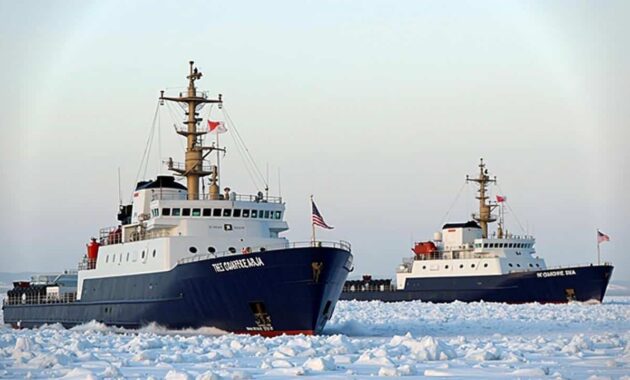
Choking sea lanes, melting ice and rising rivalry are forcing Washington to rethink how it operates at the top of the world.
The US Coast Guard has quietly taken one of its most radical procurement decisions in years: outsourcing key parts of its future Arctic fleet to partners with far more experience in building ships for ice.
A Canadian design and Finnish shipyard to pull America back into the Arctic
The United States has admitted what defence analysts have been saying for a decade: it cannot rebuild a modern icebreaker fleet on its own, fast enough. After years of delays and spiralling costs on domestic programmes, the Coast Guard has picked a ready-made Canadian design as the blueprint for its new Arctic Security Cutters (ASC).
The chosen platform is the MPI, a 100‑metre multipurpose icebreaker developed by Seaspan Shipyards in Vancouver with Finnish specialist Aker Arctic Technology. Ottawa originally ordered the design for its own coast guard, aiming at long, autonomous missions in the Canadian Arctic.
Washington is effectively leasing foreign know‑how: Canadian blueprints, Finnish ice engineering and American yards, all fused into one crash programme.
Under the plan announced in North Vancouver, construction of up to six vessels will be split between Rauma Marine Constructions in Finland and Bollinger Shipyards in Houma, Louisiana. The first two units are set to be built in Europe and delivered from 2028. Follow‑on ships would then shift to US construction from around 2029.
This hybrid approach breaks with the traditional “build everything at home” reflex. It trades political purity for speed and predictable timelines, in a niche market where very few yards can credibly build modern icebreakers without a steep learning curve.
An “ICE Pact” that turns allies into co‑builders
The pact of ice as an industrial shortcut
The programme sits inside the ICE Pact, a trilateral framework signed in July 2024 by the US, Canada and Finland. The idea is blunt: share designs, suppliers and testing experience so that every new polar ship does not start from a blank sheet of paper.
For Washington, the MPI offers precisely that shortcut. The engineering work is largely finished, critical systems have been selected, and a supply chain is already running for Canadian orders. That means fewer technical surprises during construction and more predictable life‑cycle costs.
- Canada brings the base design and much of the supplier network.
- Finland contributes decades of ice model testing and polar hull expertise.
- The US provides funding, security requirements and final integration.
In an era of tight defence budgets and mounting Arctic competition, the trio is betting that standardised hulls built in series will trump bespoke national projects that arrive a decade too late.
➡️ Meet “stained glass hair”, the chic way to soften grey roots without hiding them
➡️ Fine hair after 50: a hairstylist reveals the tricks that really work on her clients
➡️ Grey hair: the haircut that makes your face look younger
A ship built to stay far, and stay long
The Canadian MPI was never meant as a showpiece. It was designed as a workhorse for months‑long patrols in harsh conditions. That suits the Coast Guard’s needs almost perfectly.
The hull is certified Polar Class PC4 under Lloyd’s rules, allowing operation in thick first‑year ice with old, harder ice mixed in. With a displacement around 9,000 tonnes and a beam of 20.4 metres, the ship can push through one metre of level ice at roughly 7 km/h.
Range is over 22,000 kilometres without refuelling. Endurance exceeds 60 days thanks to large fuel and stores capacity. That kind of staying power matters in an Arctic where ports are few, weather windows are short and help is often days away.
Propulsion uses a continuous‑bus diesel‑electric system delivering about 10.1 MW in total, of which roughly 7.2 MW goes to the propellers. This setup gives fine control at low speed in ice, while still allowing reasonable open‑water transit performance.
| Characteristic | Arctic Security Cutter baseline (MPI) |
| Length | 100 m |
| Beam | 20.4 m |
| Draught | 6.4 m |
| Displacement | ≈ 9,000 t |
| Ice class | Polar Class PC4 |
| Installed power | 10.1 MW |
| Propulsion power | ≈ 7.2 MW |
| Speed in ice | 7 km/h in 1 m ice |
| Range | 22,000 km |
| Endurance | > 60 days |
| Crew | ≈ 85 people |
| Propulsion type | Diesel‑electric, continuous bus |
Mission packages will likely cover classic Coast Guard roles: search and rescue, law enforcement, escorting merchant ships, scientific support and asserting US sovereignty in Arctic waters off Alaska.
From three ageing hulls to a credible Arctic presence
A small fleet under heavy pressure
America’s polar fleet today is painfully thin. Only three ships are genuinely available: the heavy icebreaker Polar Star, launched in 1976; the medium icebreaker Healy, used heavily for science; and the smaller Storis, recently brought in to plug gaps.
Internal Coast Guard studies point to a minimum need of nine Arctic Security Cutters just to keep up with planned missions.
Age is taking its toll. Polar Star regularly sails south to Antarctica each year for Operation Deep Freeze, opening the way to McMurdo Station. Keeping the 1970s‑era ship running has required extraordinary levels of cannibalisation, ad‑hoc repairs and bespoke spare parts.
The ASC programme is therefore less about luxury expansion and more about basic continuity. Without new hulls, the US risks being physically unable to reach parts of its own Arctic exclusive economic zone during difficult ice years.
An industrial reset after troubled programmes
For Seaspan in Canada, the US selection crowns years of work under Ottawa’s National Shipbuilding Strategy. The yard now has a backlog including up to 16 MPI‑type ships and a heavy PC2 icebreaker, with more than 5,700 workers and around 400 engineers and designers on payroll.
In the US, Bollinger Shipyards views the ASC as a chance to prove that Gulf Coast yards can handle sophisticated polar vessels, after the slow start and technical interruptions of the separate Polar Security Cutter project. The American funding line, close to €8.3 billion for a family of heavy, medium and light icebreakers, gives the programme unusual budget stability.
A tight, strategic icebreaker market
Why icebreakers matter in a warming Arctic
Melting sea ice might sound like it makes icebreakers less necessary. In practice, it has had the opposite effect. Seasonal openings in the Arctic Ocean have widened, but the ice that remains is more unpredictable. Floes move faster with wind and current, ridges form where slabs pile up, and storm‑driven freeze‑thaw cycles create pockets of very thick ice.
Cargo ships, research vessels and patrol craft can take advantage of new routes for part of the year, yet they also face higher risk of becoming trapped or damaged. That pushes coastal states to maintain dedicated icebreaking escorts and rescue capability.
The Arctic is no longer a solid white cap; it is a shifting patchwork of open water and dangerous ice that punishes unprepared ships.
Russia understood this early and never stopped investing. It now fields around 40 to 45 ice‑capable ships, including about seven nuclear‑powered giants that can smash through very thick ice along the Northern Sea Route. China, starting from almost nothing a decade ago, has built a modest but technologically advanced polar fleet, using it to run record numbers of transits along the same corridor.
By contrast, the US allowed its fleet to age, assuming that open water would do part of the job. That bet has not paid off.
How the numbers stack up
Estimates for 2026 highlight the gap in hull numbers among major players:
| Rank | Country | Icebreakers | Nuclear | Notable points |
| 1 | Russia | ~40–45 | ~7 | Exclusive nuclear fleet, permanent Arctic presence |
| 2 | Canada | ~18–20 | 0 | Large civil fleet, long Arctic patrols |
| 3 | Finland | ~8 | 0 | Global reference for ice engineering |
| 4 | Sweden | ~7 | 0 | Baltic winter escort focus |
| 5 | China | ≥5 | 0 | Rapidly growing polar capability |
| 6 | United States | 3 | 0 | Recognised capability gap |
| 7 | Norway | 2–3 | 0 | Research and offshore support |
| 8 | Japan | 2 | 0 | Antarctic supply and science |
| 9 | France | 1 | 0 | L’Astrolabe for Antarctic logistics |
The number of shipyards that can deliver such vessels quickly is tiny: essentially Finland, Canada and a handful of Asian builders, plus Russian yards locked out by sanctions. That scarcity explains why the US has dropped its usual insistence on fully domestic design.
What changes for the United States in practice
With the Arctic Security Cutter, the US is betting on quantity and reliability more than headline‑grabbing performance. A fleet of nine broadly similar, mid‑sized ships would allow year‑round coverage near Alaska, regular patrols in the Bering and Chukchi Seas, and more frequent presence in the central Arctic Ocean during the summer season.
In Arctic operations, simply having a steel hull on scene often matters more than who has the thickest armour plate on paper.
The Coast Guard would also gain more predictable logistics. Shared design with Canada means spare parts, training material and maintenance procedures could be aligned. In a crisis, that opens space for joint operations where crews can move between ships without starting from zero.
Key terms and real‑world scenarios
Two concepts underpin much of this debate.
Polar Class (PC): This is a rating system, used by classification societies, that tells you what kind of ice a ship can safely handle. PC4, the level chosen for the MPI, means the vessel can operate year‑round in first‑year ice, even when thick patches of older, harder ice are present. It is not the highest rating, but it offers a good balance between capability and cost.
Ice escort: Merchant ships often are not built to push through heavy ice alone. An icebreaker steams ahead, carving a channel and giving real‑time advice by radio. If a container ship or gas carrier becomes trapped, the icebreaker can tow or free it. On the Northern Sea Route, this is routine. The US wants that same level of assurance for future traffic along Alaska’s coast.
Imagine a fully loaded LNG carrier leaving a terminal in northern Alaska in late autumn. A sudden storm pushes drifting ice against the shore, choking the coastal track. Without an icebreaker nearby, the captain might have to hold position for days, risking hull damage and major commercial losses. With an ASC‑class ship in the area, the Coast Guard can escort the tanker through the moving pack and stand by for emergency support.
That kind of practical scenario, repeated dozens of times over the coming decades, is what drives Washington’s new Arctic urgency. The decision to lean on Canadian and Finnish strengths is less about prestige and more about making sure those icebreakers are actually there when the call comes in.
Originally posted 2026-03-07 19:20:00.