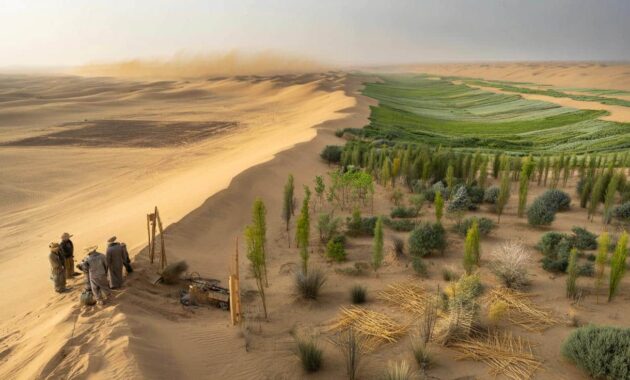
The sand starts as a whisper. A faint haze on the horizon of the Gobi that, from far away, looks almost gentle. Then the wind rises, and you suddenly understand why people here talk about the desert as if it were alive. Grains sting the face, swallow the road markings, creep through door cracks, bury young saplings overnight.
In a village on the edge of Inner Mongolia, an old man points to where his family’s fields used to be. He laughs, but it’s the nervous laugh of someone who has watched the land he knew turn yellow and empty.
Behind him, the skyline is no longer just dunes and dry scrub. Thin green lines now cut across the sand — belts of young poplars and pines, part of a staggering plan that sounds almost mythical.
A new Great Wall, this time made of trees.
China’s audacious bet: a living wall against the sand
From satellite images, the project looks unreal. A vast arc of green, stretching thousands of kilometers from the dusty plains of Xinjiang in the west to the windy edges of the Bohai Sea in the east. Officially launched in 1978, China’s “Great Green Wall” aims to halt the march of its northern deserts. Tens of billions of trees have already been planted, and more are planned by 2050.
This is not a poetic metaphor. It’s a literal forest shield, designed to slow desertification that threatens homes, harvests, and entire cities.
For Beijing, the stakes are brutally practical: if the sand keeps moving south, whole regions could become unlivable.
Travel along the edge of the Gobi and you start to see the wall not as one long forest, but as a patchwork of human attempts. In Ningxia, farmers plant rows of drought-resistant shrubs by hand, their backs bent under the sun. In Hebei, near Beijing, students and office workers arrive by bus on weekends to dig holes in dusty soil and drop in spindly saplings.
Further north, giant machines plant trees in geometric grids, while drones spray water and nutrients from above. The numbers are dizzying: Chinese authorities say more than 66 billion trees have been planted since the program began.
Some stretches are lush and dense. Others look fragile, a green suggestion against endless sand.
Behind the romantic image of a green wall lies a tight mix of strategy and survival instinct. Desertification in China is driven by overgrazing, deforestation, poor irrigation, and rising temperatures. When vegetation disappears, soil dries out, breaks apart, and starts to travel with the wind.
Beijing’s answer has been to throw almost everything at the problem: massive tree-planting campaigns, grazing bans, relocation of herders, and subsidies to encourage farmers to leave marginal land fallow. **The Great Green Wall is both symbol and tool**, a flagship project that says: we won’t surrender this land to sand.
But a tree is not a fence. It’s a living gamble on climate, water, and time.
How do you plant a forest where rain almost never falls?
On paper, you just trace a line on a map and fill it with green. In reality, the first step of China’s living wall is painfully low-tech: dig, plant, protect. In the Kubuqi Desert, one of the major battlefields of the campaign, villagers spend days planting saplings in checkerboard patterns, each one shielded by straw or grid-like barriers that trap moisture and sand.
The idea is simple: stabilize the dunes, reduce wind speed near the ground, then let shrubs and grasses slowly reclaim the surface. Once the sand is locked in place, slightly taller, deeper-rooted trees can be introduced.
A forest is built one fragile layer at a time, like scaffolding against the wind.
On the ground, mistakes have piled up alongside the successes. Early campaigns favored fast-growing species like poplars, planted densely in rows as if they were soldiers. Many of those monoculture forests looked good in photos for a few years, then withered. Roots couldn’t find water, pests spread easily, and the soil beneath remained poor.
Local officials had incentives to hit tree-planting targets, so the focus leaned heavily on quantity: how many seedlings in the ground, not how many survived. Let’s be honest: nobody really tracks every sapling in a region bigger than many countries.
Slowly, that mindset is shifting toward survival rates, diversity, and long-term soil health — lessons paid for in dead wood.
Today, researchers and local communities talk more about what not to do than what to do. They warn against planting water-hungry species in already thirsty regions, against lining up identical trees like a factory product, against ignoring local shrubs that quietly thrive where imported pines fail.
One Chinese ecologist summed it up in a sentence that lingers:
“We don’t need a green wall that looks good from Beijing. We need roots that can still drink in thirty years.”
To move away from brute-force planting, some regions now favor:
- Mixed species adapted to local soils and rainfall
- Dense shrubs and grasses before taller trees
- Partial planting, leaving natural vegetation in place
- Monitoring survival rates instead of raw planting numbers
- Smaller, continuous corridors instead of one rigid belt
*pure coverage on a map no longer impresses those who live with the dunes at their door.*
➡️ White rocks found on Mars reveal the Red Planet was a tropical paradise 3 billion years ago
➡️ This oven recipe works when you want food, not fuss
➡️ At a blistering 603 km/h, this new maglev officially becomes the fastest train ever built
➡️ Here is the favorite color of people smarter than average
➡️ Why your houseplants turn yellow even when you water them regularly
➡️ People over 60 who maintain this sense of purpose age more comfortably
A wall that questions what “fighting the desert” really means
Walk through a successful stretch of the Great Green Wall and the change is almost physical. The air feels cooler. The wind loses its bite. Children can play outside without goggles when spring storms blow in from Mongolia. City dwellers in Beijing and Tianjin, once regularly suffocated by yellow dust, now experience fewer severe sandstorm days than in the early 2000s.
These are not abstract climate wins. They’re daily comforts, the kind that quietly rewrite how people remember a place.
Yet every planted tree here also asks a question about water, land rights, and who gets to decide what a “healthy” landscape looks like.
Some scientists argue that parts of northern China were always semi-arid grasslands and that trying to turn them into dense forests is like forcing a desert to pretend to be a park. Re-greening can help, but if it drains scarce groundwater or erases traditional grazing cultures, what kind of victory is that?
At the same time, local communities who used to be blamed for overgrazing now find themselves hired as tree guardians, nursery workers, and restoration experts. **The desert is no longer just a problem; it’s a shared project**.
We’ve all been there, that moment when a grand solution collides with the messy reality of people’s lives and habits.
What makes China’s Great Green Wall so fascinating is not just its scale, but the fact that it’s still an open experiment. Each planting season adds new data: which species survive, which dunes keep moving, which villages feel safer, which water tables drop. The project’s timeline stretches to 2050, long enough that some of the children planting saplings today will be old by the time the forest truly matures.
Their work speaks beyond China. Countries in the Sahel, from Senegal to Ethiopia, are studying this experience for their own African Great Green Wall, trying to copy the ambition without repeating the mistakes.
The next time we see a satellite image of Earth with a new green scar across a dusty region, we might wonder less “Is this real?” and more “Who stayed long enough to see which trees survived?”
| Key point | Detail | Value for the reader |
|---|---|---|
| Desertification is not inevitable | China has slowed sand expansion in several regions using trees, shrubs, and grazing bans | Gives hope that human action can reshape degraded landscapes |
| Tree choice matters more than raw numbers | Diverse, local, drought-resistant species now replace fragile monocultures | Shows why “plant trees” is not a magic formula without context |
| Long-term care beats one-off campaigns | Survival rates, water use, and community involvement decide success | Highlights that any climate or land project needs patience and local ownership |
FAQ:
- What exactly is China’s Great Green Wall?A multi-decade program to plant forests, shrubs, and grasslands along the country’s northern edge, designed to slow desert expansion and cut sandstorms.
- How many trees has China planted for this project?Official figures mention tens of billions of trees since 1978, though not all survive, and counting is imperfect.
- Has the Great Green Wall really reduced sandstorms?Yes, major northern cities now record fewer severe dust storm days than in the 1980s–2000s, thanks to reforestation and stricter land-use rules.
- What are the main criticisms of the project?Overuse of water, fragile monocultures, and attempts to force forests where grasslands or mixed landscapes might be more sustainable.
- Can other countries copy this model?They can learn from it, but success depends on local species, water, and community involvement, not just planting huge numbers of trees.