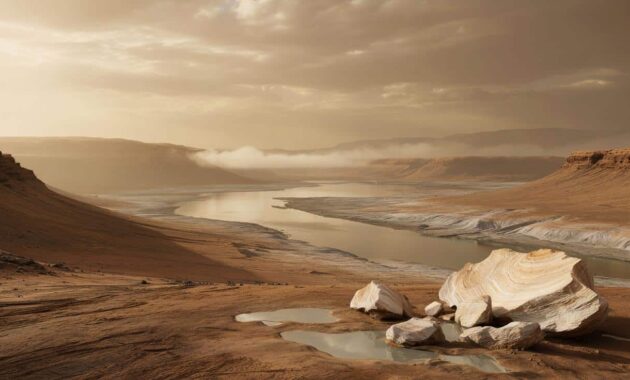
New data from NASA’s Perseverance rover suggest that, three billion years ago, the Red Planet was warm, rainy, and wrapped in thick clouds — and that a quiet, Earth‑like tropical climate may have lasted for millions of years.
A tropical hint hidden in white Martian rocks
Perseverance has been roaming Jezero crater since 2021, drilling, zapping and photographing every weird rock it can reach. Among the usual rusty-red boulders, the team noticed something that instantly stood out: small, pale fragments, almost white against the iron‑rich dust.
Those ghostly rocks turned out to be packed with kaolinite, a clay that on Earth forms in hot, humid, rainforest-style conditions.
The fragments are what geologists call “float rocks”: loose pieces with no obvious bedrock attached. Spectroscopic data from instruments on the rover, including SuperCam and Mastcam-Z, showed that these light-toned chips are unusually rich in aluminium, with aluminium oxide exceeding 30%. That composition is a hallmark of kaolinite.
On Earth, kaolinite rarely appears without sustained liquid water. It usually forms in deeply weathered soils where constant rainfall gradually strips out most elements, especially iron and magnesium, leaving behind a pale, aluminium‑rich residue. The same pattern is now seen on Mars, in Jezero crater, once an ancient lake basin.
Conditions that feel uncomfortably like the tropics
The international research team compared Perseverance’s rock data to well‑studied ancient soils on Earth. They focused on two reference sites: an Eocene (about 55 million years old) tropical palaeosol near San Diego, and a 2.2‑billion‑year‑old weathered soil in Hekpoort, South Africa.
The Martian rocks matched them closely, both in infrared spectra and in bulk chemistry. One sample, nicknamed “Chignik”, showed titanium dioxide levels of up to 1.4%. Titanium barely moves in water, so it tends to pile up when everything else is washed away by heavy rain. That pattern is exactly what you see in long‑lived, rainy climates on Earth.
The chemistry points to years of intense surface weathering by liquid water, not brief splashes or underground hot springs.
That distinction matters. Kaolinite can form in hydrothermal systems, but hydrothermal signatures look different: less titanium, more alkali elements, and mineral associations tied to hot vents. The Jezero fragments do not fit that script. They look more like soils that sat under persistent rain, with a fluctuating water table gradually leaching out iron, leaving the rock unnaturally pale.
➡️ It’s the worst washing-machine program and even repair techs warn against it: a real waste of water
➡️ I learned it at 60 : few people know the difference between white eggs and brown eggs
➡️ This creamy spinach pasta recipe takes less than 20 minutes to prepare
➡️ A rare environmental event has scientists paying close attention
Climate models used by the team suggest that such alteration would demand annual rainfall well above 1,000 millimetres in some regions — similar to modern subtropical or tropical belts on Earth. For that to happen on Mars, the planet must once have had a dense atmosphere, an active water cycle, and temperatures that stayed well above freezing for long stretches.
Where did these white rocks come from?
There is still a puzzle: Perseverance has not yet found a big, intact bed of kaolinite-rich rock. Instead, the pale fragments are scattered with no obvious original layer in sight. That suggests they were carried into Jezero from somewhere else.
Two main scenarios for their journey
- River transport: Ancient rivers that once fed Jezero, including Neretva Vallis, could have eroded kaolinite‑rich terrains upstream and dumped the fragments into the lake as sediment.
- Impact blast: A meteorite striking a distant kaolinite deposit could have launched blocks across the region, scattering them into Jezero as ballistic debris.
Orbital data give some support to both ideas. The CRISM instrument aboard Mars Reconnaissance Orbiter has identified kaolinite signatures in several patches near the rover’s current path, particularly in the south‑west of Jezero, less than 2 kilometres away. These areas often appear as light‑coloured breccia blocks that might be remnants of a larger kaolinite-bearing source.
Farther afield, on the plateaus of Nili Planum, orbital spectra show layered sequences of clays: aluminium‑rich units sitting on top of magnesium‑rich clays. Such stacking is exactly what you would expect from long-term weathering of a basaltic crust under changing climate, hinting at a much broader kaolinisation episode across that part of Mars.
A new story for Martian water
The presence of well-preserved, hydrated kaolinite carries heavy consequences for Mars’s water budget. Kaolinite does not just record past water; it locks some of it away. The mineral structure contains hydroxyl groups as well as tightly bound water that only leaves at high temperatures, around or above 450°C.
If large swaths of early Mars turned to kaolinite-rich soils, then a substantial portion of the planet’s ancient water may be trapped permanently in clay.
Unlike Earth, Mars does not appear to have active plate tectonics. On our planet, clay‑rich crust can be pushed down into the mantle, heated, and recycled, eventually venting water back into the atmosphere through volcanism. Mars lacks that global recycling engine. Once its surface water became mineral-bound, there was little chance of getting it back.
This scenario fits a picture where early Mars went through a relatively warm, wet phase with thick air and heavy clouds. Over time, sunlight and the solar wind stripped the atmosphere. As pressure dropped and temperatures fell, rain shut down. Water either froze at the poles, seeped underground, escaped to space, or, as this study suggests, became locked in clays during that tropical-style interval.
Was ancient Mars actually habitable?
The chemical environment implied by these rocks looks surprisingly friendly to life as we know it. The alteration likely occurred under moderately acidic to near‑neutral conditions, with dissolved oxygen present and liquid water stable at the surface for very long durations.
On Earth, kaolinite-rich tropical soils often host thriving microbial ecosystems in their upper layers. The Martian equivalents would have provided similar niches: wet, chemically active, and stable on geological timescales. These are exactly the types of environments astrobiologists rank highly when scanning for past habitability.
Perseverance cannot detect life directly, but it can cache samples. Some of the kaolinite-bearing fragments, including Chignik, are prime candidates for the Mars Sample Return campaign. Only detailed lab measurements on Earth can reveal whether these clays contain subtle organic residues or distinctive isotope ratios that might hint at ancient biological activity.
Key terms that help make sense of the findings
| Term | Simple meaning | Why it matters for Mars |
|---|---|---|
| Kaolinite | A white clay mineral formed by long-term rain and chemical weathering | Acts as a fingerprint of warm, wet surface conditions |
| Palaeosol | Ancient soil layer preserved in rock | Lets scientists reconstruct vanished climates and landscapes |
| Float rock | Loose rock fragment not found in its original bedrock | Hints that material was transported, revealing ancient rivers or impacts |
| Hydrated mineral | Mineral that contains water or hydroxyl in its structure | Acts as a long-term storage vault for planetary water |
What simulations say about a “tropical Mars”
Climate modellers have already started folding the Jezero data into their calculations. To match the level of chemical weathering seen in the kaolinite, models require a thicker CO₂ atmosphere than Mars has today, perhaps alongside other greenhouse gases such as hydrogen or methane.
In those simulations, early Mars carries broad belts of cloud and heavy rainfall around its equator, drenching volcanic plains and crater rims. Rivers cut networks of channels, feeding lakes like Jezero. Over a few million years, basaltic rocks at the surface break down into clay‑rich soils, just as tropical rainforests on Earth slowly eat their way into fresh rock.
Such a climate need not have lasted forever. Some runs show that once the atmosphere thinned past a certain threshold, the rain belts would have collapsed rapidly. The planet could then shift from “humid subtropical” to “cold desert” in a geologically short time, freezing the remaining water and halting deep weathering.
Why this matters for future missions and for us
For mission planners, knowing that parts of Mars went through strong tropical-style weathering changes how they choose landing sites. Regions with stacked clay layers, or nearby kaolinite signatures, become top targets, because they offer the longest-lived, wettest environments with the best chance of preserving biosignatures.
There are practical angles too. Hydrated clays are potential resources for future crews: they may release water when heated and can be used as raw material for construction. Understanding where these deposits lie, and how deep they run, feeds into long-term visions of human bases and in‑situ resource use on Mars.
For Earth scientists, Mars is turning into a natural experiment in planetary climate change. It shows how a once‑wet, potentially lush planet can gradually dry out when atmospheric shielding fails and water sinks into minerals and space. That story, written into a handful of white rocks in Jezero crater, is now reshaping how researchers think about the fates of rocky worlds — including our own, sitting comfortably in its temperate zone, for now.
Originally posted 2026-03-09 07:43:00.