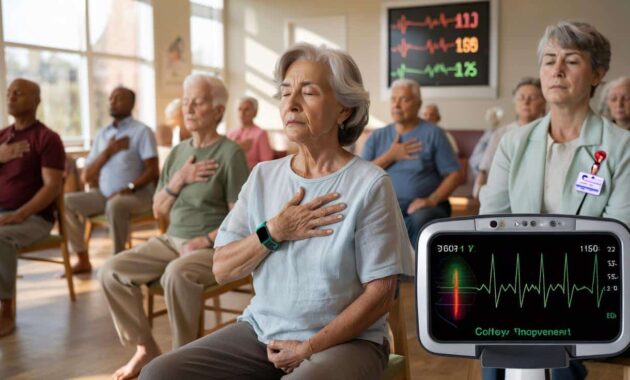
The room was almost silent, apart from the faint hiss of oxygen and the slow wheeze of breath. On a Tuesday afternoon in a community center, twelve older adults sat in a circle, feet in orthopedic shoes, hands crossed over their bellies as a young physiologist counted in a soft voice: “In… two… three… Out… two… three… four…”
On the wall, a heart-rate monitor flickered red numbers. One by one, the resting heart rates dropped: 78, 72, 68. Smiles, a few proud nods, someone whispered, “Look, I’m down to 64.” The instructor praised them. Lower is better, right? Lower means fitter, safer, stronger.
Only in the back, a retired nurse raised an eyebrow. She’d seen the other side of those numbers.
What if chasing that perfect pulse comes with a quiet cost?
When a “calm” heart becomes a new obsession
The breathing exercise itself looks almost too gentle to matter. You sit in a chair, back supported, eyes soft or closed. One hand on your chest, one on your belly. You inhale slowly through your nose for four counts, hold for a beat, then exhale through pursed lips for six or eight. After three or four minutes, the smartwatch buzzes with a smug little graph: resting heart rate down, stress score improved, tiny green arrows everywhere.
For many older adults, this little ritual becomes the high point of a medicalized day. Pills at 8. Blood pressure at 10. Walk at 3. Breathing at 5.
Take Marianne, 72, who started “coherent breathing” after her cardiologist recommended relaxation. At first it was just five minutes before bed. Within weeks, she was tracking her resting heart rate every morning, comparing numbers with her daughter by text.
On days when she hit 62 beats per minute, she felt victorious. When it crept back to 72 after a bad night’s sleep, she called it a “failure.” She started extending her breathing sessions, staying perfectly still, skipping her afternoon walk so she wouldn’t “mess up” her resting value. Her life was slowly reorganized around a number on a tiny screen.
That’s where the uncomfortable truth starts to surface. A lower resting heart rate correlates with better cardiovascular health, but *it’s not a trophy to collect at any cost*. Some older bodies react differently to deeper, slower breathing. Too aggressive a drop in heart rate can bring on dizziness. For those with certain rhythm disorders or on beta blockers, pushing the pulse even lower can flirt with fainting, falls, or sheer exhaustion.
What began as a soothing ritual risks turning into a quiet form of self-pressure, wrapped in wellness language and pretty charts.
➡️ Pasta gratin: easy, indulgent recipes for every night of the week
➡️ Spy drones over Europe: Poland plans military response that is already raising alarm
➡️ A young Korean mathematician finally cracks one of the century’s toughest puzzles
➡️ UK Ends Retirement at 67 Historic Shakeup New Pension Age Officially Announced
The gentle exercise – and the not-so-gentle risks
The method itself is simple, almost charmingly low-tech. Sit in a stable chair with a firm seat. Place both feet flat on the floor, knees at hip height. Rest one hand on your stomach and one on your chest. Breathe in through your nose for four slow counts, feeling the belly rise more than the chest. Then breathe out for six to eight counts, as if fogging a window, lips softly pursed.
Do this for five minutes, once or twice a day. Nothing forceful, no breath-holding contests, no dramatic sighs. Just a quiet, rhythmic wave.
Where it starts to go sideways is when this gentle routine turns into a biohacker’s project. Some older adults begin stacking: breathing exercises, cold showers, intermittent fasting, all in the hope of shaving off a few more beats per minute. They double session length without asking a doctor. They lie down immediately after meals and breathe deeply while their blood pressure medication is peaking.
Then come the warning signs nobody posts on Instagram: standing up and suddenly seeing black spots. Feeling oddly tired after “relaxation.” Anxious if the watch battery dies because “I can’t see if my heart rate dropped.” We’ve all been there, that moment when something meant to care for us starts quietly controlling us instead.
Here’s the plain-truth sentence: chasing a lower resting heart rate can quietly steal more health than it gives, if you ignore your limits. Breathing practices can lower blood pressure and soothe the nervous system, yes. But older hearts are often on a cocktail of drugs, pacemakers, or long histories of silent mini-strokes. The same exercise that relaxes one person might tip another into a too-low blood pressure episode.
“I love these breathing sessions,” a 79-year-old man told his rehab nurse, “but one day I stood up after doing them and woke up on the floor. Turns out my heart was already slowed by my meds. Nobody warned me I could overdo relaxation.”
- Start small – 2–3 minutes once a day, seated, with someone nearby the first few times.
- Watch the signals – dizziness, nausea, blurred vision, or chest discomfort are red flags to stop.
- Talk to your doctor if you have arrhythmias, a pacemaker, or take heart-rate–lowering drugs.
- Aim for feeling calmer, not for hitting a specific resting heart rate number.
- Keep moving: walks, light chores, and social visits matter more than a “perfect” pulse.
Beyond the number: what are we really trying to lower?
There’s something symbolic about this race toward a lower resting heart rate. On the surface, it’s about longevity and risk reduction. Dig a little deeper and it sounds like a wish to quiet everything: the rushing thoughts, the fear after a friend’s sudden stroke, the low roar of news about “silent killers.” A breathing app feels like control in a body that sometimes surprises you.
Yet a heart kept too quiet, too still, is not automatically a healthy heart. The goal is a responsive heart: one that slows when you rest, speeds up when you climb stairs, settles quickly after a scare, and lets you fall asleep without that pounding in your ears.
| Key point | Detail | Value for the reader |
|---|---|---|
| Gentle is enough | Short, seated breathing sessions can help without forcing the heart rate down aggressively | Reduces stress while keeping you safe and confident |
| Context matters | Medications, heart rhythm issues, and age change how breathing affects your pulse | Encourages a talk with your doctor before chasing numbers |
| Numbers aren’t everything | How you feel in daily life often tells more than what the watch reports | Helps you focus on energy, balance, and joy instead of constant tracking |
FAQ:
- Question 1Can a breathing exercise really lower my resting heart rate as an older adult?Yes, slow, regular breathing can nudge your resting heart rate down a few beats by activating the parasympathetic (“rest and digest”) system. That effect is usually modest and should feel pleasant, not overwhelming.
- Question 2What hidden risks should I watch for when trying to lower my heart rate?For some people, especially those on beta blockers or with rhythm disorders, pushing the pulse too low can trigger dizziness, fainting, or extreme fatigue. Any new or strange sensation is a reason to pause and talk to a professional.
- Question 3How low is “too low” for a resting heart rate in older adults?There’s no single number, but resting below about 50 beats per minute in someone who isn’t a trained athlete often deserves a medical check, especially if it comes with symptoms like weakness or lightheadedness.
- Question 4Is it better to focus on breathing or on walking for my heart health?Walking wins for long-term heart health, hands down. Breathing exercises are a useful bonus for stress and sleep, not a substitute for movement, social life, or good medical follow-up.
- Question 5How often should I do this breathing exercise safely?Many older adults do well with 5–10 minutes once or twice a day, always seated, with breaks on days when they feel off-balance, sick, or unusually tired. Let comfort and clarity be your guide, not the app’s target.