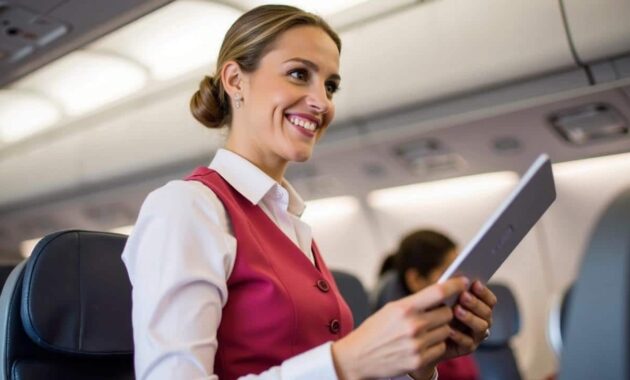
You’re scanning the numbers above the rows. They’re scanning you. The cabin crew smiles, nods and gestures down the aisle, but their eyes are running through a quiet checklist you never see.
Maybe you think they’re just being polite. In reality, they’re clocking your body language, your hands, your shoes, your voice, the way you walk. They have seconds to decide who might need help, who could cause trouble, and who could become crucial in an emergency.
By the time you reach row 17, they’ve already learned more about you than you’d guess in an entire small talk conversation.
1. Your emotional temperature the second you cross the door
The moment you step over the aircraft threshold, flight attendants are reading the weather in your eyes. Are you tense, distracted, already annoyed by the boarding queue? Or relaxed, open, quietly curious? Your shoulders, your jaw, how you hold your phone – all of it sends signals.
They’re trained to spot fear and anger long before you say a word. Someone gripping their passport like a lifebuoy. A teenager walking extra slowly, pretending to be cool. The frequent flyer who looks half-asleep but keeps scanning exits. That first three-second snapshot helps crew decide who might need a softer tone, a quick joke, or, in rare cases, a firmer boundary.
On a night flight from London to New York, a senior flight attendant told me she spotted a problem passenger in “two and a half steps”. He stormed on board, earbuds in, jaw clenched, tugging his roll-aboard like it had personally offended him. He ignored her greeting, swatted away another passenger with his shoulder and sighed loudly as he checked his seat number.
Before he’d even stashed his bag, two crew members had silently agreed: check in with him early, offer water, be hyper-clear with safety instructions, and loop in the purser. Later, when his seatmate reclined, he exploded. Because they’d already clocked his mood, the crew defused it in under a minute. Without that early read, the same scene might have spiralled.
The logic is brutally simple. In a pressurised metal tube, 11 kilometres above the ground, emotions spread fast. One anxious passenger can infect a whole row. One aggressive outburst can ripple down an aisle. So crew treat your “emotional temperature” like a vital sign. If you walk in grounded and polite, you’re mentally filed as low-risk. If you stomp in fuming, you join the invisible “watch list” in their heads. Not to judge. To manage.
2. How you handle your carry-on tells them who they’re dealing with
Watch someone with their cabin bag and you’ll see a whole personality. The passenger who stops dead in the aisle, blocking 40 people, to re-pack their backpack like it’s a game of Tetris. The one who tosses a heavy suitcase into the overhead like a shot put. The quiet traveller who already has laptop, headphones and book in hand, bag zipped and ready to go up in one move.
Flight attendants notice all of it. They’re not just thinking about punctuality. They’re quietly predicting future friction points: Will you argue when they gate-check your bag? Will you get snappy when someone else’s coat touches your luggage? Or are you the type who’ll jump up later to help a parent with a stroller?
➡️ Your leftover raclette deserves better than a box forgotten at the back of the fridge
➡️ The first cities may not have been in Mesopotamia… but here
On a packed holiday flight to Tenerife, boarding slowed to a crawl in row 9. One man, two giant cabin bags, no spatial awareness. He parked his suitcase in the aisle, unzipped it and began rearranging shoes, chargers, duty-free bags. People backed up all the way to the door. One flight attendant tried a light joke, another gently guided him to step aside while others passed. He didn’t move, muttering that he’d “paid for overhead space”.
From that moment, he was red-flagged. When overhead bins finally filled, and his second bag had to be checked, crew braced for a scene. They weren’t surprised when he started raising his voice at the gate agent. They had already seen how he treated shared space. What looked like a simple packing drama was, to them, a preview.
Behind the smiles, there’s a hard safety angle. Heavy bags tossed carelessly can injure someone. A slow, chaotic boarding can delay pushback. So the way you handle your carry-on feeds into a quiet risk-and-confidence matrix in their heads. If you move with basic awareness, keep your essentials with you and stow your bag swiftly, you signal that you’re able to follow instructions under mild stress. If a simple luggage moment overwhelms you, they wonder: how will you react if the cabin fills with smoke?
3. Your shoes and clothes: comfort, safety… and attitude
Ask any flight attendant and they’ll tell you: they look at your shoes first. Flip-flops on a winter night flight. Sky-high stilettos on a short-haul hop. Thick, laced trainers versus slick leather soles. It’s not a fashion critique. It’s a fire-drill in their heads. In an evacuation, shoes can mean speed, grip, burns, broken ankles.
They notice clothes too. The passenger in tight jeans and a heavy belt who moves like armour is welded to their waist. The one in soft layers and sneakers who can twist, duck, climb armrests if they had to. The group in matching hen party T-shirts, already smelling of pre-flight prosecco. Clothing becomes a shorthand: comfort level, practicality, and frankly, how much drama you might bring on board.
One crew member remembered a flight where turbulence hit hard, fast. Drinks carts froze in the aisle, passengers clutched armrests, one child shrieked. A woman in four-inch heels attempted to stand up to reach her overhead bag just as the plane jolted. She toppled sideways, twisting her ankle and crashing into another passenger. The crew had to abandon service to help her, while the seatbelt sign glowed bright above their heads.
Since then, that attendant says she subconsciously “marks” every pair of precarious shoes that walks past her. Not to punish those passengers, but to keep an eye on them when the seatbelt sign dings. The more fragile or impractical your outfit, the more attention you silently attract when things get choppy.
The logic is blunt. In an emergency, nobody cares how stylish you look. Bare feet on a hot tarmac, flip-flops lost on an evacuation slide, tight clothes that rip when you climb over seats – these details matter. Flight attendants are trained to imagine worst-case scenarios every time they brief a door. So when you step on board, your outfit is instantly filed under one of two boxes in their minds: “can move fast” or “might need extra help”. And yes, that mental note can mean they stand closer to your row when you land.
4. The way you answer “hello” (or don’t)
That tiny greeting at the door is more than politeness theatre. When a flight attendant says “Good morning”, they’re not just being nice. They’re testing how present you are. Do you look up, meet their eyes, say hi back? Do you grunt something without taking out your headphones? Or do you breeze by like they’re invisible furniture?
On a human level, it stings when people treat you like part of the wall. But it also tells them a lot. Someone who can’t acknowledge a simple hello is less likely to listen in an emergency. Someone who responds with warmth is more likely to cooperate later. That tiny exchange, half a second long, shapes how they’ll approach you for the next few hours.
On one early morning flight, a crew member greeted a man in a worn grey hoodie. He paused, pulled out one earbud and gave a tired but sincere “Morning, thanks” with a small smile. Two hours later, mid-flight, a passenger near him fainted. He was the first to press his call button, then calmly moved out of the row, held another person’s baby while the mother shifted seats, and followed instructions without fuss.
The crew weren’t shocked. They’d mentally filed him as “kind, cooperative” at the door. In the same cabin, there was a man who had barged past with sunglasses on, ignoring both the greeting and a request to remove his headphones during the safety demo. When turbulence started and service paused, he was also the one demanding a fresh coffee.
It sounds harsh, but the psychology is straightforward. In a cramped, high-stakes environment, social cues are early warning systems. A simple “hello” shows if you’re reachable. *Are you here in the room with the rest of us, or locked in your own bubble?* Flight attendants don’t have the luxury of waiting to find out during a fire drill. So that doorway moment becomes a fast, almost unconscious diagnostic of your willingness to join the team that this metal tube briefly becomes.
5. Your fitness level and whether you could help in an emergency
As you walk down the aisle, flight attendants are quietly mapping the cabin like a chessboard. That tall woman in row 5 with broad shoulders. The guy in row 14 in a fire brigade T-shirt. The retired nurse who mentioned her career while stowing her bag. They’re not stereotyping; they’re identifying potential allies.
In aviation training, crew are taught to look for “ABPs” – able-bodied passengers. People who, if things went sideways, could help open a door, guide others, translate, or simply stay calm under pressure. Your posture, your gait, the way you lift your bag – all hint at whether you might be one of them.
On a delayed flight from Madrid, one attendant noticed a woman in sports gear who moved with that unmistakable ease of someone who uses their body daily. When boarding finished, she quietly asked her if she’d be willing to help with an overwing exit “in the very unlikely event” it was needed. The woman said yes, listened carefully, and went back to her podcast.
Hours later, smoke smell in the cabin forced an emergency landing. No flames, no screaming, but a heavy sense of panic as the plane stopped on the runway. In the rush to get out, that same woman helped keep people moving on the wing, telling them to leave their bags and step away. The crew later said that those few extra calm voices outside the aircraft made all the difference.
The deeper layer is this: safety isn’t a solo sport for cabin crew. They need backups they can call on in seconds. When they see you moving confidently, listening closely, or simply looking up during the safety demo, they file you in that “possible helper” category almost instinctively. And if you’re seated by an exit, your level of fitness and focus becomes a silent priority check. That’s why sometimes, very politely, they’ll reseat someone who seems unlikely to manage a heavy door in a rush.
6. Your relationship to rules – from seatbelts to smartphones
The small stuff gives you away. Do you click your seatbelt on without being asked twice? Do you keep your phone in airplane mode or secretly keep messaging as the doors close? Are you the type to sneak your seat upright when the crew’s backs are turned, or to argue about keeping your laptop out during take-off?
Flight attendants watch that micro-behaviour like hawks. Compliance with small rules predicts how you’ll respond to big ones. If you roll your eyes at a simple request, chances are you’ll push back harder when it’s about something that actually matters, like staying seated during turbulence or keeping an aisle clear.
“I don’t care if you hate the rules,” one long-haul attendant told me. “I care whether you’ll follow them when someone’s life depends on it.”
They also know real life is messy. Parents juggling toddlers, elderly passengers overwhelmed by apps and QR codes, workers sending one last urgent message before losing Wi-Fi. That’s why you’ll often see an attendant bend down, speak softly, explain twice. They’re not the rule police. They’re trying to read your intention: are you struggling, distracted, or just refusing?
- Quickly follow basic requests (seatbelt, tray table, electronics) once.
- Ask questions if you don’t understand instead of ignoring.
- Speak up early if you have a real issue, like pain with seatbelts or anxiety.
That tiny pattern of cooperation is currency in the cabin. When crew see you playing along with the boring bits, they’re far more likely to go the extra mile for you later – whether it’s hunting down your special meal or quietly moving you to a better seat when they can.
7. The story your face tells when turbulence hits
There’s a special silence that falls when the plane shudders for the first time. Drinks tremble, someone makes a nervous joke, the seatbelt sign dings. Flight attendants instantly look down the rows, scanning faces. That’s when your real state shows up.
Some people grip the armrests with white knuckles. Others laugh too loudly and start talking faster. A few close their eyes and breathe slow, like they’ve done this a thousand times. Crew store that mental snapshot: who’s likely to panic, who needs a kind word, who might faint at the sight of a dropped oxygen mask.
On a flight over the Rockies, one cabin was hit by a sudden pocket of rough air. Nothing extreme, but enough to send a cart bouncing an inch off the floor. One man started muttering, “This isn’t right, this isn’t right” in a tight loop, his leg shaking so hard it rattled the tray. A flight attendant knelt in the aisle and chatted with him about his destination, his kids, anything that grounded him. She’d already noticed his clenched jaw during taxi.
She also knew the flip side: another passenger two rows back had barely flinched, calmly sliding his drink back on his tray. If things had escalated, that calm presence near the nervous man might have been quietly enlisted as a stabilising neighbour. In the crew’s mental map, anxiety and calm are resources to distribute around the cabin.
8. Whether you’re drinking to relax or to disappear
Order a glass of wine with dinner and no one blinks. Ask for a double vodka before pushback with slightly shaky hands, and you’re on their radar. Flight attendants aren’t anti-alcohol; they’re anti-losing-control-at-30,000-feet. They watch how fast you drink, how your voice changes, whether your jokes get sharper or sloppier.
On one long-haul flight, a solo traveller in business class ordered whisky with his first meal, then another, then another, barely touching his food. His speech slowed, then turned unexpectedly aggressive when told the bar was closing for landing preparations. Because crew had tracked his orders and his body language the entire flight, they’d already quietly agreed to switch him to water after drink number three.
They’re doing mental math constantly. Cabin air dehydrates you. Altitude exaggerates alcohol’s effects. A person who seems just a bit tipsy on the ground can turn into a serious risk in a pressurised tube. So they count your drinks, watch your eyes, your coordination, how you interact with the people around you.
9. If you’re silently terrified of flying
Some fear of flying is loud. Hands shaking, eyes wide, whispered prayers during take-off. Some of it is ice-quiet. The person who stares at the safety card a bit too long. The one who jumps at every mechanical whirr. The traveller who asks, a little too casually, “So… how long have you been doing this?” while the plane taxis.
Flight attendants look for both. They know fear doesn’t always look like drama. Often it looks like hyper-control: tidying the tray table again and again, checking your watch every two minutes, keeping your backpack clamped between your feet as if it could somehow save you.
Many crew members have stories of sitting on the armrest next to someone during take-off, quietly explaining each noise. “That thud is just the landing gear retracting.” “The bumps here are normal, it’s like driving over a gravel road in the sky.” They’ve seen grown adults cry from sheer relief when the wheels touch down. That’s why some airlines train them specifically to handle aviophobia, using calm voices and simple facts.
10. How you treat people who can’t give you anything
One of the clearest things they notice has nothing to do with safety cards or seatbelts. It’s how you treat other passengers who are vulnerable: the crying baby, the elderly man blocking the aisle, the student struggling with an oversized backpack. Your patience, or lack of it, is loud.
A passenger who offers to lift a bag for a shorter person, or swaps a window seat so a parent can sit next to their child, earns silent gold stars. The one who sighs dramatically when a wheelchair user needs more time, or complains loudly about a toddler kicking their seat before even calmly speaking to the parent, lands in a different mental folder.
On a short hop between European cities, a flight attendant watched a man in row 10 quietly help three different people before take-off. He folded a jacket for an elderly woman, held a baby for 20 seconds while a mother buckled her other child, and shifted seats without making it a production. When a medical issue cropped up mid-flight, guess who they instinctively approached first for a bit of help moving another passenger? Human kindness doubles as a safety resource up there.
11. Whether you’re actually listening to the safety demo
Most people think the safety demo is background noise. Flight attendants see it as a live test: who is capable of following instructions under zero stress? Are you scrolling your phone, chatting, scrolling through the film menu? Or are you quietly watching, even for just a few seconds?
They know the odds of a serious incident are low. They also know that when something does go wrong, people default to muscle memory. If your only muscle memory is that you always ignore the briefing, that’s a real problem. So they scan the cabin during the demo, noting who’s switched on and who’s off in their own world.
There’s one phrase you hear a lot from crew when they talk off-duty: “In an emergency, people forget how to unbuckle their seatbelts.” It sounds absurd, but panic wipes simple knowledge. The few passengers who genuinely paid attention – who know their nearest exit and how long it would take to reach it – become islands of stability. Flight attendants can’t say this over the PA, but they think it every day: those are the people they’re counting on not to freeze.
12. If you’re likely to be a problem… or a partner
By the time boarding is complete, flight attendants have a mental map of the cabin that goes far beyond seat numbers. The anxious flyer in 7A. The impatient businessman in 3C. The friendly couple in 11D and E who are happy to chat but not demanding. The group that might drink a bit too much in the back. The quiet, observant person by the exit.
That map isn’t about judgement. It’s about game-planning. Who needs checking in after take-off? Who might escalate if their special meal doesn’t appear? Who can they lean on to translate in case of a language barrier? Who will smile back when they’re exhausted at 4 a.m. over the Atlantic?
On a human level, they notice the small acts. The person who says thank you when handed water. The one who waits to use the bathroom until service carts are past. The passenger who makes room without rolling their eyes. Those details shape how the whole flight feels from the crew’s point of view. And flights, more than anything, run on feel.
Why all this noticing changes your place on the plane
Once you see a flight through cabin-crew eyes, it’s hard to unsee it. The aircraft stops being just rows and rows of anonymous strangers, and turns into a living, shifting puzzle of needs, risks, kindness and potential allies. You’re not just 22B. You’re the way you walked on, the way you looked up, the way you sighed or smiled.
Most of us never think about what we broadcast in those first 30 seconds on board. We’re juggling chargers, kids, snacks, travel worries, work emails. Yet for the people in uniform at the door, those seconds are everything. That’s when they decide where to place their limited energy, who to soothe, who to gently steer, who to mentally tag as backup if the day goes sideways.
On a long enough timeline, everyone has their “airplane story” – the rough landing, the terrifying turbulence, the medical emergency two rows back. On those days, all the tiny things you thought didn’t matter suddenly do. The shoes you wore. The way you listened. The way you treated the stranger across the aisle when they were having a worse day than you.
| Point clé | Détail | Intérêt pour le lecteur |
|---|---|---|
| Premières secondes à bord | État émotionnel, langage corporel, réaction au “bonjour” | Comprendre ce que le personnel perçoit instantanément de vous |
| Signaux de sécurité | Chaussures, forme physique, comportement face aux règles et à la démo | Adapter ses choix pour être perçu comme un passager fiable |
| Relation aux autres | Attitude envers les passagers vulnérables, consommation d’alcool, empathie | Améliorer l’ambiance de vol et augmenter les chances d’aide en cas de pépin |
FAQ :
- Do flight attendants really judge you as soon as you board?They’re not judging your personality; they’re rapidly assessing mood, fitness and behaviour to manage safety and service in a tight space.
- Can being polite actually change how crew treat me?Yes. A simple greeting, eye contact and basic cooperation often translate into more patience, attention and small “above and beyond” gestures.
- What’s the number one thing they notice first?Your overall vibe: tension or calm, anger or openness. Body language and facial expression usually speak louder than your words.
- Do they really look at your shoes for safety reasons?They do. Footwear and clothing help them predict how easily you could move in an evacuation or on a wet, hot tarmac.
- How can I be the kind of passenger crew love having on board?Travel light mentally and physically, follow simple instructions quickly, be kind to people who are struggling, and remember: soyons honnêtes : personne ne fait vraiment ça tous les jours, alors un peu d’humanité aide tout le monde à mieux voler.
Originally posted 2026-03-09 08:03:00.