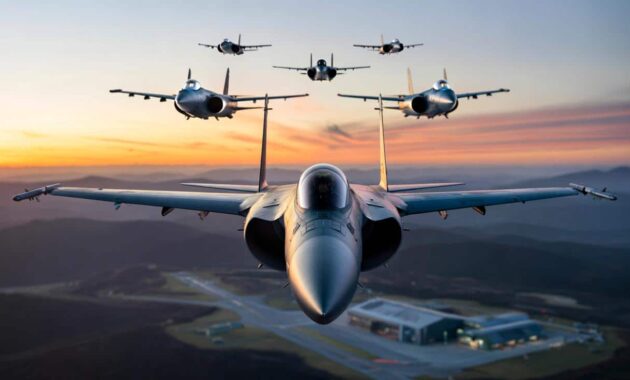
South Korea’s KF-21 Boramae fighter is moving from test ranges to frontline bases in 2026, marking a pivotal step in the country’s long campaign to build its own cutting-edge combat aircraft and sell it abroad.
South Korea’s long game for airpower independence
The KF-21 story began in 2010, when Seoul launched the KF-X (Korean Fighter eXperimental) programme. The aim was blunt: stop relying on ageing US-made F-4 Phantoms and F-5s, and reduce exposure to foreign export controls.
That decision came as North Korea tested new missiles, China expanded its air force, and regional competition sharpened. South Korean officials concluded that buying foreign jets, even advanced ones, would no longer be enough to guarantee long-term freedom of action.
By fielding the KF-21, South Korea shifts from being a major fighter customer to becoming a serious fighter supplier.
From the outset, the project was framed as much more than a simple aircraft replacement. It was designed to build a domestic aerospace ecosystem: engineers, software developers, radar specialists, and a supply chain able to support future designs without starting from scratch each time.
From drawing board to flightline
The programme accelerated through the 2010s. Years of computer modelling, wind-tunnel testing, and negotiations with foreign partners culminated in the public unveiling of the first KF-21 prototype in April 2021.
Just over a year later, in July 2022, the jet flew for the first time. That initial sortie opened a demanding test campaign that used six prototypes and continued into 2024.
During those trials, test pilots and engineers worked through more than 2,000 flight hours. They pushed the aircraft across its flight envelope, checked its advanced radar, and stress-tested new avionics and weapons interfaces.
The test programme focused on proving that the KF-21 could reliably perform air-to-air and air-to-ground roles under realistic combat conditions.
➡️ Experts’ window-cleaning tricks: streak-free frames and no condensation this winter
➡️ It’s the end of microcement in : the material set to replace it in our homes
➡️ Why people with high emotional intelligence often struggle internally more than they admit
Key stages in the KF-21 programme
| Year | Milestone |
|---|---|
| 2010 | KF-X / KF-21 programme formally launched |
| 2021 | First KF-21 prototype unveiled |
| 2022 | Maiden flight and start of intensive flight testing |
| 2024 | Start of production of the first 20 Block I aircraft |
| 2026 | First production jets delivered to South Korea’s air force |
| 2028 (planned) | Full operational capability for initial KF-21 squadrons |
What kind of fighter is the KF-21 Boramae?
The KF-21 is often described as a “4.5-generation” multirole fighter. That label places it between older fourth-generation jets like the F-16 and full fifth-generation stealth aircraft such as the F-35.
It features stealth-influenced shaping, an advanced fly-by-wire system, and a modern active electronically scanned array (AESA) radar. These elements give it strong situational awareness and allow pilots to track multiple targets at range.
The aircraft is twin-engined, giving extra thrust and redundancy during combat. Its combat radius is tailored for regional missions over the Korean Peninsula and surrounding seas, including air defence, strike, and maritime operations.
The KF-21 aims to offer much of the performance of fifth-generation fighters at a lower cost and with fewer political strings attached.
Unlike the F-35, the KF-21 does not yet have internal weapons bays, which limits its radar-evasion profile. South Korea plans to offset this through improved sensors, electronic warfare systems, and upgrades in future blocks.
Planned capabilities by block
- Block I (mid-2020s): Focus on air-to-air missions, basic precision strike, and initial radar and avionics suites.
- Block II (late 2020s–early 2030s): Expanded air-to-ground roles, more indigenous electronic warfare systems, and integration of a wider range of Korean-made missiles.
- Potential later blocks: Further stealth enhancements, deeper sensor fusion, and increased automation in mission management.
What the 2026 deliveries change for South Korea
Production of the first 20 Block I aircraft began in July 2024. Those jets are now on track to reach what the military calls “limited operational capability” in 2026, meaning they can perform real-world missions with some constraints.
South Korea’s air force plans to take delivery of at least 120 KF-21s by the early 2030s. As more aircraft arrive and crews train up, older F-4 and F-5 airframes will be gradually retired.
Delivering the first jets in 2026 gives South Korea a modern backbone fighter while it continues to fly a smaller fleet of F-35s for high-end stealth missions.
This mix allows South Korea to keep its most advanced F-35s for the hardest, highest-risk tasks, while the Boramae handles day-to-day air policing, deterrence patrols, and many strike missions. Financially, that is far more sustainable than trying to buy and operate large numbers of F-35s alone.
A new player in the fighter export market
Seoul is not building the KF-21 solely for itself. The aircraft is being pitched aggressively to overseas customers as a capable but less politically constrained option.
Several air forces are watching closely. Indonesia is already a formal development partner, despite delays in meeting its funding commitments. Other potential customers mentioned by defence officials include the Philippines, Malaysia, and states in the Middle East.
South Korea believes the KF-21 can find a sweet spot: modern enough to stay credible into the 2040s, yet affordable enough for countries that cannot justify or cannot obtain the F-35.
For many mid-sized air forces, the KF-21 promises advanced capability without the long waiting lists or restrictive export policies tied to US or European jets.
South Korea’s reputation as a defence supplier also helps. Recent export wins for the K2 tank and K9 self-propelled howitzer have shown that Korean kit can be delivered at scale and on tight timelines, something many Western manufacturers struggle with.
How the KF-21 stacks up against global rivals
The Boramae is part of a broader movement: countries that once imported fighters are now trying to build their own.
India, for instance, has its Tejas Mk1A fighter in service and is working on more advanced designs like the Tejas Mk2 and the AMCA. Those projects still wrestle with engine and radar issues, and they are some distance behind the KF-21 in terms of production readiness.
Turkey’s TF-X Kaan has begun ground testing and aims for a first flight around mid-decade. Yet it remains at an earlier stage than the Korean jet, which is already in production and about to field its first combat-ready units.
China has gone further with its J-20 and FC-31 stealth fighters, rolling them out in increasing numbers. Still, limited transparency around performance figures and years of dependence on imported engines have left analysts cautious when comparing them directly with Western and Korean designs.
In Europe, the focus is on even more advanced sixth-generation concepts: the FCAS project led by France, Germany and Spain, and the UK-led Global Combat Air Programme (Tempest) with Japan and Italy. Those aircraft are expected closer to the 2035 timeframe, leaving a gap that the KF-21 can exploit in the 2020s.
Strategic ripple effects in the Indo-Pacific
For South Korea, the KF-21 is partly about deterrence. A credible, modern air force makes any large-scale attack on the peninsula far riskier for an adversary.
But the jet also functions as a diplomatic tool. Offering advanced fighters without heavy political conditions can deepen Seoul’s partnerships with Southeast Asian and Middle Eastern states that want options beyond the US, Russia or China.
As KF-21 orders spread, South Korea gains not just revenue, but long-term security relationships based on training, logistics and shared upgrades.
That kind of defence ecosystem can last decades, locking in influence and cooperation long after the headlines around the first deliveries have faded.
Key terms and concepts worth unpacking
Several technical labels around the KF-21 can sound opaque but matter for understanding its role:
- Fourth, 4.5 and fifth generation: These informal labels describe jumps in fighter technology. Fourth-generation jets, like early F-16s, focus on manoeuvrability and basic sensors. Fifth-generation ones, like the F-35, add low observable design, sensor fusion and deep networking. “4.5 generation” covers aircraft that bridge the two, adopting many advanced systems without full stealth.
- AESA radar: An active electronically scanned array uses many small transmit/receive modules instead of a single rotating dish. This allows the radar beam to move almost instantly, track multiple targets, and switch modes quickly, all while reducing the chance of detection.
- Limited vs full operational capability: When the KF-21 first arrives in 2026, crews will be cleared for specific missions with defined restrictions. Once tactics, maintenance and weapons integration mature, the air force declares full operational capability, meaning the jet can perform its intended mission set without major limitations.
What KF-21 operations could look like in practice
On a typical day in the early 2030s, a South Korean air base might launch mixed formations: F-35s flying slightly ahead with radar emissions kept low, and KF-21s providing additional missiles and sensors behind them. Data links would allow each jet to share what it sees, letting KF-21s fire at targets detected by stealthier F-35s while staying outside the hottest threat zones.
For an export customer, the picture could be different. A Southeast Asian country might use the KF-21 primarily for air policing, intercepting unidentified aircraft approaching its airspace, and adding occasional precision strikes against insurgent camps or maritime targets. The same aircraft could also train with partners, giving aircrews experience against a modern fighter profile they might face in a real conflict.
That flexibility—high-end combat potential combined with everyday utility—is at the heart of why the 2026 delivery to South Korea’s own air force matters far beyond the Korean Peninsula.