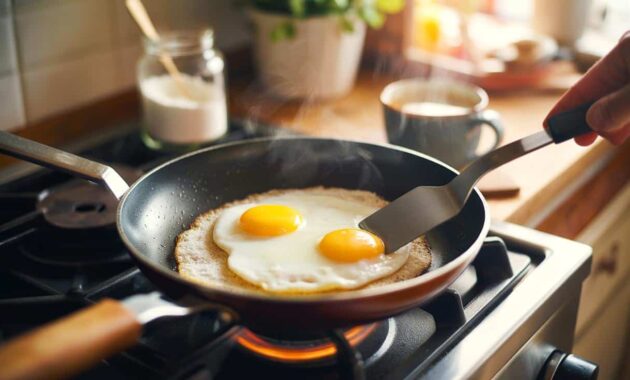
The pan was already hot, the coffee just starting to smell right, and all I wanted was a perfectly fried egg. No crust of burnt white welded to the bottom of the pan. No sad, torn yolk staring up at me like a failed promise. Just that simple, glossy circle you see on café plates and in photos that somehow never resemble your kitchen reality.
I cracked the egg, lowered it gently, and… heard the telltale hiss of a future disaster. You know that sound. The one that says part of this breakfast is about to become permanent cookware decoration. Except this time, the egg slid. It cooked, set, and then released with a tiny, smug shimmy.
No butter, no oil, no water. Just a light dusting of flour and a small act of domestic rebellion.
Why our eggs keep betraying us in the pan
Most of us grew up with one universal cooking promise: if you want eggs that don’t stick, drown the pan in fat. A thick slice of butter, a long swirl of oil, maybe both if the day already looks complicated. It seems logical. The fat is supposed to slide between the egg and the metal like a peace treaty. Except real life does not always follow cookbook logic.
Sometimes the egg grabs anyway. The white glues itself in a thin, stubborn film, leaving you scrubbing the pan and resenting your breakfast. Heat, pan quality, impatience — everything counts. So does something we rarely think about: the simple physics of wet protein hitting hot metal with nowhere to go.
Picture the last time you tried to fry an egg “clean”. Maybe you used a beautiful new nonstick pan, followed the heat advice, counted to ten like the recipe said. The egg started off looking promising, then slowly, as you nudged it with the spatula, you felt resistance. That tiny drag. The first sign of trouble.
You waited longer, hoping it would release on its own. Instead, when you finally tried to slide it out, half the white stayed behind, like a ghostly stencil of what could have been. For a lot of people, this is the exact moment they stop trying careful cooking. They crank the heat, flood the pan with oil, and accept slightly rubbery eggs as the cost of not losing their mind.
What actually happens in those seconds is surprisingly simple. Egg white is mostly water and proteins. When it hits a hot dry surface, the water flashes off quickly and the proteins set directly against the metal. Once they grab, they bond, and that delicate film becomes almost part of the pan. Fat interrupts that contact, which is why it helps.
Flour plays a different role. It doesn’t slide. It stands in the way. A dry, thin barrier, just enough to keep the egg white from welding to the metal, but not enough to turn your breakfast into a crusted pancake. Think of it as laying down an invisible landing strip between the pan and the egg.
The flour trick that changes everything
Here’s the actual method, as quiet and unpretentious as a weekday morning. Set your pan on medium heat. No butter, no oil, no water. Let it warm for a couple of minutes until you can hover your hand above and feel a clear, steady heat. Not a blast, just a calm warmth.
➡️ “I finally saw my finances clearly when I asked the right question”
➡️ Centenarian shares the daily habits behind her long life : “I refuse to end up in care”
➡️ People who push in their chair when leaving the table often share these 10 unique personality traits
➡️ A polar vortex anomaly is approaching, and its intensity is almost unheard of in February
Take plain flour — all-purpose is fine — and sprinkle a pinch into the dry pan. You’re not baking a cake in there. You just want a light dusting, as if you were fogging the surface with flour snow. Tilt the pan so the base is covered with the thinnest film, then tap out any visible excess into the sink or trash. Crack your egg on top of that faint, ghostly layer and listen.
The first time you do it, you might doubt yourself. No sizzle of melted butter, no aroma of toasted fat. Just egg on flour, like a strange kitchen dare. After a few seconds, the white will start turning opaque around the edges. The flour underneath will quietly toast, creating a micro-crust between the metal and the protein. When the egg looks set enough, slide your spatula underneath with a calm hand.
If the heat was right and the flour wasn’t in heavy clumps, the egg lifts. The pan stays mostly clean. No shredded lace of white left behind, no burnt circles that need soaking for an hour. It feels a little unreal, like you accidentally unlocked a cheat code. Then you do it again the next day, and it works a second time.
A few things do go wrong, and it helps to say them out loud. If you add too much flour, you end up with weird powdery edges that brown too fast. If the pan is scorching hot, the flour burns before the egg even begins to cook. If the pan is too cold, the egg crawls outward and settles in slow motion, clinging where the flour didn’t reach.
*Let’s be honest: nobody really measures a “pinch” of flour at seven in the morning.* You’ll eyeball it, you’ll overdo it once, you’ll underdo it once. Then your hands will learn. The sweet spot is when you can’t really see the flour anymore, but you know it’s there because the metal no longer shines as much. That’s the quiet line between sticky chaos and that satisfying, easy release.
How to make the flour trick part of your real life kitchen
Turn this from a one-off experiment into a habit with one small setup. Keep a tiny jar of flour next to your stove, with a dedicated teaspoon or even a pinch bowl. That way you’re not dragging the big flour bag out of the cupboard every time you crave an egg. The less friction between you and the trick, the more likely you’ll actually use it on a rushed morning.
Heat your pan, toss in a half-teaspoon of flour, swirl, tap out the extra, then crack in the egg. That’s the whole choreography. Two moves, one pause, one crack. You can still season the egg with salt, pepper, maybe paprika on top. The flour isn’t there to add flavor. It’s there to disappear between the heat and the egg, quietly doing its job.
One common fear is that the flour will make the egg taste “doughy” or feel undercooked. That tends to happen only when the pan is barely warm and the flour stays pale and pasty instead of toasting. So if you ever taste that, nudge the heat up next time. Another misstep is moving the egg too early, poking at it out of impatience. Give the bottom time to set and the flour time to form that slim, golden layer.
People also worry about burning flour. A small truth: a few tiny brown spots aren’t a disaster. They bring a faint, toasty note, a bit like the bottom of a flatbread. What you want to avoid is a dark, smoky smell before the egg even touches the pan. When the pan smokes, you’re no longer cooking an egg, you’re conducting a science experiment on combustion.
Sometimes the best kitchen tricks don’t come from chefs in starched jackets, but from a tired home cook who simply refused to scrub one more stuck egg off a pan and thought, “What if I just dust it with flour first?”
- Use a dry, clean pan
Any leftover moisture will turn the flour into sticky paste instead of a dry barrier. - Keep the flour layer ultra-thin
More like a light fingerprint than a visible coating on the metal. - Stay at medium heat
The flour needs time to toast gently while the egg sets on top. - Tap out the excess
If you can see visible piles of flour, it’s too much and will taste chalky. - Test with one egg first
Once you feel the right heat and timing, start cooking two or three at a time.
From small kitchen hack to quiet daily ritual
There’s something strangely comforting about a trick like this. It doesn’t require buying a new pan, stocking up on pricey sprays, or memorizing complicated timings. It just asks for what you already have in the cupboard and a moment of attention before cracking an egg. A small act of care for the person you are before the day really begins.
You might start using the flour trick just to avoid scrubbing, and that’s fair. Yet once the frustration is gone, space opens up for tiny pleasures — watching the yolk tremble, deciding how runny you want it, adding herbs without worrying they’ll burn in a pool of oil. Cooking stops feeling like a fight with your equipment and returns to being a quiet agreement between heat, food, and time.
Some people will read about this and shrug. Others will try it once and then tell a friend, or send a quick message: “Hey, the flour thing actually works.” That’s how these little methods travel, from one tired kitchen to another, leaving behind slightly better mornings and pans that spend less time soaking in the sink. Maybe you’ll test it tomorrow. Maybe you’ll adopt it without saying anything, just you, your pan, and an egg that finally slides when you ask it to.
| Key point | Detail | Value for the reader |
|---|---|---|
| Dry flour barrier | Thin dusting of flour in a hot, dry pan before cracking the egg | Prevents sticking without butter, oil, or water |
| Control of heat | Steady medium heat so flour toasts gently and egg sets evenly | Cleaner release and better texture for the egg white and yolk |
| Simple routine | Flour jar by the stove, quick swirl, tap, and crack | Makes the trick realistic to use on busy everyday mornings |
FAQ:
- Question 1Does the flour trick work with any type of pan?
- Question 2Will the egg taste like flour or dough?
- Question 3Can I use this method for scrambled eggs or omelets?
- Question 4Is this healthier than using butter or oil?
- Question 5What kind of flour works best for non-stick fried eggs?